On-Camera Coaching for Executives: A Practical Guide


October 29, 2026


Managing employee headshots means running them as a program with an owner, a written standard, a schedule, a consent process and one place where approved files live. Treated as a one-off event, headshots go stale within a year. Treated as a program, they stay consistent as you hire, open offices and update your website. This guide walks through the whole cycle for the marketing manager, HR lead or operations owner who has been handed the job.
The first headshot day is easy. The trouble starts six months later. A new VP joins and sends a phone selfie. A salesperson in another city uses a photo from a wedding. Your website shows one background, your proposals show another, and LinkedIn is a third version again.
None of that is anyone’s fault. It happens because no one owns the images. A headshot is a small asset that appears in many places: the team page, email signatures, sales decks, investor updates, conference badges, press releases and internal directories. Without a system, each of those places gets its own version.
The fix is less about photography than about operations. You need decisions made once (the standard), a repeatable process (sessions and makeups), and a record (consent and file storage). The rest of this guide takes those in order.
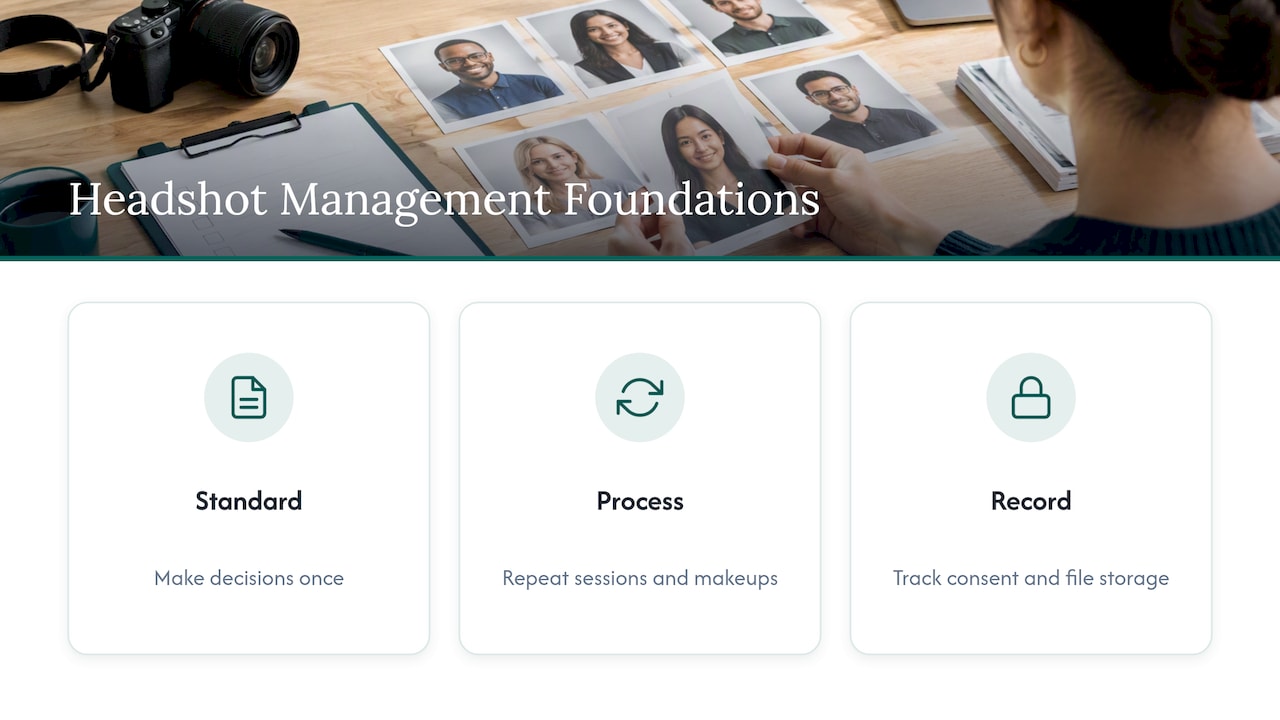
Start with a single accountable person. In smaller companies it is usually the marketing manager. In larger ones, HR and brand share it, with one name on the checklist. If everyone owns it, no one answers when a new hire needs a photo.
Then write a one-page standard. It should be short enough that an employee reads it. Cover:
Organizations that care about a unified web presence do this explicitly. Trevecca Nazarene University’s digital brand policy, for example, limits its online directory to headshots produced by its marketing team so the directory looks unified and professional. A company needs the same logic: official images come from the official process.
If you want a fuller template, see our guides on corporate headshot guidelines and an employee headshot policy.
Consistency is a trust signal. Buyers, candidates and investors form an impression quickly, and a mismatched team page reads as a company that has not finished building itself. If you want the broader argument, why brand consistency matters for growth is worth a read before you pitch the budget internally.
This is the step teams skip, and it is the one that can cause real trouble. Using an employee’s photo in marketing is not the same as using it in an internal directory, and the rules depend on the state.
In California, employers generally need prior consent before using a person’s likeness to advertise or sell goods and services, under Civil Code Section 3344, according to Sherman Law Corporation. The same firm notes that using a photo by accident is not a defense there, and that compliance is simple if you obtain informed, voluntary consent up front.
The Association of Corporate Counsel says that the intended use and state law both affect what permission you need. It describes a written release specific to each intended use as a best practice, in its guidance on using employee photos.
In practice, that suggests a simple routine:
Rules differ by state and by situation, so have your employment counsel review the release wording, especially if you operate in several states or use images in paid ads.
How you schedule depends on how your team is spread out. There are three common setups.
Pick a day, set up in a conference room, and publish a sign-up sheet in 10-minute slots (headshots themselves take only a few minutes, but people need time to arrive and settle). Keep the room close to the work area so people can step away between meetings.
The temptation is to hire a local photographer in each city. That is how you end up with five slightly different looks. A better approach is one provider with portable equipment who sets up the same way in every office, so lighting and background match. This is the reason we built our model around on-site sessions with portable studios that come to you.
Remote staff are the hardest to keep consistent. You have three realistic options:
Our guide to how to organize employee headshots covers the logistics in more detail, and company-wide headshots covers the larger rollouts.
| When | What happens |
|---|---|
| 3 to 4 weeks before | Pick the owner, finalize the standard, book the photographer |
| 2 weeks before | Send the announcement, release form and prep guide |
| 1 week before | Open the sign-up sheet, reserve the room, confirm headcount |
| Day before | Reminder email with time slot and wardrobe tips |
| Shoot day | Check-in, shoot, quick review, flag anyone who missed |
| Within days after | Selection, retouching, delivery to the shared library |
| 2 weeks after | Makeup session for no-shows, then update the site and directory |
Adjust the lead times to your size. The order is what matters.
Most bad headshots come from surprise. Someone learns about the shoot that morning, wears a pattern that moires on camera, and rushes in from a meeting. A short prep message fixes most of it.
Include:
Tell people the process is quick. Most are nervous about the first 30 seconds, and a photographer who talks them through it makes the difference.
This is where most programs break down. The photos exist, but no one can find the approved version.
Let the employee choose from a small set of options, within limits. If you let people pick from fifty frames, selection becomes a project. Offering two or three and a deadline keeps it moving. Then have the program owner approve the final against the standard.
Use a shared drive or digital asset tool with restricted write access and broad read access. A workable structure:
Point every system at the same source: the website team page, email signatures, the HR directory, the sales deck template, conference registration. When someone’s photo is updated, you change it once and replace it everywhere. Telling people to “just use the one from the shoot” is how old versions persist.
When someone leaves, remove the image from public pages and from active templates. When someone changes roles, check whether the new role calls for a different style, such as an executive portrait. Our overview of executive headshot styles can help you decide.
The first shoot day is the easy part. Consistency over time depends on how you treat new hires.
Three approaches work:
The key is that the photographer has your written standard and your reference images. Lighting, distance, background and editing style should be documented so the person who shoots in March reproduces what was shot last year. Ask your provider to keep your settings on file.
People change. Hairstyles, glasses, weight and age all drift. A common practice is to refresh the full team every one to two years, with new hires added in between. See our notes on an annual photo refresh for how to decide the cadence. Put the date on a calendar now, or it will not happen.
Some people dislike being photographed. Pushing harder rarely helps. What works:
For people who miss the day, which will always be a few, schedule the makeup session in advance and tell people about it. A visible second date means that missing the first is not a crisis, and it keeps the stragglers from submitting selfies.
When we work with teams, the pattern is consistent. The shoot goes well, and then the program decays because no one assigned the follow-up. The companies that keep their visuals sharp treat headshots like any other brand asset: one owner, one standard, one library.
We also think headshots are rarely just headshots. For a startup that has just closed a round, the team page is one of the first places an investor, candidate or customer looks. For a private equity firm folding in an acquisition, matching portraits across portfolio companies is a fast, visible sign that the businesses are now aligned. We start every project with a discovery call so the images are built for the use you have in mind, not just for a file folder.
Our advice is to decide the standard first, then book the photographer. A good photographer will follow your standard. A vague brief gets you a photographer’s default, which is rarely your brand.
— Kevin
We bring a portable studio to your office and shoot your team on site, with retouching and a five-day turnaround. For multi-location companies, we use the same setup in each place so the results match. Pricing is fixed by package. Our START UP package is $2,500 per shoot. Our STANDARD package starts at $2,000 per shoot, ENTERPRISE starts at $3,500 per shoot, and a branding add-on is $1,000 per shoot, all described on the same page.
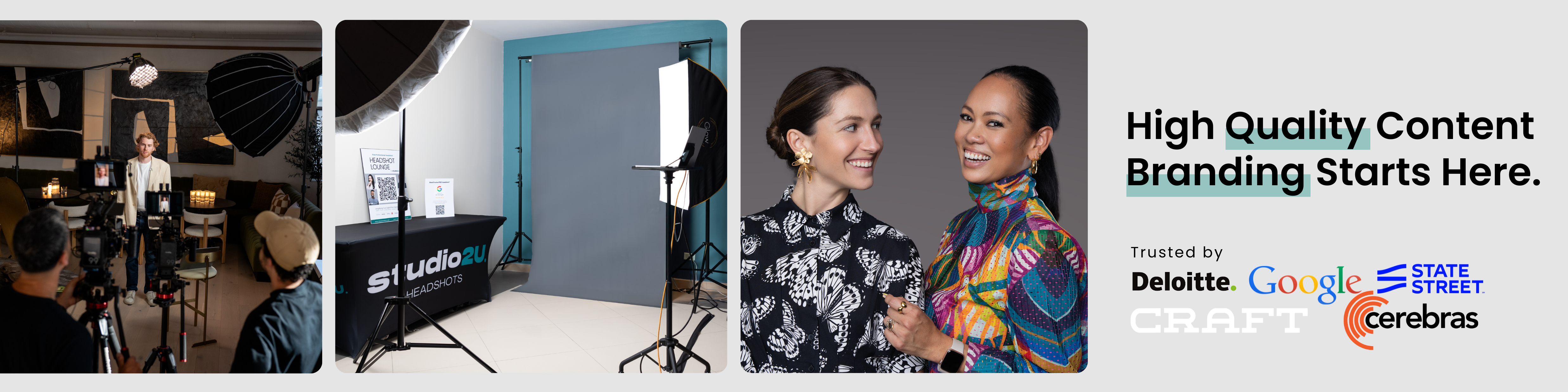
If you want to see the full range, including event and conference coverage, browse our services or start with a discovery call from the studio2U homepage.
That list is the program. Everything else is execution.
Either can, as long as it is one named person. Marketing usually sets the visual standard, and HR holds consent forms and onboarding triggers. Decide the split in writing so a new hire knows who to contact.
It is the safer practice. Some states, California among them, generally require prior consent when a likeness is used to advertise or sell, and legal guidance recommends a written release specific to each use. Because rules vary by state, have your employment counsel review your form.
Many companies refresh the full team every one to two years and add new hires in between. Update sooner if someone changes role or looks noticeably different. Put the date on the calendar so it does not slip.
Use a visit when the photographer is in their city, a headshot station at an offsite, or a studio that follows your written standard. The first two give you the most consistent results. Whichever you choose, keep the same background and crop rules for everyone.
You can allow it, but expect inconsistent results and more work for whoever reviews them. If you do, publish minimum requirements for background, resolution and framing, and have the program owner approve each image before it goes live.
