On-Camera Coaching for Executives: A Practical Guide


October 28, 2026


Keep the beard if it is how people know you, and groom it well. A neat, deliberate beard looks professional in a headshot. A patchy, overgrown or half-trimmed one looks like you forgot about it. The decision is not beard versus no beard. It is groomed versus unmanaged, and whether the photo will still look like you when someone meets you in person.
This guide covers when to keep, trim or shave, how to prepare skin and hair in the week before, what lighting and posing do to facial hair, and how a company can keep bearded and clean-shaven team members looking consistent on one page.
For most people, yes. Career guidance from Brandeis International Business School says that facial hair is not inherently unprofessional in today’s U.S. workplace, and that the real requirement is that it is well groomed. The same guidance frames it as authenticity plus upkeep, not a mandatory clean shave.
A headshot is a promise about who shows up to the call, the pitch or the first meeting. If you have worn a beard for five years and your headshot is clean-shaven, the photo is the thing that is out of date. Clients, investors and candidates notice the mismatch, and it costs a little trust at exactly the moment the photo is supposed to build it.
If you are undecided, do not shave on the day. You can always remove a beard later, and you cannot put it back. Many photographers will shoot a few frames both ways if you ask in advance, though that takes planning on a group shoot.
A headshot is a tight crop, usually from the chest or shoulders up. Facial hair takes up a large share of the frame, so its shape matters more than it does in a full-body photo.
| Style | What it does in a headshot | What to watch |
|---|---|---|
| Close stubble | Looks relaxed and casual, and keeps jawline detail | Uneven density shows under bright light, so even it out with a trimmer guard |
| Short, tapered beard | Reads as polished and defines the jaw | Keep the neckline and cheek lines crisp |
| Full beard | Strong, confident look that fills the lower frame | Can hide the jaw and chin, so lighting and head position matter |
| Long beard | Distinctive and memorable | Stray hairs and flyaways show, so comb and tame it |
| Goatee or mustache only | Clean and sharp | Mustache hairs over the lip should be trimmed so they do not hide the mouth |
No style is wrong. A mismatched style is when the beard is longer, shorter or fuller than what people see in person.
If your face is round, grooming guidance generally points to adding vertical length and angular definition rather than width. One beard-care guide for round faces suggests keeping the sides short and tapered, letting the chin area carry a little more length, and keeping crisp lines. It also advises against styles that fill out the cheeks, because they add width.
That is a grooming preference, not a rule. Use it as a starting point when you sit down with a barber. A good barber will adjust it to your growth pattern, and what you want in a headshot is the version you will actually keep up.
Skin condition shows up in a close portrait. Dry flakes, redness and razor bumps are easy to see and slow to retouch. The American Academy of Dermatology offers practical care advice that doubles as a pre-shoot routine.
Start a simple daily routine. The AAD recommends washing the face and facial hair daily with a gentle cleanser and moisturizing after washing, and using a beard comb while the hair is wet. That alone improves how the beard lies.
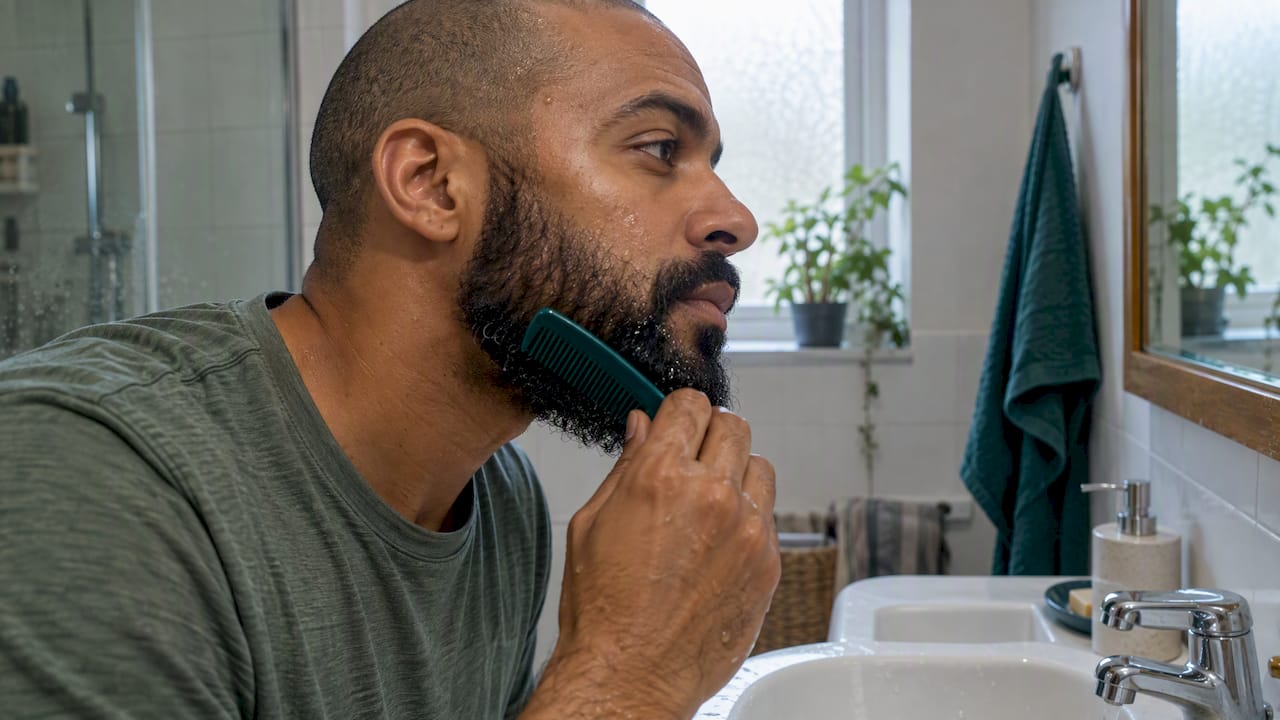
Apply moisturizer through the beard to the skin underneath. The AAD also says conditioner or oil should be used sparingly so the beard does not look greasy. Under studio light, a little too much product looks like a shine on the hair, and it is hard to fix afterward.
Book your barber or do your own shaping now. Get the neckline right, clean the cheek line, tidy the mustache over the lip and trim any strays. Doing it two or three days ahead leaves time for any irritation to calm down. A fresh trim the morning of the shoot can mean a red neck and visible nicks.
If you shave any part of your face, follow the dermatologist guidance:
If you get persistent razor bumps or skin irritation, see a board-certified dermatologist before the shoot rather than covering it up on the day.
A beard hides the lower half of the face, so it affects how the jaw and chin read. Two things control that: the light and the angle of your head.
Headshot photographer Peter Hurley, in an interview with Popular Photography, describes bright, even, soft light as flattering while still preserving facial detail. That matters for beards. Harsh, directional light carves shadows into the hair and makes a full beard look like one dark mass. Soft light keeps texture visible and lets the edges of the beard show.
The same interview recommends extending the jaw forward and bringing the forehead slightly forward and down to define the jawline. With a beard, that small adjustment keeps the line between beard and neck visible, which stops the face from looking shorter or heavier than it is. Ask your photographer to coach you on it. It feels odd for the first few frames and looks natural in the photo.
The beard is one part of a whole picture. If the beard is groomed but the shirt is wrinkled, the photo still looks careless.
University of Louisiana guidance on taking a headshot recommends facing a window for even natural light, avoiding overhead light and bright backlight, wearing simple solid colors and using a relaxed posture. Those are useful ideas even if a professional is doing the shoot. Solid, simple clothing keeps attention on the face, and a patterned shirt competes with a textured beard.
For hair, get your haircut a few days before, in line with the beard trim, so the two look like one decision. A haircut that is a week old on a beard that is two days old can look mismatched. If you wear your hair long, decide before the shoot whether it will be worn up or down, and keep the same choice for the whole session.
Our pages on corporate headshot attire and executive headshot styles go deeper on wardrobe and overall look.
Retouching should clean up, not rewrite. Reasonable edits for facial hair include removing a few stray hairs, softening a red patch of skin and evening out light distracting highlights. Unreasonable edits include adding density that is not there, changing the shape of the beard or removing it altogether.
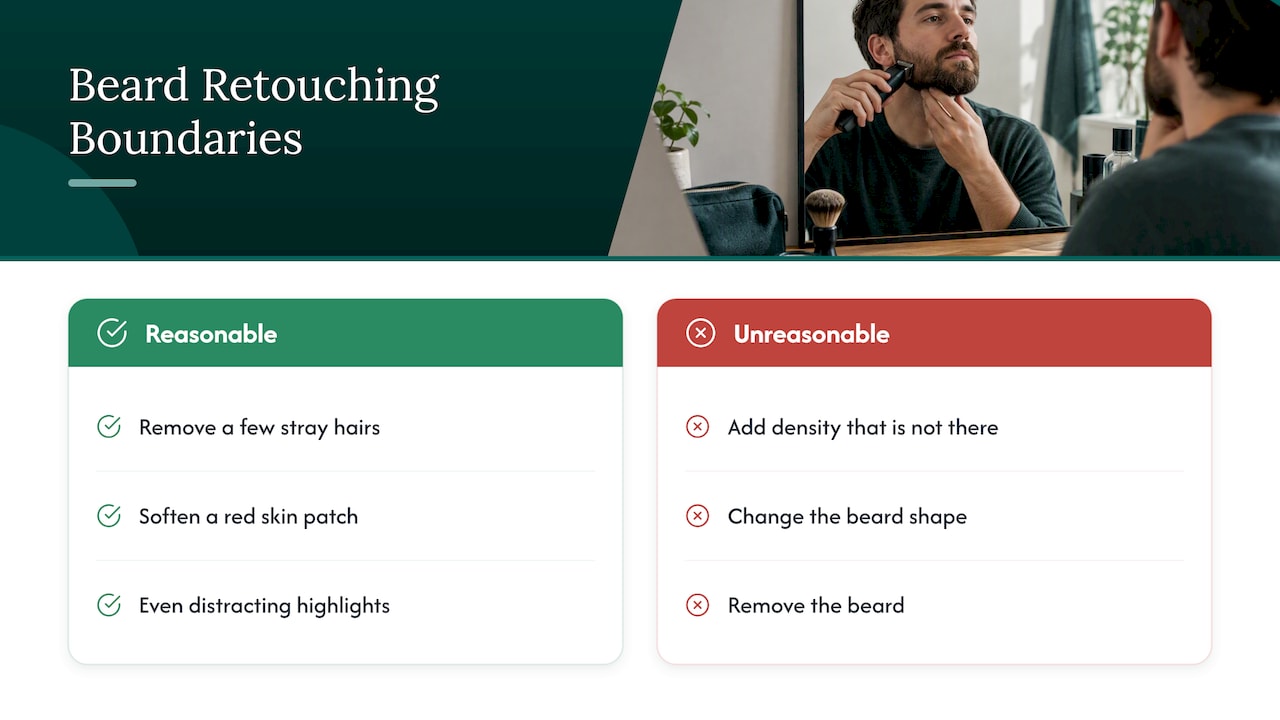
The test is simple: would a colleague recognize you from the photo on the first day? If someone asks “is that you?” the edit went too far. We explain our approach in our headshot retouching policy.
This is where companies run into trouble. A team page with eight people shot in the same light, with the same crop, looks consistent. Add two bearded executives and a clean-shaven founder, and the page still looks consistent as long as the photography is consistent. The facial hair is not the issue. Variation in lighting, background and crop is.
So do not set a rule about beards. Set rules for the things that make a page look uniform:
A grooming note works better than a policy. Something like “please arrive looking like you would to meet a client, and trim facial hair a few days before” is clear and does not feel like a rule about anyone’s face. Our corporate headshot guidelines give a template for what to send your team, and the headshot makeup policy explains what we do and do not touch on the day.
The broader point about consistency applies to every channel. A well-made photograph on a company site changes how visitors judge the business, as this piece on the role of professional photography for websites explains. Mismatched headshots undo some of that work, and a coherent set of portraits is one of the quickest ways to look established.
We photograph corporate teams on site, with portable studios set up in an office or at an event. After many sessions, the bearded-versus-shaved question looks smaller than people think. The photo that goes wrong is not the one with the beard. It is the one where the person was nervous, rushed or felt they had to look like someone else.
Our advice is to arrive as yourself, groomed. We run every project from a discovery call, and for team shoots that call is where we agree what the photos are for: a website, investor materials, recruiting, press. The use decides the look. A founder photo for a fundraising announcement can be a little more relaxed. A financial services team page usually benefits from a more formal frame. In both cases, the beard is not the point. Consistency and recognizability are.
We also keep the day easy for the person in the chair. Because we come to the office, people do not take half a day out of work, and live photo viewing lets someone see a frame and say “the neckline looks off, let’s reshoot that” while we are still there. That is far better than finding out a week later.
— Kevin
If you are arranging headshots for a company, we bring the studio to you. Our START UP package is $2,500 per shoot and covers on-site team headshots. Our STANDARD package starts from $2,000 per shoot and ENTERPRISE from $3,500 per shoot, both on our branding page, where you can also add branding photography for $1,000 per shoot. Packages vary with team size and frequency, and we plan the details on a discovery call.
If you are scheduling a shoot for a team that includes bearded and clean-shaven members, tell us on the call and we will set one light, one background and one crop for everyone. Our guide to scheduling headshots at work walks through the logistics. When you are ready, you can get started on our site.
Not unless you plan to look that way afterward. A groomed beard is accepted in most U.S. workplaces, according to Brandeis career guidance. Shave only if your beard is patchy, your employer has a rule about it, or you are about to remove it anyway.
Two to three days before is a safe window. It leaves time for redness or razor irritation to calm down while the lines are still crisp. Do a small tidy of the neckline and strays on the morning if needed.
Only a little. The American Academy of Dermatology says conditioner or oil should be used sparingly to avoid a greasy look. Moisturize the skin underneath the beard and keep the hair itself light.
Yes. Extending the jaw slightly forward and bringing the forehead forward and down helps define the jawline, as photographer Peter Hurley explains in his Popular Photography interview. Soft, even light also keeps beard texture visible instead of turning it into a dark shape.
Grooming guidance usually points to short, tapered sides with a bit more length at the chin, and crisp lines, as in this guide to beard styles for round faces. Ask your barber to adapt it to how your beard grows.
