Standardize Executive Headshot Styles for HR and Branding Teams
%20(1)%201.png)
.png)
.png)
October 2, 2026
%20(1).jpg)

The Executive headshot style uses composed expressions, structured wardrobe, and soft directional lighting against darker neutral backgrounds to project authority and trust for senior leaders. It fits C-suite portraits, partner bios, board photos, and any investor-facing profile where credibility matters more than approachability alone. Anyone presenting leadership to clients, media, or capital should start here.
TL;DR:
- Executive headshots use darker backgrounds and cinematic lighting to project authority and confidence, emphasizing texture and composed expressions.
- For senior leadership, the headshot should focus on gravitas with a narrow expression range, tighter framing, and clothing choices in structured, dark neutrals.
- Consistency across multiple offices requires a standardized photography setup, background, and retouch policy to maintain a unified professional image.
- Background color and reflectivity influence authority perception, with mid-gray and charcoal backgrounds preferred for their serious tone and contrast at thumbnail size.
- Proper technical setup includes soft, angled lighting, a focal length around 85mm, and natural skin texture preservation for a credible, polished look.
An executive headshot is not just a sharper version of a standard professional photo. The style exists to communicate gravitas, a kind of steady, unhurried confidence that signals someone has made decisions under pressure before and will again. That mood comes from a combination of expression, framing, and light working together rather than any single trick.
Framing tends to be tighter than a typical corporate shot, often head and shoulders, sometimes cropped closer to emphasize the face. The expression range is narrower too: composed, calm, deliberate, never a wide grin or an overly casual tilt. According to FreeHeadshot’s style guide, the Executive style pairs cinematic soft lighting with darker neutrals and composed expressions tailored specifically to senior leaders.
A noticeable shift in 2026 leadership photography favors softer, more cinematic lighting over flat, evenly lit corporate looks, along with a deliberate effort to preserve natural skin texture instead of smoothing it away.
What separates Executive from merely professional:
These elements together create an image that reads as deliberate rather than default, which is the whole point when the photo will sit on an investor deck or a press page.
Choosing the right headshot style starts with understanding how Executive differs from the categories it gets lumped in with. Corporate headshots aim for approachable consistency across an entire staff directory. Startup or casual styles lean into relaxed energy, often with softer light and brighter backgrounds, meant to signal openness and youth rather than seniority.
Executive can be overkill for a 200-person engineering team’s directory photos, where Corporate consistency matters more than individual gravitas. A quick checklist: if the photo will appear next to a title like CEO, partner, or board member, or alongside investor materials, Executive is the right call. If it is one of many similar photos on a team page, Corporate usually serves better.
Background choice shapes how much authority a headshot carries before anyone reads the caption. Photography Shark Studios notes that dark neutrals such as charcoal and deep navy are commonly used for executive portraits because they eliminate distractions and reinforce authority, while mid-light gray remains the safest, most versatile choice for LinkedIn and directory photos.
Reflectivity matters more than most people expect. Light gray backgrounds have high reflectivity, mid gray has moderate reflectivity, and charcoal has low reflectivity, which is part of why charcoal reads as heavier and more serious on screen.
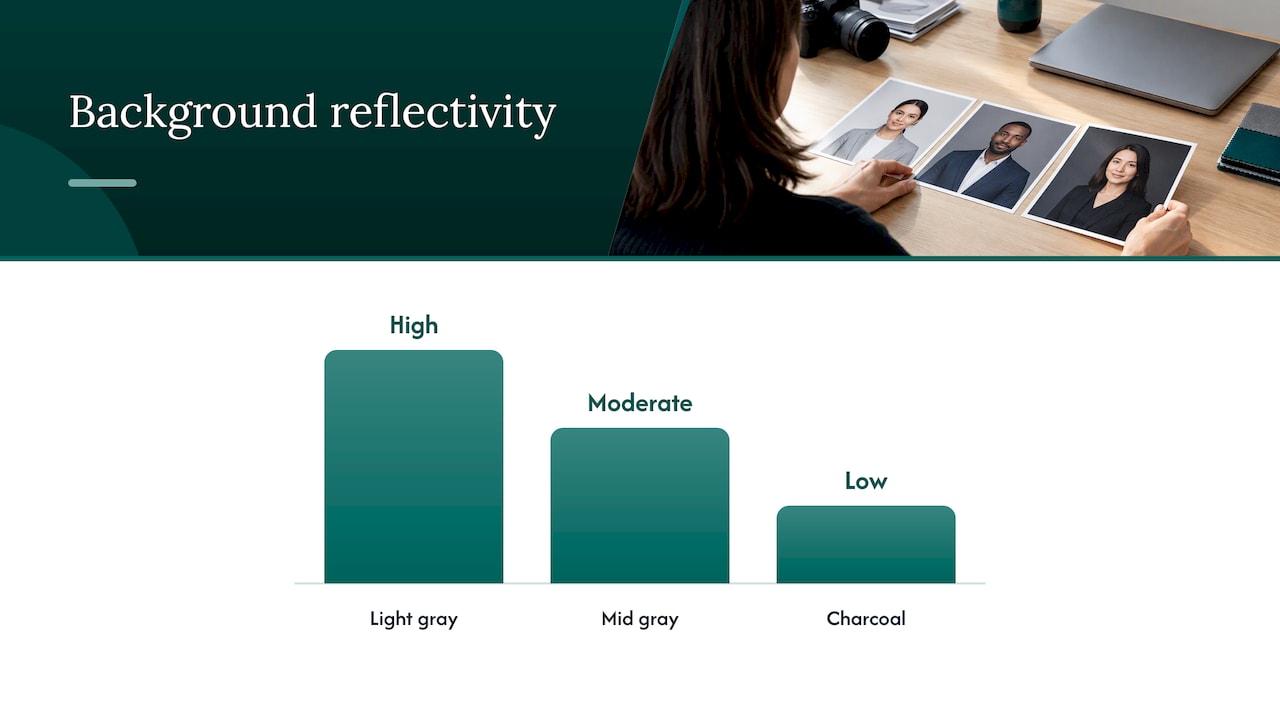
A background that works for one channel can fail on another: a light gray background often performs best across LinkedIn thumbnails and press kits because it holds contrast at small sizes, while a pure black backdrop can look dramatic in a large print but muddy on a phone screen.
Quick guidance by option:
Before finalizing a background, test it at thumbnail size, against the company website header, and in grayscale for print press kits. A background that looks rich on a monitor can flatten out or clash once it is resized.
The technical setup behind an executive headshot determines whether the final image feels polished or simply edited to look that way. FreeHeadshot’s technical notes describe the standard approach: a soft, diffused key light positioned at roughly a 45-degree angle, a subtle fill to soften shadows without erasing them, and a gentle rim light to separate the subject from the background.
Lens choice affects how flattering the final portrait feels. A focal length that simulates an 85mm view, shot around f/2.8 to f/4, produces gentle compression and a shallow depth of field that keeps the background soft while the face stays sharp. Wider lenses shot too close tend to distort features in ways that undercut the composed look the style depends on.
Retouching deserves its own restraint. Preserving visible skin texture rather than airbrushing it away has become a credibility signal rather than an afterthought, since audiences tend to read heavy retouching as inauthentic. For more on balancing edits with realism, editing techniques for professional portraits cover how to adjust contrast and tone without stripping natural detail.
Key technical targets:
Pro Tip: Shoot a test frame at the exact size your LinkedIn or website thumbnail will display, then check contrast and skin detail before running the full session.
How someone stands, looks, and dresses in front of the camera does more to create authority than any lighting setup. The goal is composed confidence: a steady gaze, a relaxed jaw, and either a slight closed-mouth smile or a confident neutral expression. A full smile with visible teeth can undercut gravitas, while a flat, expressionless stare reads as cold.
For a deeper breakdown of what to wear and what to leave in the closet, see this guide to corporate headshot attire. Wardrobe choices that work for a casual team photo rarely translate well to a board photo or press kit, so it is worth treating the two as separate decisions entirely.
The Executive style is not applied identically across every field. Finance and legal portraits tend to favor the darkest, most conservative end of the palette: charcoal or navy backgrounds, structured suits, minimal expression beyond a composed neutral. Private equity and enterprise tech often follow the same formula but allow slightly more warmth in expression, since these portraits frequently appear alongside growth stories and investor narratives rather than purely institutional bios.
Startups occupy a middle ground. Founders photographed for a press kit or funding announcement often benefit from Executive-level lighting and composition but with a touch more approachability, a genuine smile rather than a strict neutral, since the story being told is as much about vision as authority.
Environmental portraits, where a leader is shot in an office or workspace rather than against a solid backdrop, work well for annual reports or feature profiles where context adds credibility. They carry more risk for board photos or directory use, since inconsistent backgrounds across a leadership team can undercut the unified look those pages are meant to project. For board and leadership-specific guidance, see this overview of board member headshot approaches.
Common use cases to calibrate for:
Running a consistent executive headshot program takes more planning than booking a single photographer and hoping everyone shows up looking similar. Start with a written standard before the first session happens.
Pro Tip: Ask any vendor how they maintain consistency across multiple offices before booking. If they cannot describe a repeatable process, expect mismatched results.
Red flags include vague turnaround promises, no written retouch policy, and an inability to show how lighting stays consistent across different rooms or locations.
Some visual branding agencies run executive headshot programs nationally using portable studio systems, which means the same lighting setup and background standard travels to every office, portfolio company, or conference rather than depending on whatever room happens to be available that day. Every engagement ideally starts with a strategic discovery conversation to understand how the photos will be used, whether for a leadership page, an investor deck, or a recruiting campaign, before a single frame is shot.
That upfront planning matters most for organizations with multiple locations: private equity firms aligning portfolio company leadership, startups preparing for a funding announcement, or conference organizers capturing speaker headshots on-site. Fast editing turnaround helps ensure images are ready to deploy while the context, a product launch, a funding round, a keynote, still carries momentum.
In my experience watching companies invest in visual branding, the organizations that treat executive headshots as a styling decision alone usually miss the bigger point. A consistent leadership page builds quiet trust with investors and candidates before anyone reads a word of copy. Inconsistency, mismatched backgrounds, different lighting, one executive looking far more polished than another, reads as disorganization even when nothing else about the company is disorganized. Standardize the style across every senior leader; allow more personal variation further down the org chart where consistency matters less.
— Kevin
Building a leadership page, press kit, or investor deck that looks unified across every executive takes more than booking one photographer per office. Some companies bring a portable studio directly to your location, so every leader can get the same lighting, background, and crop regardless of city or office layout.
Fast turnaround means your team’s photos are ready while a launch, raise, or event is still top of mind. Start a conversation about your leadership team’s visual consistency through Studio2U’s home page.
Common styles include Corporate, used for full-staff directories and consistent team pages, Executive, used for senior leaders and press-facing roles, and Startup or casual, used for founders and early-stage teams. Each differs mainly in lighting warmth, background choice, and wardrobe formality.
Definitions of this common rule vary across photography guides, and it is not addressed consistently enough in sourced material to state a single standard version here. It generally relates to balancing exposure or composition zones, but readers should confirm the specific application with their photographer.
Avoid busy patterns, loud colors, and visible logos, since they distract from the face and can create visual noise at small sizes like a LinkedIn thumbnail. Pure white backgrounds and stark black backdrops also carry some risk, since white can wash out and black can lose contrast depending on the platform.
A notable trend for 2026 favors soft, cinematic directional lighting over flat, evenly lit corporate setups, paired with preserving natural skin texture instead of heavy retouching. Darker neutral backgrounds such as charcoal and navy are also increasingly common for leadership and executive portraits.
