5 Zone Event B-Roll Checklist: Editor-Ready for Conferences
%20(1)%201.png)
.png)
.png)
September 8, 2026
%20(1).jpg)

An annual photo refresh is a coordinated on-site photography and short-form video program scheduled once a year to keep a company’s headshots, team imagery, and brand video current across marketing, recruiting, and investor channels. Studio2U treats it as a standing production, not a one-off event, and Forbes Business Council has framed professional photography as trust-building “visual proof” that shapes lead conversion and hiring outcomes.
TL;DR:
- A comprehensive annual photo refresh should include executive headshots, team portraits, office environment shots, product images, short videos, and coverage of key events or milestones, not just headshot days.
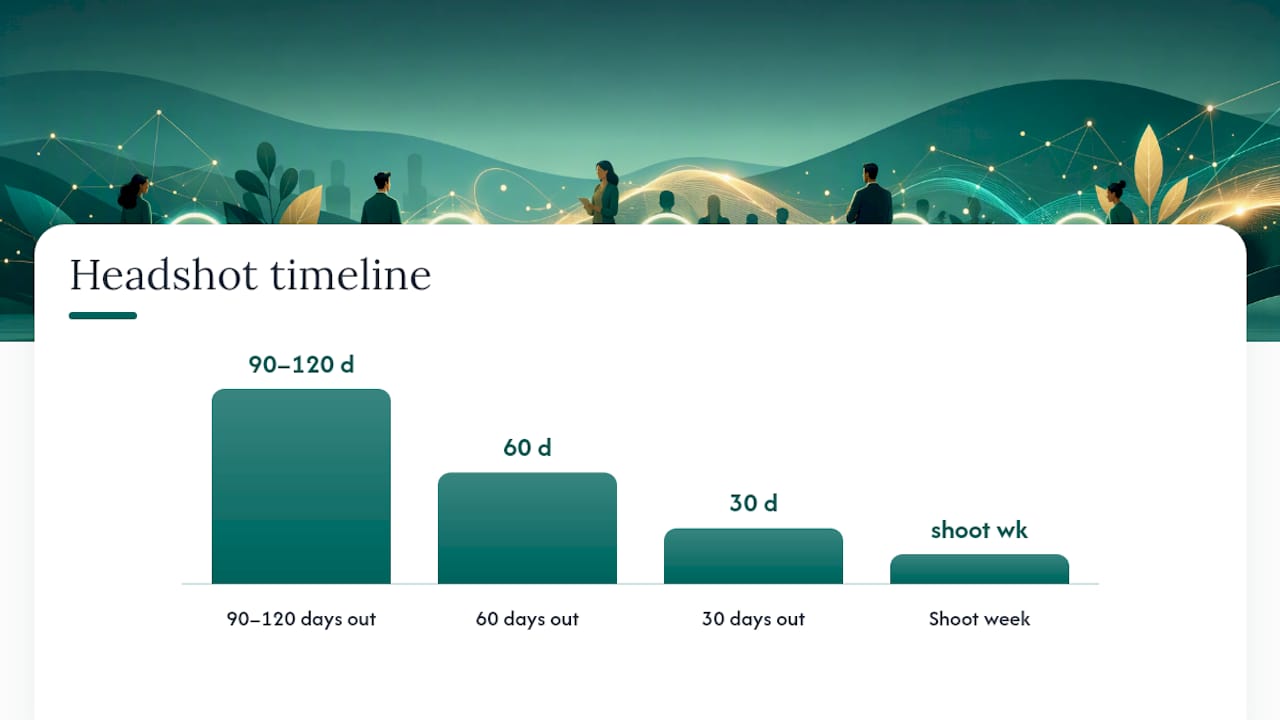
- Scheduling should begin 90 to 120 days in advance, with clear deadlines for confirming budget, vendors, and employee participation, and rebranding or major changes should trigger earlier updates.
- The shoot day must be efficiently organized with predetermined time slots, a designated space, and a fast-paced process to minimize disruption and ensure quick turnaround times of a few business days.
- Multi-office programs require careful vendor coordination, portable studios, and clear deliverables in multiple formats, along with licensing in writing to sustain asset reuse across channels.
- Reusing assets across website, social media, recruiting, and PR channels maximizes return, requiring a consistent file naming system and governance sheet tracking usage rights and expiration dates.
The mistake most teams make is booking a headshot day and calling it a refresh. A real annual program covers six categories, and skipping any one of them means someone in marketing or HR is scrambling for stock photography by March.
Here’s what to prioritize when the shoot clock is running:
If time is tight, triage in this order: hero portraits of leadership and customer-facing staff first, then B-roll for social feeds, then short interview clips last. For file specs, ask for full-resolution masters (at least 300 DPI for print), web-optimized exports at standard social crop ratios (1:1, 4:5, 9:16), and a separate batch of raw or lightly graded video files your editor can recut later. On headcount, prioritize anyone client-facing, anyone in recruiting materials, and your board; batch everyone else by department so no one loses more than 10 to 15 minutes.
Annual programs fail for one reason more than any other: nobody owns the calendar. Best-practice guidance from VisualBirds recommends refreshing photography every 1 to 2 years at minimum, and sooner after a rebrand, a large hiring wave, or a new office opening.
A working timeline looks like this:
Rebrands, funding rounds, acquisitions, executive changes, and new office launches are all valid triggers to move the date up rather than wait for the anniversary.
Pro Tip: Book your next year’s date on shoot day itself. Teams that wait until “sometime next fall” to schedule almost always slip into an 18-month gap instead of a 12-month one.
A well-organized shoot day should feel closer to a fast-moving barbershop than a movie set. Photographers who specialize in on-location headshot days recommend treating the whole thing as a calm, repeatable system rather than a special production, because that consistency is what gets employees to actually use the resulting photos.
Before the crew arrives, scout the space for a corner with enough ceiling height and wall clearance for a portable studio setup, confirm power access, and designate a separate staging area so people aren’t lining up in a hallway.
The run sheet itself typically breaks into blocks:
Give employees a 30-second coaching script before their turn (chin down slightly, weight on one foot, relax the jaw) and offer an express retouch option so people leave the studio confident instead of anxious. Collect image releases digitally before the day starts, not during it.
Pro Tip: Put your fastest-scheduling person, usually someone from HR or office management, in charge of keeping the line moving. A dedicated timekeeper prevents the single biggest cause of shoot-day overruns: chatty small talk at the camera.
Pricing for corporate photography generally falls into three shapes: per-person headshot rates for small teams, flat half-day or full-day packages once headcount passes 15 to 20 people, and enterprise multi-site pricing when you’re coordinating several offices under one contract. Multi-site programs usually price per location plus a coordination fee rather than a flat national rate, since travel and scheduling complexity vary by market.
Whatever the pricing shape, insist on these deliverables in writing before you sign anything:
On turnaround, VisualBirds notes that a typical edited-delivery window is several business days for standard commercial photography, though larger multi-site projects or added video services can run longer. Some vendors structure their production workflow around fast delivery so photos and clips can go live while a launch or hiring push still has momentum, rather than landing weeks after the news cycle has moved on.
The annual refresh only pays off if the assets get reused constantly, not filed away after the launch announcement. Forbes Business Council’s reporting on visual branding points to the same lesson: photography delivers more return when a shoot is planned for multiple channels from the start, rather than treated as single-use photography.
Set a simple file naming convention before the shoot (department, name, date, asset type) so nobody is digging through unlabeled folders in month eight. From there, the repurposing map is straightforward:
Keep a one-page governance sheet noting who signed a release, which images are approved for external use, and an expiration reminder tied to next year’s shoot date.
A standard cadence isn’t always the right call. Skip or delay if nothing material changed and last year’s assets still represent the team accurately. Accelerate the schedule after a funding round, executive change, or acquisition, since outdated leadership photos undercut credibility during exactly the moments people are searching for them. Expand scope when you’ve added a product line or a new office, since a single-location shoot can’t cover that ground.
For smaller gaps, a full production isn’t always necessary. Micro-sessions for a handful of new hires, a satellite day at a single new office, or a self-recorded video supplement can bridge the year without a full crew.
Most companies underestimate how much coordination a multi-office refresh actually takes until they try to schedule one. Vendors often run these programs by bringing portable studios directly to client offices, which helps keep quality and lighting consistent whether the shoot is happening in one building or multiple locations.
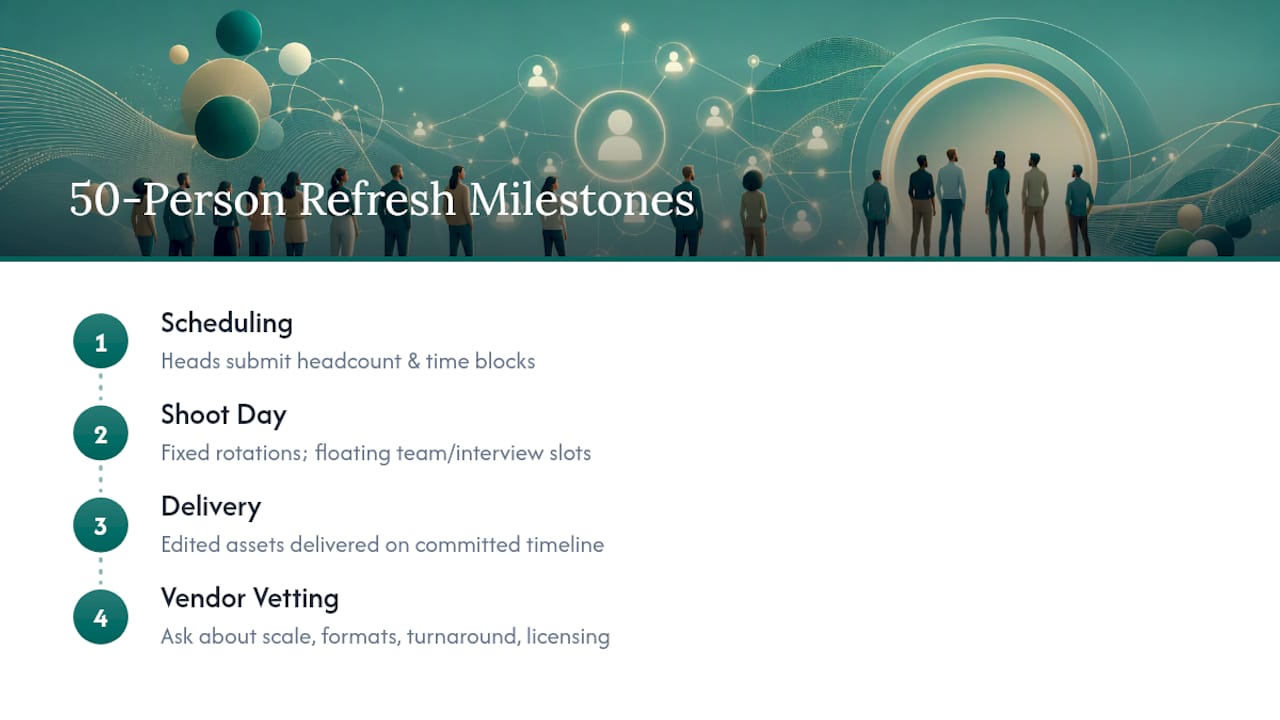
A typical 50-person annual refresh breaks into three milestones: a scheduling phase where department heads submit headcount and time blocks, a shoot day built around fixed rotations for headshots and floating slots for team and interview sessions, and a delivery phase where edited assets land on a committed timeline rather than “whenever it’s ready.” When vetting any vendor for this kind of program, ask directly: how do you handle scale across multiple offices, what exactly gets delivered and in what formats, what’s the actual turnaround in business days, and who owns licensing on the final files.
If you’ve read this far, you already know the hard part isn’t deciding to do a refresh, it’s finding a partner who can execute one without eating three days of your team’s time. Studio2U runs on-site headshot days, team and environmental photography, and event or conference content coverage, all built around the fast turnaround that keeps new assets usable while a launch or hiring push is still fresh.
Before signing with any vendor, put three questions in your RFP: how they handle multi-office scale, exactly what deliverables and file formats you’ll receive, and their committed turnaround window in business days. A vendor’s production workflow should be responsive to these concerns, whether managing a single headquarters shoot or coordinating across multiple cities. For a look at what a scheduled program looks like for larger teams, review company-wide headshot planning, or get a quote for your next shoot directly.
Once a year is the standard cadence for most companies, with best-practice guidance suggesting a refresh at least every 1 to 2 years and sooner after a rebrand, major hire, or new office.
A well-run session typically moves several people per hour, based on 5 minute rotations per person once lighting and setup are locked in.
Fundraising announcements, executive changes, acquisitions, rebrands, and new office openings are the most common reasons to move a shoot up rather than wait for the annual date.
Standard commercial photography deliveries often land within 5 to 10 business days, with larger multi-site or video-heavy projects sometimes taking longer.
No. Prioritize client-facing staff, leadership, and anyone featured in recruiting or PR materials, then batch remaining departments in smaller groups to keep the day efficient.
