Recruiting Video Examples That Work, and How to Make Your Own


November 11, 2026


The best recruiting videos do one job: they let a candidate see real people doing the real work before they apply. Below are examples from a hospital system, a remote software company, a police department and a review platform. After them come the formats behind those examples and a plan for producing your own without wasting a shoot day.
Examples are useful only if you can name why they work. Each one below is paired with the lesson you can borrow.
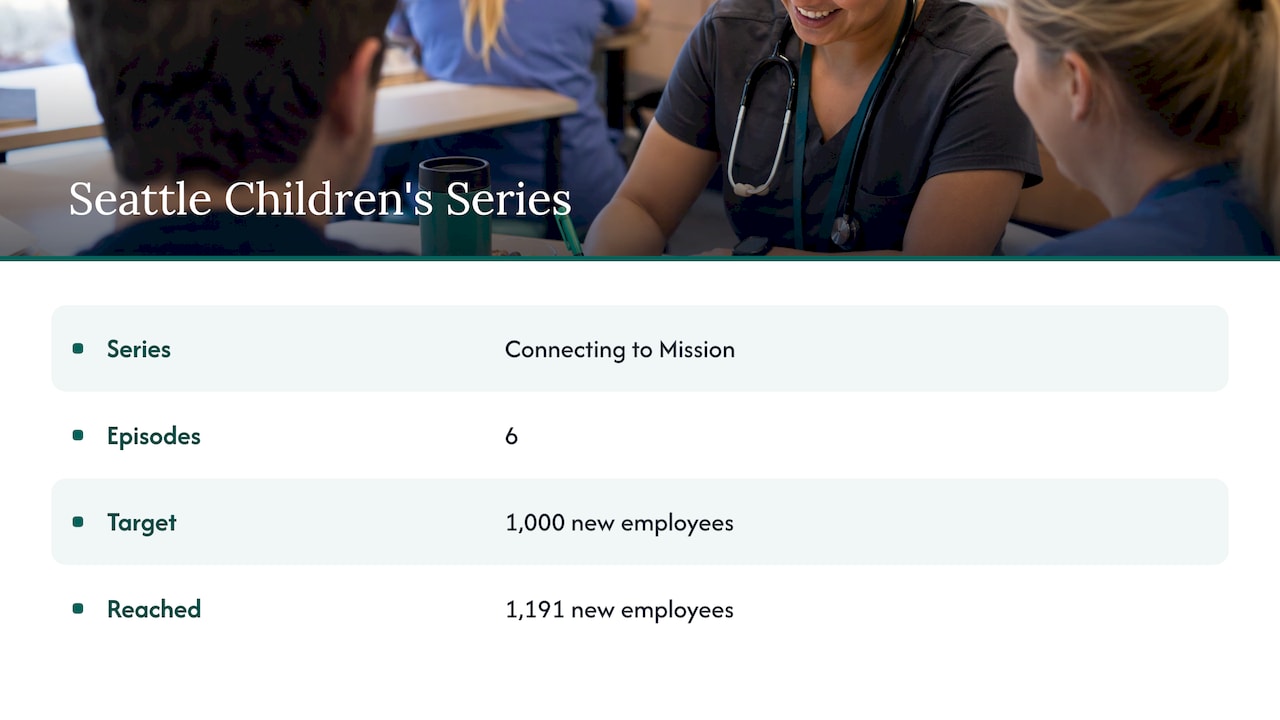
Seattle Children’s Hospital produced a six-episode series called “Connecting to Mission.” It featured clinical and non-clinical employees with different roles, lived experiences, abilities and tenure. Its onboarding target was 1,000 new employees, and the hospital reached 1,191, according to Ragan Communications’ 2024 account.
What to borrow: a series beats a single hero video when your workforce is varied. A candidate in billing and a candidate in nursing each need to see someone like them. If you hire across several functions, plan one episode per audience instead of one film that tries to speak to everyone.
Buffer’s Growth Product Manager video is short and specific. According to PlayPlay’s roundup, it shows the hiring manager, role perks, a key skill and the salary range in a natural home setting, and PlayPlay says the video generated more than 3,000 applications.
What to borrow: the hiring manager speaks, the pay is on screen, and nothing is over-produced. For a single open role, this format is the fastest to plan and the easiest to repeat for the next opening.
PlayPlay’s roundup describes Fort Worth Police’s recruitment video as a 2-minute-35-second humorous used-car-style commercial that listed the qualities the department wanted. The same account says it reportedly drew more than 1,000 applications.
What to borrow: a recognizable format can carry a serious message. The comedy worked because the video still told viewers who should apply. If your culture is genuinely playful, a parody format can stand out in a feed. If it is not, skip it.
Yelp made employee video testimonials for onboarding and its careers site, and also featured Employee Resource Group members discussing important months and days, per Phenom’s 2024 write-up. Phenom reported that Yelp’s average global tenure rose from 2.8 years in 2022 to 3.5 years in 2023, and that career-site views increased 183% year over year. Social followers grew 210%.
What to borrow: one batch of employee footage can serve recruiting and onboarding. Those are Yelp’s reported results, and they came from a program rather than a single clip, so treat them as a direction to aim for and not a promise.
Candidates come with different questions. Match the video to the question and you stop producing content nobody needed.
| Video type | Candidate question it answers | Best for |
|---|---|---|
| Employee testimonial | What do people here actually think of working here? | Proving culture and satisfaction |
| Day in the life | What will I do all day? | Realistic job previews, entry and mid-level roles |
| Culture or team video | Why here instead of somewhere paying the same? | Differentiating from similar employers |
| Founder or leadership message | Where is this company going, and will I grow? | Startups, senior hires, vision-led roles |
| Role explainer | What does this specific job demand? | Hard-to-fill or technical openings |
| New-hire welcome | What happens after I say yes? | Offer stage and onboarding |
These categories line up with guidance from several sources. VidCruiter’s guide recommends testimonials for genuine culture, day-in-the-life videos for realistic job previews, culture videos for differentiation and leadership messages for vision. A broader list adds behind-the-scenes, hiring-process, development and growth, and diversity and inclusion videos. VocalVideo makes the useful point that each type answers a different candidate question, so most employers make more than one.
Testimonials are not one format. A 2026 guide splits them into day-in-the-life clips of 60 to 90 seconds, onboarding experience testimonials collected at the 30-day and 90-day marks, and team-and-culture videos with three or four people. The team format suits industries where compensation is similar and culture is the tiebreaker.
If you want a deeper look at how testimonial footage works for business audiences, see our guide to B2B testimonial videos.
If you are staring at a blank brief, start with one of these. Each can be shot in a single day on location.
Engineers tend to distrust polish. The strongest engineering recruiting videos show the team’s actual work: a whiteboard session, a code review, a conversation about a hard technical decision. Let an engineer, not a marketer, explain the problem the team is solving. Keep the script loose and the audio clean, and put the tech stack and team size on screen so a candidate can qualify themselves in seconds.

Most weak recruiting videos fail in planning, not in filming. Vimeo’s 2026 recruiting guidance recommends that teams define one measurable objective and audience, use employees who represent the role and plan locations and logistics. It also advises keeping content concise, adding a single clear call to action and captioning videos.
“Attract great people” is not a goal. “Increase qualified applications for senior backend roles” is. Pick one, and write the viewer in a sentence: who they are, what they worry about and what they need to believe before applying.
Candidates compare themselves with whoever is on screen. Put people on camera who do the job being advertised, at the level being hired. A video for junior analysts led by the CFO tells the wrong story.
Vimeo recommends showing real work in context and connecting the company mission to the specific role instead of generic culture claims. “We love collaboration” means nothing. Two designers disagreeing about a layout and resolving it means something.
The National Child Welfare Workforce Institute’s realistic job preview toolkit suggests explaining why the video exists, using workers’ own descriptions as voiceover over on-the-job footage, and prompting viewers to decide whether the job fits. That last point is worth copying: a good recruiting video helps the wrong people opt out and the right people lean in. If your roles need a clear explanation of employment basics, a practical resource on hiring employees in the US can help you get the job details right before you script the preview.
Clean audio and mobile-readable captions are, in Vimeo’s words, core production requirements. Most viewers meet recruiting content in a feed or a job post, often muted. Aim for 30 to 90 seconds for social and role videos, and let longer culture pieces run to two or three minutes only if every scene earns its place.
Vimeo’s guidance is to answer candidates’ questions and point them to one clear next action. One link, one button: “See open roles” or “Apply for this position.” Not five.
One shoot should produce several assets. Vimeo advises tailoring distribution to job posts, careers pages, email and recruiter messages. In practice:
Video gets the attention, but photography does a lot of quiet work: job-post thumbnails, careers-page headers, LinkedIn banners, ads and email signatures. The mistake is stock imagery. Candidates can spot it instantly, and it undercuts every authentic claim your video makes.
Shoot photos on the same day as video, with the same people, so the visuals match. Team portraits, working candids and consistent headshots turn into a library you can reuse for months. Our guides on company culture photos and company-wide headshots cover how to run that shoot.
Brand consistency matters here too. Employer branding works best when storytelling and varied employee perspectives show up the same way across every touchpoint, from the careers page to the ad.
Most companies treat recruiting video as a one-off project the week a hard role opens. We think of it as part of the visual brand, shot with the same care as the sales and investor material.
The principle we work from is simple: real people, real experiences, real outcomes. Candidates, like customers and investors, form an opinion before the first conversation. If the first thing they see is staged, they discount everything after it.
That is why we bring a portable studio and production team to your office instead of asking your people to travel. Employees stay in their own environment, disruption is minimal, and the footage looks like your company, not a set. It is also how we cover multiple offices with a consistent look.
Our advice for startups, especially after a funding round: shoot the founder story, team portraits and a few role videos in one session. You get your hiring assets, your press photos and your website visuals from a single day. Every project starts with a discovery call so the content has a strategic purpose before anyone picks up a camera.
Kevin
We produce on-site corporate photo and video, including team headshots, branding photography, video production and event content, with retouching and a five-day turnaround. Everything is shot at your location with our portable studio, and we customize it for startups, financial firms, conferences and corporate teams.
Published pricing is per shoot. Our START UP package is $2,500 per shoot, the STANDARD package starts from $2,000, ENTERPRISE from $3,500, and the BRANDING ADD-ON is $1,000, all on our branding page. Not sure which fits? Browse our full services or start with a discovery call.
If your goal is to tell a stronger story about what it is like to work at your company, our guide to employer brand video explains how we approach it. Customer proof matters to candidates too, and client story videos can double as recruiting content.
It features real employees doing real work, answers a specific candidate question and ends with one clear next step. It also has clean audio and captions. Production polish matters less than honesty and relevance to the role.
For job posts and social, 30 to 90 seconds works well, and Buffer’s role video above runs about 45 seconds. Longer culture videos or series episodes can run two to three minutes if each scene adds something new. Cut anything that does not help a candidate decide.
Start with the type that answers your biggest drop-off. If candidates do not understand the job, make a day-in-the-life or hiring-manager video. If they do not know why to pick you over similar employers, make an employee testimonial or team video. Many companies add a founder story after a funding round.
Yes, and it is usually the better use of budget. Plan the shoot list around several uses: careers page, job posts, social, sales decks and press. We shoot photo and video together on location, so team portraits, founder content and role videos come out of the same day.
