Recruiting Video Examples That Work, and How to Make Your Own


November 8, 2026


A good headshot day schedule gives every person a fixed 10-minute slot and builds in a setup block, a midday reset and a few buffer slots for late arrivals and retakes. Slots are staggered so no one waits in a line, and the photographer’s station never sits idle. Below you will find the math, a sample timeline you can copy, a countdown for the weeks before, and the instructions to send your team.
Every schedule begins with one number: minutes per person. Slot length drives everything else.
Here is the arithmetic for one station with 10-minute slots: 60 divided by 10 is 6 people per hour. A 6-hour shooting window is 36 people. Add a second station and the same window covers 72.
One published example gives a feel for the upper end. A guide to a 100-person corporate headshot day in New York describes two shooting stations at 7 minutes per person, which works out to roughly 16 to 18 people per hour. Seven-minute slots are workable, but they leave less margin for the unexpected, so we advise building your plan on 10 minutes and treating anything faster as a bonus.
Set your headcount against the window before you book. If the numbers do not fit in one day, you have three choices: add a station, add a half day, or split the company by floor or department across two dates. Splitting is usually the least disruptive, a point we cover in our guide to minimizing disruption on photo day.
This is a template for one photographer, one background and about 40 people. Adjust the clock times to your office hours.
| Time | What happens |
|---|---|
| 8:00 to 9:00 | Crew arrives, builds the portable studio, tests light and background, walks the route from check-in to the shoot space |
| 9:00 to 9:15 | Test shots with a volunteer, confirm framing and crop, lock the look |
| 9:15 to 12:15 | Rolling appointments, 10 minutes each, 18 slots |
| 12:15 to 1:00 | Lunch and equipment check, last chance to catch anyone who was out in the morning |
| 1:00 to 4:00 | Rolling appointments, 10 minutes each, 18 slots |
| 4:00 to 4:30 | Catch-up slots for no-shows, late arrivals and retakes |
| 4:30 to 5:15 | Breakdown and load-out |
That is 36 scheduled slots plus catch-up time, which is why the 40-person figure holds. If you book every slot back to back with no gaps, one late arrival pushes everyone behind it. Leaving one open slot at the end of each hour is a simple fix: it absorbs the overrun and keeps the rest of the clock honest.
A larger company can run two stations side by side, or one station and one second room for a different style, such as an executive look versus a standard team look. The same New York guide describes a typical flow with crew arrival and setup at 8:00, rolling appointments in the morning and afternoon, a short midday break for an equipment check, and a final window for pickups before breakdown at 4:30 PM. Our table follows the same logic: setup first, two shooting blocks, a reset in the middle, and a tail for stragglers.
A schedule is more than a list of time slots. It is a sequence of decisions, and most of them have to be made weeks ahead.
Our photo day checklist covers the same ground in a printable form, and our guide to organizing employee headshots goes deeper on the coordinator role.
For a fuller timeline you can reuse, see our team headshot schedule and the notes on scheduling headshots at work.
The shoot space decides how smooth the day feels. What you need is simple.
The flow should be one-way: wait, shoot, leave. If the exit crosses the waiting area, people stop to chat and the line stalls. Keep the person after the next out of sight, so they are not watching and getting nervous.
Portable studios help here because they arrive set up in a day’s time and leave nothing behind. Because our crew brings the equipment to your floor, there is no travel for staff and no half-day lost.
Most schedule trouble comes from unprepared people, not from the photographer. Send a brief that fits on one screen.
Template for your team:
Headshot day is on [date] in [room]. Your slot is [time] and it takes about 10 minutes. Please arrive 5 minutes early. Wear what you would wear to meet a client, in solid colors if you can. Avoid very small patterns and logos. Bring a second top if you want a different look. You will see your photos on screen, and we will pick the final one together. Questions go to [coordinator].
The points that matter most:
Things go wrong on every headshot day. The question is whether the schedule absorbs them.
On-screen approval is another variable. Reviewing images right after the shot keeps people from hating their photo a week later. We offer live photo viewing as part of our service, and it adds a minute or two per person, which is why we plan on 10 minutes instead of 5. Our piece on live photo selection for headshots explains how to run it without slowing the line.
The day ends when the files arrive, so settle the back end early.
After delivery, put the photos in one shared folder and tell people where they are. Our guide to managing employee headshots covers how to keep the library tidy, and our notes on company-wide headshots cover multi-office rollouts.
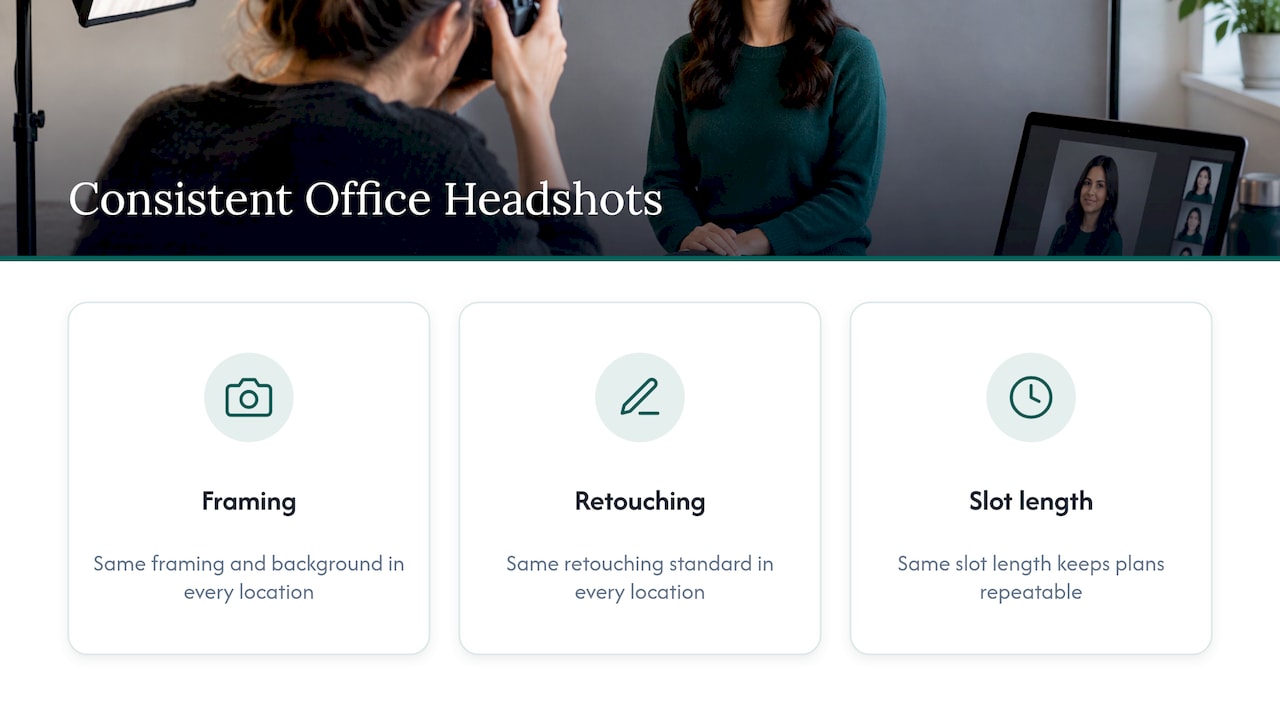
Companies that spread across cities run into a consistency problem: different photographers, different light, different backgrounds. A headshot day schedule for several offices uses the same framing, the same background and the same retouching standard in every location, with the same slot length so the plan is repeatable. Our crews work across the US, in Florida, Massachusetts, New York, the San Francisco Bay Area, Boston, Miami-Fort Lauderdale, Austin, Dallas-Fort Worth and Houston, so a single brief can travel with the team from one office to the next.
Most companies treat headshot day as a scheduling chore. We see it as the moment the company decides how it looks to customers, investors, candidates and the press. The schedule exists to protect that outcome.
That is why every project we run starts with a strategic discovery call. We ask where the photos will live: the team page, the sales deck, the fundraising announcement, recruiting pages. The answer sets the background, the framing and even the order of the day. A start-up that just closed a round needs a different look than a private equity firm aligning the branding of a newly acquired company.
We bring a portable studio to your office so the team does not leave the building, and we plan around your calendar so the business keeps running. Live photo viewing means people leave their slot knowing they have a picture they like, and professional retouching with a five-day turnaround means the files are in your hands before the moment has passed.
A schedule is only as good as the people running it. Give us your headcount and your goals, and we will build the day.
Kevin
If you would rather hand the schedule to a team that does this every week, we build the whole day for you: the run sheet, the on-site studio, live photo viewing, retouching and delivery in five days. Our START UP package is $2,500 per shoot, and you can see what it covers on the team headshots page. For branded photography across a larger team, the STANDARD and ENTERPRISE packages start at $2,000 and $3,500 per shoot, and the BRANDING ADD-ON is $1,000 per shoot. Event organizers can look at our conference photography options.
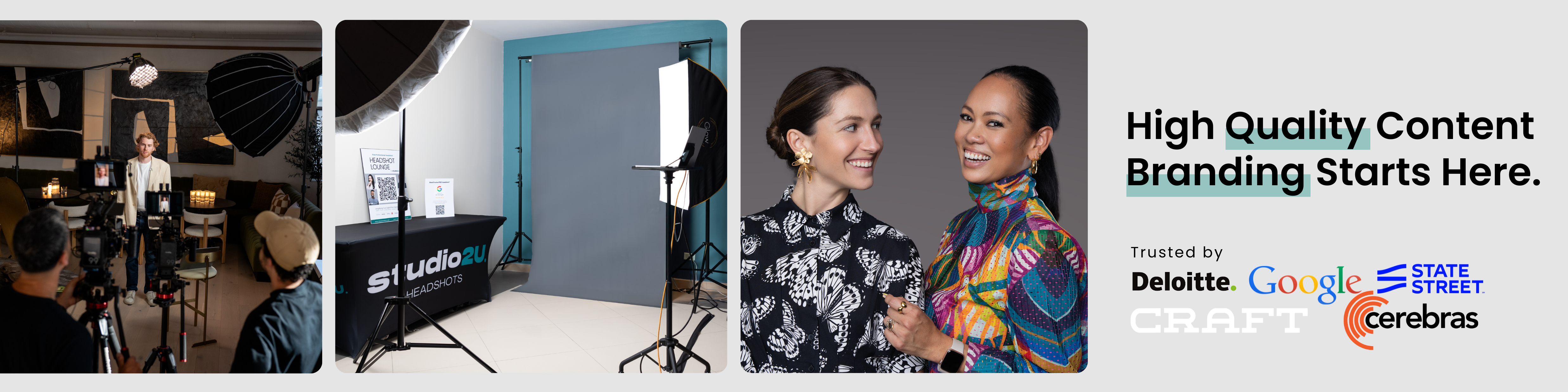
Tell us the headcount and the date, and we will send back a schedule you can forward to your team.
Plan 10 minutes per person. That covers walking in, a few directed frames, a quick review and walking out. Shorten it to 5 to 7 minutes only if the team is camera-comfortable and you have a single simple look.
On 10-minute slots, one station handles 6 people an hour. Over a 6-hour shooting window that is 36 people, with setup, a midday reset and catch-up slots on top. For a bigger team, add a second station or a second day.
Solid colors they already feel confident in, and clothes they would wear to meet a client. Avoid tight patterns and large logos. If people want a second look, ask them to bring one more top.
Open the sign-up two weeks ahead and send the full brief one week ahead. A reminder the day before, with the room and the time, cuts no-shows. Follow up personally with anyone who has not booked a slot.
Our standard is a five-day turnaround after the shoot, with retouching included. Having your team’s selections in on time is what keeps that promise intact.
