Portfolio Company Photography: A Guide for PE and VC Teams


November 5, 2026


Portfolio company photography is the planned set of team headshots, brand photos, and video that makes a firm’s companies look like they belong to one standard of quality. It matters most at three moments: right after an acquisition, right after a funding round, and ahead of conferences and investor events. The most reliable way to do it is to shoot on site, in one consistent style, with each image tied to a specific use such as a website, a sales deck, a recruiting page, or a press announcement.
This guide is for the people who usually own this work: operating partners, platform marketing leads, and founders who just closed a round. It covers what to shoot, in what order, and what the published Studio2U packages cost.
It is not one deliverable. For a private equity or venture capital portfolio company, the work usually breaks into five buckets:
The point of treating them as one program is reuse. A shoot day that captures headshots, a few environmental scenes, and a founder interview gives marketing, HR, and sales material for months. Our own startup brand photography guide goes deeper on how an early-stage company can build that library from a single session.
When a platform company buys another business, the temptation is to book a photographer immediately. Resist it until you know what the combined brand will look like, because the photo style, wardrobe guidance, and backgrounds all depend on that decision.
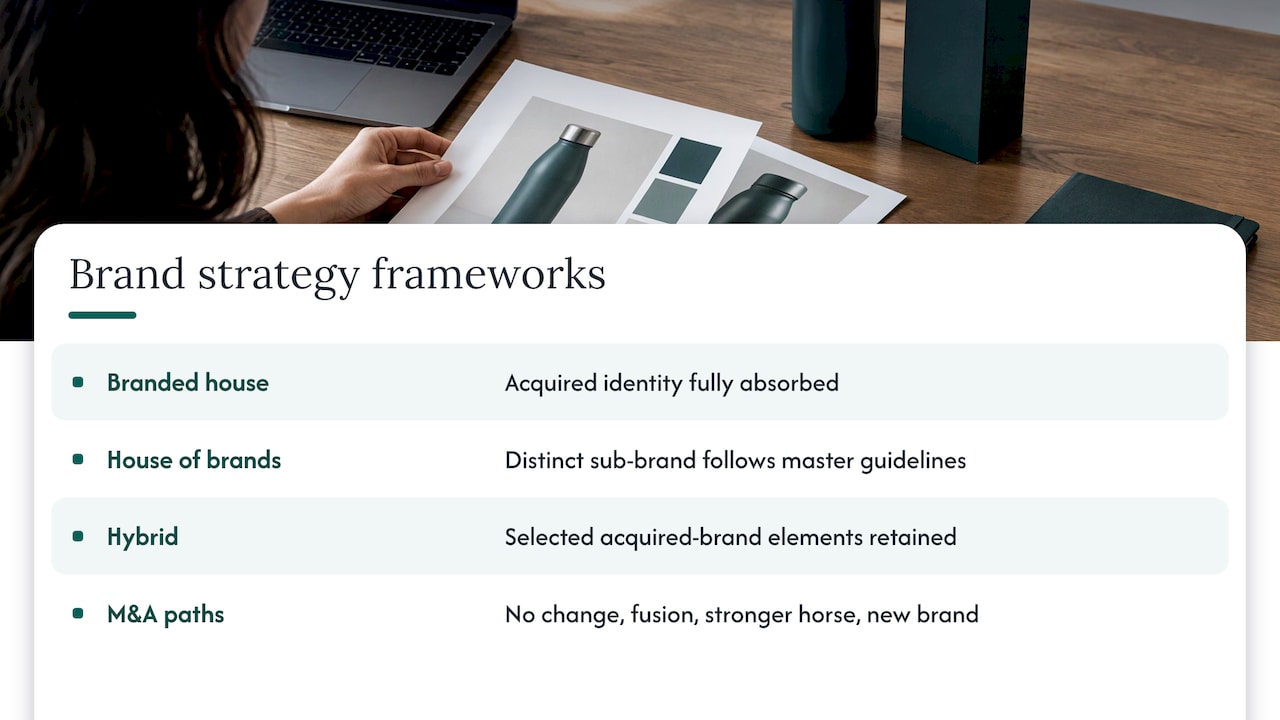
Branding agencies describe a few common models. Walker Sands outlines a branded house model and a house of brands model: in the first, the acquired identity is absorbed completely; in the second, the acquired company stays as a distinct sub-brand aligned with the master brand’s guidelines. A hybrid keeps selected elements of the acquired brand. Finch Brands names four M&A identity strategies: no change, fusion, stronger horse, and new brand.
Percepture advises that portfolio company brand architecture should set rules for the platform name, acquired company names, offers, and any parent endorsement, and that this work should stay separate from positioning, visual identity, and legal review. That separation is useful for photography too: the photo brief is a visual identity task that can start once the naming rules are settled.
| Architecture choice | What it means for photography |
|---|---|
| Branded house (absorb) | One shared look. Re-shoot acquired staff in the parent’s style so the website and decks feel unified. |
| House of brands (retain) | Same quality and lighting standard, but each company keeps its own colors, settings, and tone. |
| Hybrid | A shared headshot standard for everyone, with selective brand elements kept in environmental and video work. |
| New brand | Wait for the new identity, then shoot everyone once, in the final style. |
The detail that trips teams up is timing. If you shoot before the decision, you pay twice. If you wait too long, the acquired team spends months on the website with mismatched headshots, which is the most visible sign of a merger that has not finished.
Goran Paun, writing in Fast Company, says a comprehensive audit of both brands’ identities, values, and market perceptions is essential to decide which elements to keep, adapt, or drop. Do the visual version of that audit: collect every headshot, office photo, and video from both companies and sort them into keep, retake, and retire. Most of the time the headshots are the first to go, because they are the cheapest to fix and the most inconsistent.
For teams working through this, these visual storytelling tips are a useful complement when you are deciding how imagery should carry the combined story.
A merger usually means several locations. That is where on-site production earns its place: a portable studio travels to each office, so everyone is photographed with the same lighting, backdrop, and framing, whether they sit in Boston, Austin, or Miami. We designed our process for exactly this, and it keeps disruption to a few minutes per person. See our guide to scheduling headshots at work for how to run a day without derailing the calendar, and hybrid team headshots for people who are rarely in an office.
A closed round brings pressure to look like a bigger company. The better move is to be deliberate. Opere18 advises that the first month after a raise should focus on strategy rather than spend: get positioning right, map the funnel, and set up measurement before spending to generate pipeline. Visual assets belong inside that plan, not ahead of it.
A sensible sequence for a newly funded startup:
Our website team page photo guide covers the update step, which is where most of the visible payoff shows up first.
Crew VC’s playbook says startups should aim to create multiple media artifacts for an announcement: a press release, a news article, social posts, a blog post, a launch video, and customer testimonials. It names three story elements: the founder’s journey and vision, the market and tailwinds, and traction with customers and proof points. Crew VC’s Sonia Damian adds that launch videos have become a key artifact in 2025, and that a short, creative, attention-grabbing video can travel far.
Translated into a shoot plan:
The common mistake is making the video about the investors. Readers care about what the company will do next. Keep the investor to a mention and put the founder and team in front of the camera. For group images, our company group photo ideas lay out options that look natural rather than staged.
A case study video is a sales tool, so plan it backward from the sales conversation. Ask which objection it needs to answer, who in the buyer’s company will watch it, and where it will be used: on a proposal page, in a follow-up email, or on stage at a conference.
A workable structure:
Shoot on location at the customer’s office when you can. Real surroundings read as honest in a way a studio backdrop cannot. A portfolio company that already has headshots and brand scenes on file can capture a customer interview in the same visit and add it to the library.
For firms with many portfolio companies, repeat the same format. When each company’s case study opens, frames, and closes the same way, the firm can present a portfolio of proof rather than a set of unrelated videos.
Some firms now publish founder content on a regular rhythm. Paul Smalera argues that a VC firm should build repeatable formats and treat founders like an audience, for instance an insight series that publishes one deep dive every quarter, with storytelling prioritized over announcements. Laurie Owen recommends starting with one high-quality series rather than many weak formats.
On the production side, that points to a few decisions:
Headshots are the foundation, and they are where consistency pays off fastest. A few principles that hold across portfolio companies:
For events, such as a portfolio summit, an LP day, or a conference booth, on-site photography with live photo viewing lets attendees see and use their images quickly, and the content can feed social posts while the event is still running.
These are the prices published on our site as of 2026. Each is per shoot, one-off.
| Package | Price | Best fit |
|---|---|---|
| START UP | $2,500 | Early-stage teams, post-raise headshots |
| STANDARD | from $2,000 | Brand photography for growing companies |
| ENTERPRISE | from $3,500 | Larger teams and multiple office needs |
| BRANDING ADD-ON | $1,000 | Adds brand photography to a shoot |
| NETWORKING | $2,500 | Smaller networking events |
| SUMMIT | $4,500 | Summits and mid-size events |
| CONFERENCE | $8,000 | Large conferences |
For a firm with several portfolio companies, the practical question is how many shoots you need and how often. Frequency and team size affect package pricing, so the discovery call is where we scope it.
Most firms invest hard in product, hiring, and fundraising, then leave the visuals for later. Yet the website, the deck, the recruiting page, and the press kit are often the first thing a buyer, candidate, or investor sees.
We built Studio2U around a simple view: photography and video should be planned like any other part of the growth stack. Every project starts with a strategic discovery call, because a good image is one that has a job to do, whether that is warming up a sales conversation, supporting a raise, or helping a newly acquired team feel part of one company.
For portfolio companies, our approach is to bring a portable studio to each location, keep disruption low, and deliver edited results fast. That is how a firm gets a consistent look across offices, events, and channels without pulling people out of their work for a day.
The strongest visuals show real people, real experiences, and real customer outcomes. That is what builds trust before anyone gets on a call.
Kevin
If you are aligning brands after an acquisition, announcing a round, or preparing for an event, we bring the studio to you. Our on-site team shoots headshots, brand photography, and video, with retouching and a five-day turnaround. Packages are built for startups, financial firms, conferences, and enterprise teams.
See the full range of services or start with the branding packages to scope a shoot across your portfolio.
Shoot after the brand architecture decision, not before. Once you know whether the acquired brand will be absorbed, kept distinct, or blended, you can set one visual standard and photograph everyone once. Shooting earlier often means paying for a second session.
Because we bring portable studios to client offices, one program can cover several locations in the markets we serve, including Florida, Massachusetts, New York, the San Francisco Bay Area, Austin, Dallas-Fort Worth, and Houston. The same setup at each site keeps the look consistent.
Start with team headshots and a founder video, since both feed the announcement, the website, and recruiting. Add brand scenes in the same session, then case study video once customers are ready. Our START UP package is $2,500 per shoot.
No. They usually work better at the customer’s own workplace, where real surroundings support the story. We shoot on location, so the interview, headshots of the customer’s team, and a few scenes can be captured in one visit.
