Consistent Finance Headshot Style for CFOs, Advisors and Teams
%20(1)%201.png)
.png)
.png)
September 25, 2026
%20(1).jpg)

A complete photo RFP checklist is really one package: a scope of work, an itemized pricing sheet, a weighted scoring rubric, submission instructions, legal and insurance clauses, and a milestone timeline. Copy that structure directly into your RFP document, attach the fillable templates for each piece, and you have a bid package vendors can respond to without a round of clarifying emails.
TL;DR:
- Providing exact counts, formats, and delivery deadlines in the scope of work helps vendors produce comparable bids and prevents scope disputes.
- Requiring vendors to submit an itemized pricing sheet allows for transparent comparisons and reduces guessing by evaluators.
- Publishing a detailed, weighted scoring rubric before proposal submission ensures fairness and defends the award decision if challenged.
- Setting clear timelines, including Q&A deadlines and strict late submission policies, minimizes last-minute issues and vendor disputes.
- Including comprehensive license, release, and insurance requirements upfront avoids ownership conflicts and compliance problems months after the shoot.
Most photography RFPs fail for a boring reason: they read like a general services contract with “photos” swapped in for “consulting.” Vendors can’t price what they can’t measure, and evaluators can’t score what nobody defined. The fix is a checklist that forces specificity at every stage, rather than vague language borrowed from an IT procurement template.
Here’s the ordered structure, ready to paste into your own RFP document.
1. Cover and summary sheet. This is the first page a vendor sees, and it should answer who, what, when, and how to respond in under thirty seconds. Required fields include the issuing organization, project title, RFP number, single point of contact, submission deadline (date and time, with time zone), and a one-paragraph project summary.
2. Statement of work (SOW). Spell out exact deliverable counts (e.g., “120 employee headshots, one primary retouched image and one raw per subject”), image variants (color and black and white, square crop for LinkedIn, vertical crop for internal directory), minimum resolution, and file formats. Vague SOWs are the single biggest cause of scope disputes after award.
3. Itemized pricing sheet. Require vendors to break out day rate, per-image retouching cost, licensing or usage fees, travel expenses, and rush charges as separate line items rather than one lump sum. A State of Delaware school photography RFP shows how itemized pricing sheets let evaluators compare bids on identical line items instead of guessing what’s bundled into a flat number.
4. Submission packet requirements. List every mandatory attachment: portfolio samples relevant to the project type, team resumes or bios, three client references with contact information, certificate of insurance, and any required tax or vendor registration forms.
5. Procedural rules. Define the Q&A window (when questions are due, when answers get posted publicly), whether a pre-bid meeting is mandatory or optional, how addenda will be issued, and the accepted submission format (PDF only, page limit, file size cap, single email address or portal).
6. Evaluation criteria and scoring rubric. Publish the weighted factors up front, not after bids arrive. This single step does more to prevent post-award disputes than any other item on this checklist.
Pro Tip: Number every requirement in your SOW and cross-reference those numbers in your scoring rubric. When Requirement 4.2 maps directly to Rubric Line 4.2, evaluators score faster and vendors can’t claim a requirement was ambiguous.
A few procedural details trip up more procurement teams than the technical stuff ever does:
This is the backbone every subsequent section in this guide builds on. Get these six pieces right and everything downstream, pricing comparisons, scoring, contract language, gets dramatically easier.
Attachments are where a photography RFP either becomes usable or turns into a liability. A vendor filling out a form makes fewer assumptions than one interpreting a paragraph of prose, and a form makes their answers directly comparable to the next vendor’s.
Cover and signature sheet. This should be a fillable one-pager: company legal name, authorized signer, date, a statement certifying the vendor has read and will comply with all RFP terms, and an acknowledgment of any addenda issued. Require an actual signature, not a typed name, even on digital submissions.
Itemized pricing sheet. Structure it as a table vendors fill in line by line rather than a narrative quote. At minimum:
A pricing sheet formatted this way turns bid comparison into a spreadsheet exercise instead of a subjective read of five different proposal styles, and it’s the format Delaware’s own RFP packet uses for exactly that reason.
Deliverables appendix. List every deliverable type with its own row: headshots, environmental portraits, event galleries, video assets if applicable. Each row needs a count, resolution, file format, and delivery deadline. Attach a file-naming and metadata convention here too. If your team wants consistent alt-text or keyword tagging for a digital asset library, say so on this page, not in a follow-up email after the shoot.
Delivery method and acceptance criteria. Specify whether files arrive through a private online gallery, a cloud folder, or physical media, and what “final acceptance” means. A county RFP for tourism photography requires high-resolution JPEG or TIFF delivery through a secure gallery along with signed model releases before final payment releases. That’s a workable model to adapt: no releases, no final check.
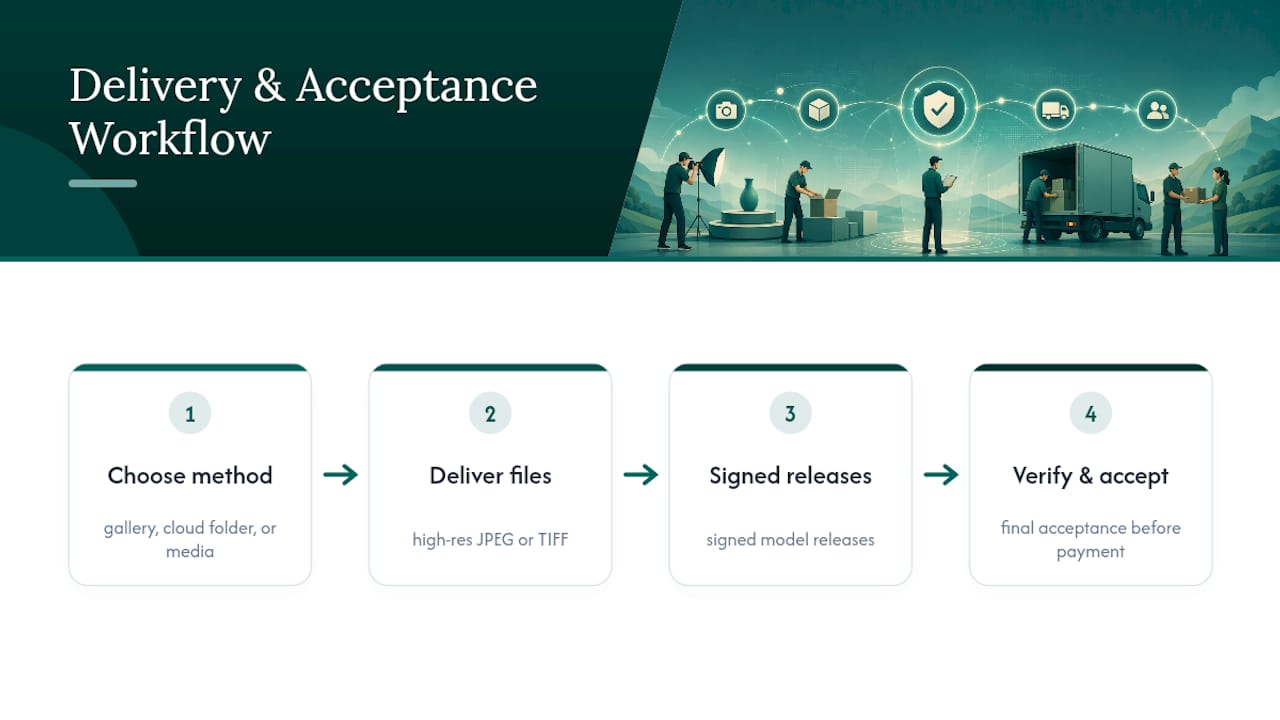
Studio2U’s own guidance on image delivery formats covers the resolution and metadata specifics procurement teams often leave out of a first-draft RFP, worth a read before you finalize this section.
Precision here is what separates three comparable bids from three wildly different quotes that force you to negotiate blind. Vague deliverable language is the single most common reason photography RFPs generate confused, incomparable proposals.
A vendor management plan matters more than most procurement teams assume. HUD’s procurement guidance treats the technical approach, including staffing and quality control, as a scored factor precisely because it predicts whether a vendor delivers on time without a crisis.
Pro Tip: Ask vendors to submit a one-page project timeline as part of their technical proposal, not just their final delivery date. A vendor who can’t map out shoot day logistics in advance usually can’t execute them either.
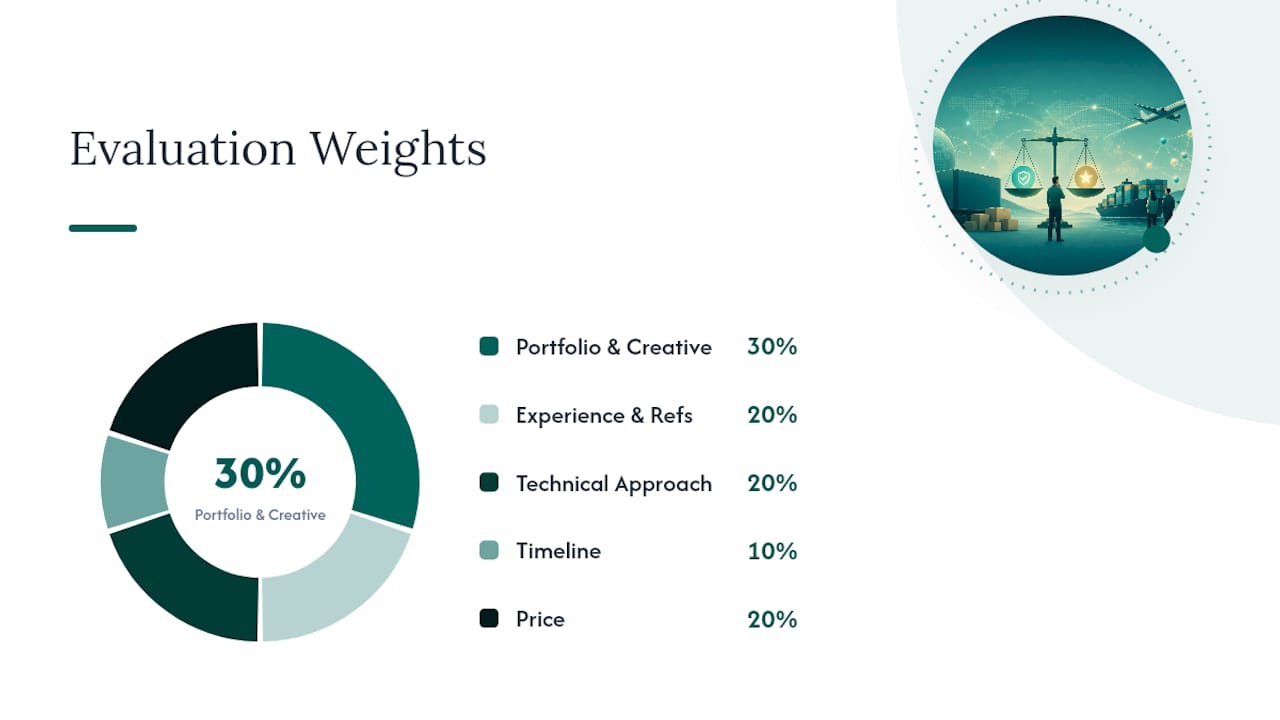
Publish your evaluation weights inside the RFP itself, before proposals arrive. This is the single highest-leverage move in the entire procurement process, and it’s the recommendation HUD’s own procurement chapter makes explicit: tailor your evaluation factors to the project and disclose them up front so award decisions hold up to scrutiny later.
A workable starting point, adapted from how public university RFPs structure photography and videography evaluations:
The University of Maine System’s RFP for photography and videography services uses a comparable split, weighting technical and creative quality separately from price rather than lumping everything into one composite score. That separation matters: a panel that scores “overall impression” produces inconsistent results across evaluators, while a panel scoring five distinct factors produces numbers you can defend if a losing vendor asks why they didn’t win.
Converting price to points works one of two accepted ways. The explicit-formula method awards full points to the lowest bidder and scales everyone else proportionally (lowest bid / your bid × max points). The trade-off method has evaluators score price qualitatively against technical merit, useful when the lowest bid comes with real quality risk. Public agencies tend to prefer the explicit formula because it’s harder to challenge after the fact.
For the evaluators themselves:
One granular example worth studying: Capturely’s school photography RFP template walks through more than 35 scoring criteria spread across categories like image quality, customer service, and pricing structure. You don’t need that level of granularity for most projects, but it’s a useful reference for how detailed a rubric can get when the stakes justify it.
Publish key dates as a table, not buried in prose paragraphs where vendors have to hunt for them.
A minimum five-business-day Q&A window, with answers posted to every bidder at once, is standard practice across the public RFP examples reviewed for this checklist, including Delaware’s packet. Skipping that step and answering vendors one-on-one creates an unfair information gap and invites a protest.
Attach your itemized pricing sheet requirement directly to this timeline section, since vendors need to know pricing structure requirements before they start drafting their technical approach, not after.
Keep this section tight, but don’t skip it. A photography RFP without release and licensing language creates ownership disputes months after the shoot wraps.
Most photography RFP problems trace back to one of a handful of repeat offenders. Watch for these before you hit send.
Before publishing, run through a short pre-flight check: confirm every attachment referenced in the SOW is actually included, confirm your scoring rubric weights add up to 100%, and confirm your timeline gives vendors realistic turnaround given your shoot dates. Studio2U’s corporate headshot guidelines double as a useful due-diligence list for reference checks and cancellation policy language if you want a second pass before release.
Pro Tip: Send a draft RFP to one trusted vendor contact for a sanity check before formal release. Ask them one question: “Could you price this accurately without calling me?” If the answer is no, something in your SOW is still too vague.
The RFPs that produce the smoothest shoots share one trait: they tell the vendor exactly what “done” looks like before the camera ever comes out. Vague turnaround language (“prompt delivery”) produces vague results. Specific language (“five business days from shoot date to final gallery delivery”) produces vendors who plan their post-production schedule around your deadline instead of guessing at it.
A precise SOW with exact counts, formats, and a clear delivery deadline lets a vendor build the shoot logistics, editing schedule, and staffing plan before the contract is even signed. Ambiguity in the RFP doesn’t get resolved by the vendor guessing correctly. It gets resolved through change orders and delayed delivery.
A vendor’s approach using portable studio systems and standardized post-production workflows across every shoot location can meet the kind of five-day turnaround language procurement teams now expect. When your RFP states delivery deadlines this precisely, use the vendor Q&A window to ask for clarification rather than assuming; a good vendor will tell you directly if a deadline is unrealistic for the deliverable count you’ve specified.
If you take one thing from this checklist, take three: define deliverables with exact counts and formats, require an itemized pricing sheet instead of a lump sum, and publish your scoring weights before proposals arrive. Every other recommendation in this guide supports one of those three moves.
The pitfall I see most often in procurement drafts isn’t a missing clause. It’s language borrowed from a general services RFP template and never adapted to photography’s actual variables: usage rights, retouch rounds, file specs. Fix that, and the rest of the process gets dramatically easier to run fairly.
— Kevin
Once your RFP is published and the scoring rubric is set, the harder question is which vendor can actually execute against it without missing your five-day delivery window. Some vendors utilize portable studio systems and standardized editing workflows designed for organizations juggling multiple offices, events, or portfolio companies, meaning the deliverable counts and turnaround language in your SOW can align with their operating methods.

For team headshot projects, the START UP package runs $2,500 per shoot. Larger branding projects with multiple locations or extended deliverable lists fall under STANDARD and ENTERPRISE packages, starting at $2,000 and $3,500 respectively, with a $1,000 branding add-on available. If your RFP covers conference or networking event coverage, the event packages range from $2,500 for networking events to $8,000 for full conference coverage. If you’re still drafting your SOW and want a vendor’s read on whether your deliverable counts and timeline are realistic, request a project plan walkthrough through our main site before you finalize the RFP.
A few primary sources are worth keeping open while you draft:
The typical sequence runs: define scope and deliverables, draft the RFP document with attachments, publish and hold a Q&A period, receive vendor proposals, score them against a published rubric, hold evaluator consensus meetings, and award the contract. Photography RFPs follow this same structure, with the scope and pricing sheet steps requiring more technical specificity than a general services RFP.
A photo RFP checklist is the set of required components a photography request for proposal needs to produce comparable, scoreable vendor bids: a scope of work with exact deliverable counts, an itemized pricing sheet, a weighted scoring rubric, submission instructions, insurance and licensing clauses, and a milestone timeline. Public-sector examples like Delaware’s school photography packet show all six pieces bundled into one attachment-driven document.
Beyond the RFP paperwork, your operational photoshoot checklist should cover exact shot counts and variants, resolution and file format specs, retouch round limits, model release collection, delivery method and deadline, and staffing or backup plans for the shoot day itself. Studio2U’s organizing employee headshots guide covers the scheduling logistics side of this in more detail.
The most frequent errors are vague deliverable counts, requesting a lump-sum price instead of an itemized pricing sheet, writing scoring criteria after proposals arrive instead of publishing them upfront, and setting unrealistic turnaround deadlines with no rush-fee provision. Each of these produces incomparable bids or disputes after award, which is exactly what a structured checklist and published rubric are designed to prevent.
