Corporate Multi-Day Photo Shoots: Plan, Staff, Secure Rights
%20(1)%201.png)
.png)
.png)
September 24, 2026
%20(1).jpg)

A multi-day photo shoot is on-site corporate photography and video production scheduled across two or more consecutive days at a conference, multi-office rollout, or corporate event. Book one when you need a reusable content engine, not a single recap album: hero images, speaker profiles, sponsor deliverables, and social clips generated fast enough to fuel marketing while the event is still being talked about. If your event has parallel tracks, sponsor obligations, or multiple locations, multi-day coverage almost always beats a single-day shoot.
TL;DR:
- Multi-day shoots are essential when events involve parallel tracks, multiple locations, or sponsor obligations that require comprehensive coverage across several days.
- Proper planning includes detailed shot lists, scheduling portrait slots in advance, and ensuring consistent lighting if executive portraits span multiple locations.
- Clear contract terms should specify usage rights, license scope, and deliverable timelines, with ownership only transferred through written agreements signed before production.
- Fast turnaround including same-day previews and full galleries within two weeks helps maximize event ROI by enabling immediate marketing deployment.
- To prevent fatigue-related quality drops, incorporate crew rest periods, role rotation, and explicit schedule communication into the multi-day production plan.
The old model treated event photography as documentation: hire a photographer, get a gallery, move on. That’s outdated. A 2026 client survey from BCD Meetings & Events found that 36% of stakeholders now name demonstrating ROI as their top driver for event content, which pushes photography and video planning into the same strategic conversation as the event budget itself.
That shift shows up in how smart teams structure their asset list before day one:
Industry analysis of AV and production trends points to the same conclusion: organizers are buying experience design now, and visual storytelling is the deliverable that proves the experience happened.
Not every event needs three photographers and two days of coverage. Use these signals to size the job correctly:
Your communications calendar matters as much as the event itself. If marketing needs six weeks of LinkedIn content and a press kit, multi-day production earns its cost. If you just need a wrap-up post, it usually doesn’t.
Planning happens weeks before the first camera turns on, and the biggest failures trace back to a shot list nobody wrote down.
Build a shot list with priority tags: must-have (keynote stage, sponsor logos, executive portraits), should-have (breakout sessions, networking candids), and nice-to-have (venue details, ambient shots). Assign target counts to each category so the crew knows what “done” looks like for the day.
Share a run of show with the production team, not just the event staff. Production needs arrival windows, VIP timing, and any reserved portrait slots baked into the schedule, the same way you’d brief a creative shoot brief for a branded campaign.
Staffing scales with complexity:
Consent needs a plan too. Ticket language, entrance signage, or a dedicated opt-out desk are all accepted approaches for handling attendee publicity rights, and you should decide which one you’re using before registration opens, not during the event.
Pro Tip: Reserve 10 minute portrait slots for your top 15 executives and speakers in advance. Walk-up portrait lines during breaks almost always produce your worst images because people are rushed and distracted.
Crew structure and file discipline decide whether your gallery is usable on day six or a mess you’re still sorting through in three weeks.
Role separation matters most on multi-track events: one shooter on the main stage, one roaming breakouts, one dedicated to portraits or a portable studio setup. Parallel coverage is the only way to avoid gaps when three sessions run at once.
Schedule ingest and backup windows explicitly, right after the flagship blocks end each day. Waiting until the end of a three-day event to back up everything is how organizers lose a full day of coverage to a corrupted card or a full drive.
A standardized folder structure keeps thousands of images from becoming unusable. A common structure looks like this:
01_Keynotes/02_Breakouts/03_Portraits/04_Sponsors/05_Candids/This naming convention, paired with scheduled backup windows, is a documented best practice for keeping multi-day event assets searchable instead of dumped into one folder nobody wants to open later.
Portable studio setups matter for consistency. If executive portraits happen on day one and day three, or across two office locations, the lighting and backdrop need to match exactly, or your leadership page ends up looking like two different companies.
Paying for a shoot does not automatically give you ownership of the images. The U.S. Copyright Office is explicit: the photographer is the default copyright owner, and moving that ownership to you requires either a written assignment or a work-made-for-hire agreement.
Work-made-for-hire has specific legal requirements, too. Per Circular 30, it only applies to certain statutory categories and always requires an express written agreement signed before the work happens, not after delivery. Without that paperwork, you may have paid for a license, not ownership, and the difference determines whether you can reuse images in next year’s campaign without going back to negotiate.
Watch for these contract issues before signing:
Delivery cadence should be part of the negotiation, not a surprise after the event ends. Standard practice in event photography delivery guidelines calls for same-day or next-day web-quality previews, typically 30 to 50 images, followed by a full edited gallery within 5 to 14 days. Press-ready files for PR use often follow on a slightly longer timeline, closer to two weeks out.
Pricing models vary, but per-day rates with travel and lodging billed separately is the most common structure across event photography. Cost drivers to expect:
If you’re managing sponsor obligations, define deliverables in writing before the event: exact photo counts, usage terms, and how you’ll report back (a shared gallery link, a curated sponsor folder, or both). Vague promises to sponsors about “photos from the event” create disputes later.
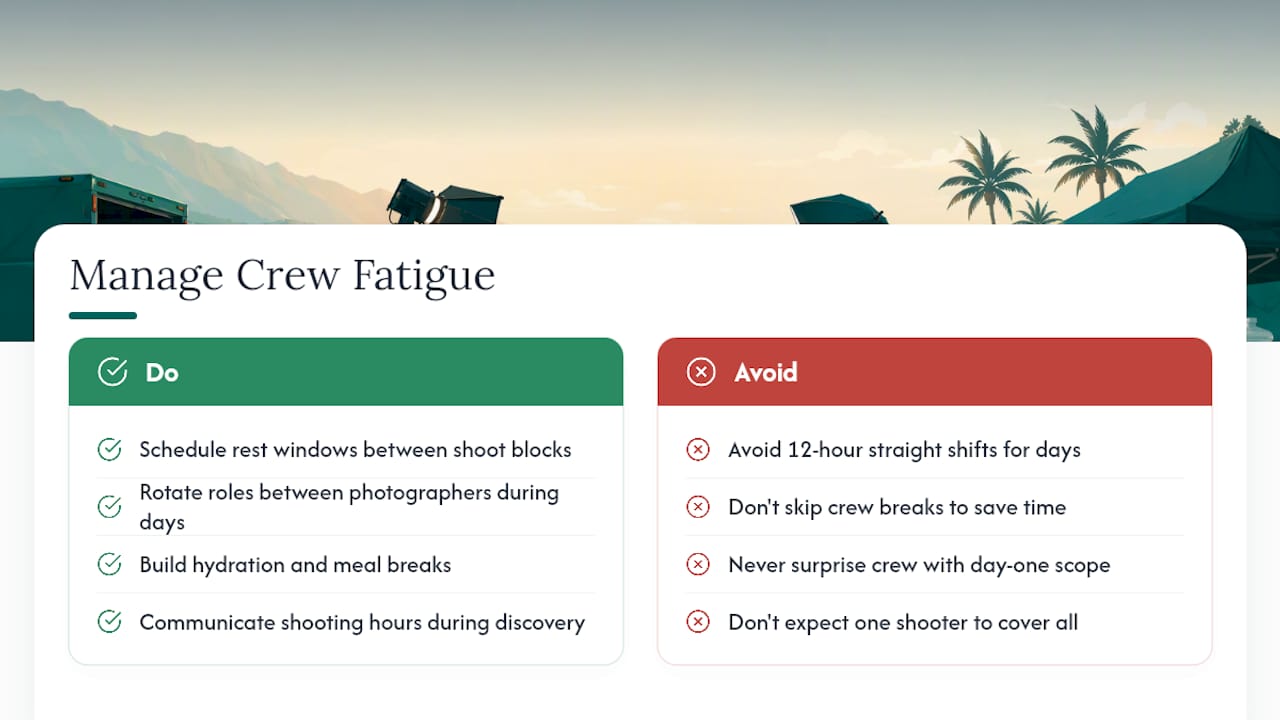
Multi-day production is physically demanding work, and fatigue shows up in the images before anyone says a word about it. A tired shooter on day three misses moments, shoots looser compositions, and edits slower.
Build rest windows into the schedule the same way you schedule ingest and backup time. A crew that shoots twelve hours straight for three consecutive days without a real break produces measurably weaker work by the final day, even with experienced photographers. Scheduling explicit downtime between major blocks isn’t a nice-to-have; it’s an operational safeguard for the assets you’re paying for.
Rotate roles across multi-person crews when possible. The photographer who covered the main stage all morning shouldn’t also handle the evening portrait session if a second shooter is available. Swapping assignments partway through a long day keeps attention sharp for the shots that matter most, like executive portraits or sponsor photos.
Hydration, meal breaks, and realistic call times sound obvious, but they’re the first things event schedules cut when the run of show gets tight. Build buffer time into the schedule for the crew, not just for talent and speakers. A 15 minute gap between the last breakout session and the evening reception gives your team a chance to back up cards, swap batteries, and reset before the next block starts.
Communicate expected shooting hours to your production partner during the discovery call, not on day one. Crews that know the full scope in advance can staff appropriately, whether that means bringing a second shooter for a heavier day or scheduling an earlier wrap time to preserve quality for the following morning.
Multi-day shoots involve more moving people than a standard shoot: speakers, executives, sponsors, and internal stakeholders all expect something slightly different from the final gallery. Managing those expectations starts before day one, not during it.
Send a short brief to speakers and executives ahead of time explaining what to expect: approximate portrait session length, what to wear (solid colors photograph better than busy patterns), and when their session will happen. People show up more relaxed when they know the process instead of walking into a portrait station cold.
Set a single point of contact on the client side for real-time decisions. Multi-day events generate small questions constantly (can we add an unscheduled group photo, can a sponsor get five extra minutes with the CEO) and a single decision maker keeps the crew from losing time chasing approvals across multiple people.
Share progress during the event, not just after. A quick preview gallery at the end of day one gives stakeholders confidence the coverage is on track and gives you a chance to flag any priority shots that got missed before day two starts.
Be direct about scope changes. If a sponsor adds a request mid-event that wasn’t in the original shot list, address it in real time rather than letting it pile up as a post-event dispute over what was promised.
Four to six weeks out: Discovery call to align on objectives, shot list, run of show, and staffing. Contracts and usage rights get finalized here, not on-site.
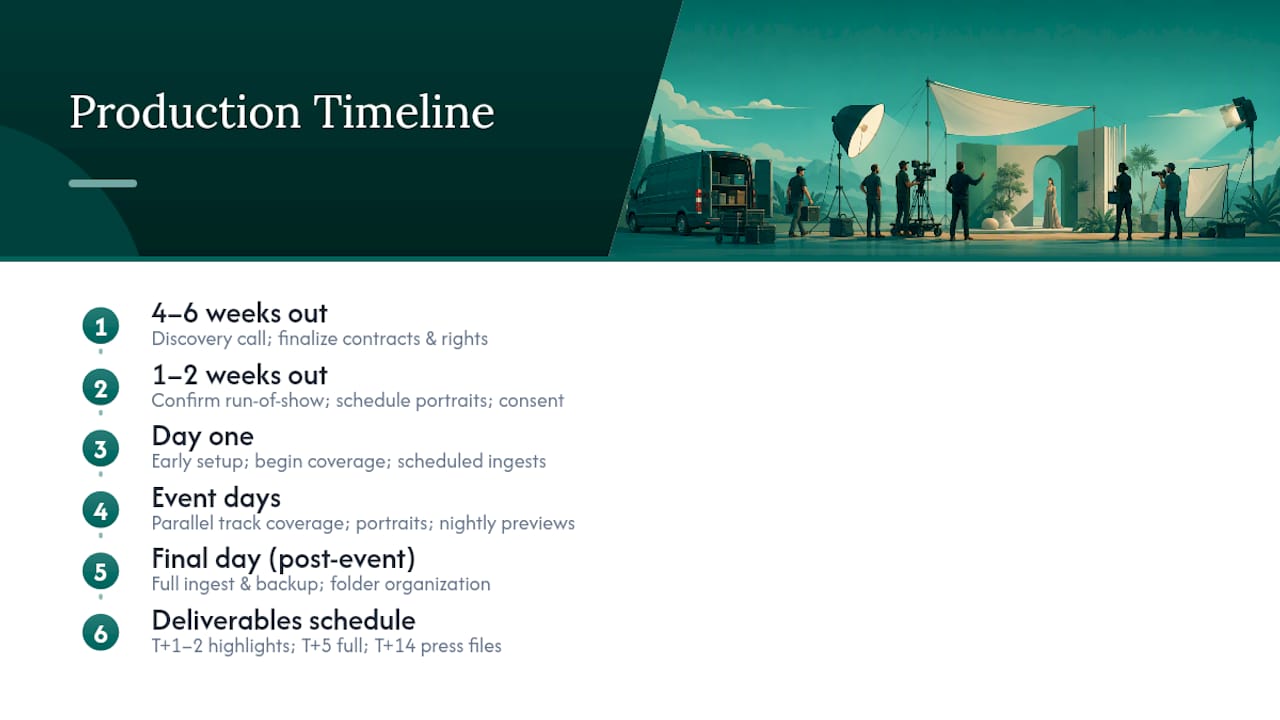
One to two weeks out: Final run-of-show confirmation, portrait slot scheduling for VIPs and speakers, and consent mechanism (signage, ticket language, opt-out desk) locked in.
Day one: Crew arrives early for setup, including portable studio configuration if portraits are on the schedule. Coverage begins with arrival and opening keynote, with scheduled ingest breaks after major blocks.
Days two through however many the event runs: Parallel coverage continues across tracks, portraits fill scheduled slots, and same-day preview galleries go out each evening so stakeholders see progress in real time.
Final day, post-event: Full ingest and backup of all remaining files, organized into the agreed folder structure.
T+1 to T+2 days: Web-quality highlight gallery delivered, typically 30 to 50 images, per standard event photography practice.
T+5 days: Full edited gallery delivered.
T+14 days: Press-ready files and any sponsor-specific deliverables finalized.
Every Studio2U project starts with a discovery call, not a camera. We ask what the content needs to accomplish, for marketing, recruiting, sales, or fundraising, before we build a shot list, because a gallery built around a real objective performs differently than one built around “get some pictures of the event.”
Portable studio setups travel with our crews so executive portraits look identical whether they’re shot on day one in the main hall or day three at a second office location. Standardized workflows across ingest, backup, and folder naming keep multi-day projects organized instead of turning into a scramble on the last day.
Fast delivery is part of how we scope every project. Same-day highlight previews and rapid full-gallery turnaround mean your marketing team can publish while the event is still generating conversation, not three weeks after everyone’s moved on.
Studio2U’s conference and summit packages cover exactly this scenario: NETWORKING fits a single-evening event with lighter sponsor obligations, SUMMIT is built for a mid-size multi-day gathering, and CONFERENCE scales up for larger events with parallel tracks and heavier sponsor deliverables. If your project is a multi-office branding rollout instead of an event, the STANDARD and ENTERPRISE branding packages are built for exactly that, with a BRANDING ADD-ON available when you just need an extra portrait block layered onto a shoot already scheduled.
Compared to piecing together a photographer for stills and a separate videographer for clips, one production partner running both means one crew, one schedule, and one gallery instead of two vendors handing you mismatched files on different timelines.
On the discovery call, come ready with your event dates, expected attendee count, the moments that matter most (keynotes, panels, sponsor activations), and any sponsor deliverables already written into contracts. That’s what lets us build a shot list and staffing plan before your crew ever arrives on-site.
Minimal disruption and fast turnaround are built into how we schedule every project, so your team gets usable assets while the event is still fresh. Get in touch through studio2U to start the discovery conversation for your next multi-day production.
It’s scheduled photo and video production spanning two or more consecutive days at a conference, multi-office rollout, or corporate event. The goal is a full library of reusable marketing assets, not a single recap gallery.
Costs vary by crew size, coverage days, and editing turnaround, with per-day rates plus travel billed separately being the most common industry model. Studio2U’s conference packages start at 2500 USD for NETWORKING coverage and go up to 8000 USD for full CONFERENCE production, while branding packages for multi-office projects start from 2000 USD.
The photographer owns the copyright by default under U.S. law. Ownership transfers to you only through a written assignment or a work-made-for-hire agreement signed before production begins.
Standard practice is same-day or next-day highlight previews, followed by a full edited gallery within 5 to 14 days. Press-ready files typically follow within two weeks of the event’s final day.
That depends on whether you have parallel sessions, multiple locations, or sponsor deliverables running simultaneously. A single shooter works for a one-track event, while multi-track conferences and multi-office rollouts usually need a crew large enough to cover everything happening at once.
