Corporate Multi-Day Photo Shoots: Plan, Staff, Secure Rights
%20(1)%201.png)
.png)
.png)
September 21, 2026
%20(1).jpg)

For reliably usable interviews at a trade show, book a turnkey pop-up interview studio. It guarantees clean audio, fast delivery, and a simple guest experience without you learning audio engineering on the fly. Self-managing only makes sense if you already have AV staff on payroll and enough lead time to test the room. Before deciding, confirm two things immediately: whether your crew has actually run live event audio before, and whether your timeline allows a full week for edited deliverables.
TL;DR:
- Using a turnkey pop-up interview studio ensures professional audio quality and fast, organized content delivery, especially if you lack AV staff or short timelines.
- A small, treated space with proper microphone placement and acoustic treatment significantly improves sound quality over open, echo-prone areas.
- Staffing should include a host, audio engineer, camera operator, and producer, with a consistent run order to maximize efficiency during lengthy event days.
- Pre-approving branding, guest consent, and footage use, along with secure data handling, prevents legal issues and streamlines on-site operations.
- Partnering with a professional provider like studio2U guarantees quick post-production turnaround, reliable deliverables, and scalable packages for multi-day or high-volume events.
An event interview booth turns a static trade show presence into an actual content operation. Recording short interviews with speakers, sponsors, and attendees on-site creates footage you can use for months, not just a recap reel that dies after the event newsletter goes out. Turning a booth into a pop-up podcast studio also draws foot traffic on its own. People are curious about microphones and cameras in a way they are not curious about another banner stand.
The best use cases are specific: thought leadership clips from keynote speakers, partner or sponsor spotlight interviews you can hand back to them as a co-marketing asset, and attendee reaction bites that prove your event mattered. A managed provider typically delivers organized, captioned, ready-to-post clips within days. A DIY setup can match that quality, but only if someone owns the edit calendar after the last flight home.
Whether you rent a full package or piece one together, the same gear list applies. Audio matters more than video here. A dynamic microphone (like a Shure SM7B) rejects more room noise than a condenser mic, which makes it the better choice for a loud show floor. Pair it with closed-back headphones for live monitoring, a small mixer or audio interface, and a multitrack recorder that captures each mic on its own channel, so a bad guest answer doesn’t ruin the host’s audio too.
On the video side, plan for a main camera on the subject, an iso camera on the host for edit flexibility, and at least one soft key light. A simple boom or C-stand mount keeps cables off the floor.
Checklist for evaluating a vendor package or building your own kit:
Pro Tip: Trade show booths built with modest kit, meaning a couple of mics, a mixer, and one solid camera, can still turn around edited episodes within weeks if someone owns the post-production calendar from day one, according to Phoenix FM’s breakdown of trade show podcast setups.
A small, semi-enclosed space almost always outperforms a bigger, open one. Convention hall echo ruins more interviews than bad microphones do. A treated room the size of a large closet beats a wide-open corner booth every time, because sound reflects less off close walls with soft surfaces than it does across an open expanse of concrete and vendor traffic.
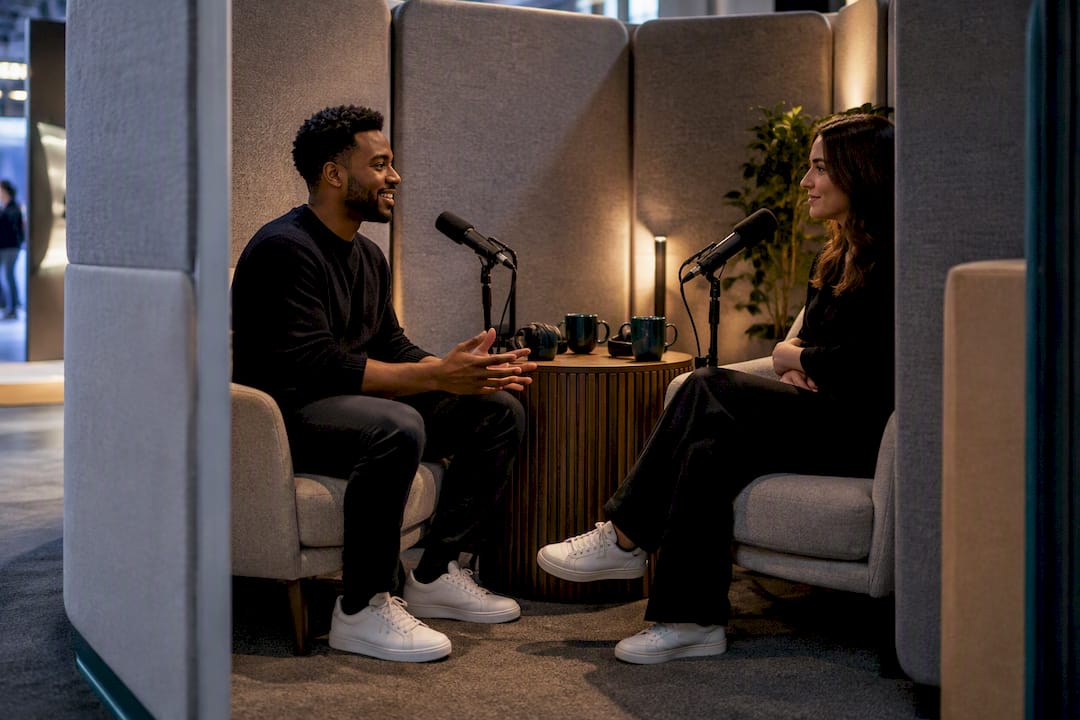
Test your camera framing and the path your host and guest will actually walk before locking in a location. Bring portable acoustic panels or even moving blankets to kill hard reflections, and always capture 20 to 30 seconds of silent room tone at the start of each session. Editors use that clip to smooth over cuts and cover awkward pauses later.
Eyeline decisions matter more than most organizers expect. Decide up front whether guests will speak to the camera directly or address an off-camera interviewer, since mixing the two within one event looks inconsistent when clips run side by side. A practical interview setup prioritizes eyeline, background distance, and mic placement over gear specs. If you are running back-to-back interviews, alternate which side the interviewer sits on between guests. That single choice gives your editor room to intercut multiple conversations without jump cuts looking sloppy.
A functioning booth needs four roles at minimum, even if one person doubles up on a tight budget: a host who keeps guests relaxed and on message, an audio engineer watching levels in real time, a camera operator managing framing between guests, and a producer or concierge who moves the next guest into place while the current one wraps up.
The run order rarely changes, and that consistency is what keeps a small crew sane during a long show day:
Keep spare mics, cables, and a portable battery pack within arm’s reach. A basic hand signal system between host and audio engineer (a raised finger for “wrap it up,” a flat palm for “we have a problem”) solves most live issues faster than a whispered aside ever will.
Guests need to feel comfortable fast, since most have never sat for an on-camera interview before. Keep the backdrop clean and on-brand, but leave enough depth between the guest and the panel so lighting doesn’t flatten their face. A short pre-interview conversation about what the footage will be used for dramatically improves on-air quality and cuts down on awkward, over-rehearsed answers.
Consent should never be an afterthought scribbled on a clipboard. A single-page release form paired with a brief verbal script explaining usage speeds up throughput and avoids legal headaches after the event. Guests appreciate knowing where their face is going to end up.
Spell out deliverables before day one: file formats, edit lengths (a 90-second social clip versus a 6-minute long-form piece), caption files, and transcriptions. Vague turnaround promises like “soon” create more frustration than any technical hiccup on-site.
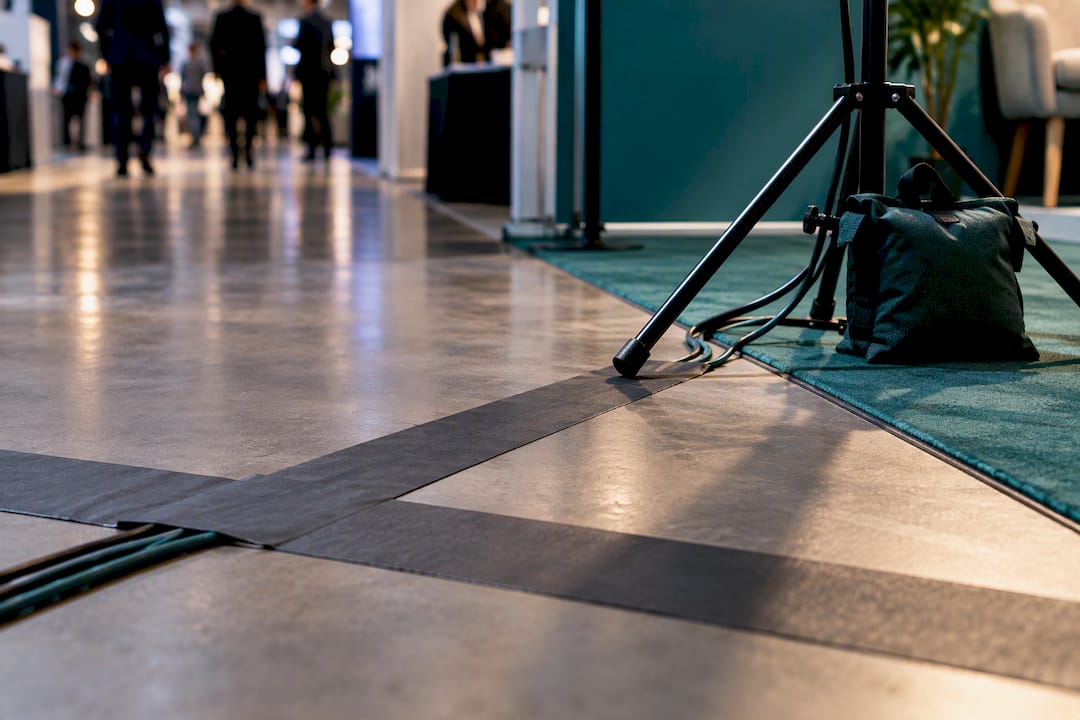
Cable management is the most overlooked safety issue at any booth. Tape down every run that crosses a walking path, and route power cords behind the backdrop rather than across the floor where a badge lanyard can catch on them. Lighting stands need sandbags or weighted bases, especially near high-traffic aisles where someone is likely to bump a leg while checking their phone.
Privacy runs deeper than the signed release form. Guests should know exactly where footage is headed, whether that’s a sponsor’s social channel, your event recap, or a paid ad campaign, before they sit down. If a guest requests footage be pulled after recording, have a clear internal process for flagging and removing that file before it reaches an editor. Waiting until post-production to sort out a pulled release wastes editing hours and risks a mistake making it to publish.
Data handling matters too. If you are collecting names, titles, or company details alongside video, store that information somewhere access-controlled rather than on a shared clipboard or open spreadsheet visible to booth traffic. For interviews touching sensitive business topics (unreleased product details, financial figures, personnel changes) confirm with the guest’s company beforehand whether legal needs to review the clip before it goes live. Skipping that step is how one enthusiastic executive interview turns into a compliance problem three days after the event ends.
Recording the interview is only half the job. The clip needs a path to an audience, and that path should be decided before the event starts, not during a scramble on day three. If you’re streaming any part of the booth live, confirm your platform, whether that’s a dedicated event app, LinkedIn Live, or YouTube, supports the multitrack setup your audio engineer is running, since some platforms compress or flatten separate mic channels into one feed.
For post-event distribution, a quick-sharing kiosk using QR codes or AirDrop at the booth increases immediate social sharing because guests post their own clip before they’ve even left the floor. That kind of organic reach beats anything your own event account posts a week later. Pair that with QR code tracking so you can see which interviews actually drove follow-up engagement, not just which ones got recorded.
Longer-form interviews typically move to a podcast feed or YouTube channel after light editing, while shorter clips get cut for Instagram, LinkedIn, or TikTok within days. Whoever owns your booth needs export specs for each destination confirmed in advance, vertical crops for social, horizontal for YouTube, captions burned in for platforms where sound defaults to off. Sorting that out after the event means re-editing everything twice.
Most organizers underestimate how much of the value in an event interview booth comes from what happens after the last guest leaves the chair, not during the recording itself. studio2U built its model around portable studios and production teams that travel directly to the event floor, because the editing turnaround is where DIY setups usually fall apart. A conference video package typically includes a full crew, organized on-site workflow, and edited deliverables back in your hands within about five business days, while the event is still fresh in attendees’ inboxes.
The gap between a decent recording and a genuinely useful one is almost always post-production discipline, not gear. That’s the piece worth paying for if your internal team doesn’t have the bandwidth to own it after the show ends.
— Kevin
If you’ve read this far, you know a good event interview booth lives or dies on crew experience and edit turnaround, not just the mic list. studio2U built its conference offerings around exactly that gap: a portable studio and production team that shows up ready to run, so you’re not training AV staff between sessions.
For a single-day activation with a handful of guest interviews, the START UP package covers a compact crew and fast turnaround at a flat rate. Larger conferences with sponsor interviews, panel coverage, and higher guest volume fit better under the CONFERENCE tier, which scales the crew and deliverables to match a multi-day floor schedule. Before booking any vendor, ask directly about crew headcount on-site, exact file specs for your delivery platforms, what their backup plan looks like if a mic or drive fails mid-day, and the actual turnaround date in writing, not just “a few days.”
If your event needs reliable, publishable interview content without building an AV team from scratch, request a quote through studio2U’s conference services page and get a discovery call on the calendar before your event date fills up your production partner’s schedule.
Most people call it a trade show booth or exhibit booth, but when it’s set up specifically for recording conversations, it’s called an interview booth or pop-up podcast studio. The distinction matters because an interview booth needs sound treatment and mic setup that a standard product display booth never has to consider.
An event interview is a short, recorded conversation, usually six to ten minutes, captured live at a conference or trade show with a speaker, sponsor, or attendee. It’s typically used afterward as social clips, podcast episodes, or sponsor marketing content rather than played live to the crowd.
Start with the space, not the gear: pick a small, semi-enclosed area away from loudspeakers and test your camera framing before committing to the spot. From there, layer in your mic setup, backdrop, and a run order for guests, and always capture room tone before the first interview begins.
Costs vary widely by scope, crew size, and deliverables, so there’s no single flat number that applies across events. studio2U’s event packages range from the START UP tier for a single-day activation up to the CONFERENCE tier for multi-day coverage with a larger crew, with exact pricing available through a discovery call.
