HR Checklist to Organize Employee Headshots with Badge Photo Matching
%20(1)%201.png)
.png)
.png)
September 2, 2026
%20(1).jpg)

The right headshot makeup policy sets camera-first grooming standards, keeps rules gender-neutral and inclusive of natural hairstyles, and handles medical or religious accommodations privately. Offer optional professional styling for leadership and a modest stipend or reimbursement route for everyone else, or state plainly why you’re not. Then move fast: adopt a written template and pilot it with one department before rolling it out company-wide.
TL;DR:
- A headshot makeup policy should specify camera-ready appearance standards that favor matte finishes, defined brows and lips, and simple jewelry to ensure consistent camera reading.
- Policies must explicitly prohibit restrictions on natural or protective hairstyles to comply with laws like the CROWN Act and maintain gender-neutral language.
- Offering professional styling for high-visibility roles and providing guidelines for DIY headshot prep help ensure high-quality images across channels.
- Scheduling headshot sessions in 7 to 10-minute slots, with clear communication and on-site staging, ensures efficient execution and a smooth experience.
- Standard retouching should uniformly remove shine, stray hairs, lint, and small blemishes without altering permanent features, with legal review recommended before company-wide implementation.
A working policy is a short document, not a style manifesto. It exists to make photos usable across every channel, from LinkedIn to your careers page to the annual report, without opening the door to bias complaints.
Start by naming where the images will live: website, sales decks, badges, press kits. That scope decision drives everything else, including resolution and crop requirements. From there, the policy needs five components:
Pro Tip: Put the retouching line in writing before headshot day, not after someone asks why their colleague’s photo looks smoother than theirs. A one-sentence rule prevents a week of Slack messages.
Grooming rules that ban natural or protective hairstyles, braids, locs, twists, aren’t just outdated. In 19 states and a growing number of localities, they’re illegal under CROWN Act legislation, and even where the law doesn’t explicitly say so, the discrimination exposure is real. Build the policy around these principles:
Handled privately means exactly that: HR fields the request, not the photographer, not the department manager, and never in front of a group.
The goal isn’t uniformity of appearance. It’s consistency of how faces read under camera lighting, which behaves nothing like office fluorescents or a bathroom mirror.
For most employees, camera-ready means:
Not every employee needs a makeup artist to hit these marks. Someone doing a quick internal directory photo can follow a written checklist and be fine. Someone shooting an executive portrait that will run on the investor deck, the homepage, and a press release for the next three years benefits from a pro, because that image gets reused far more than a standard team headshot. Studio2U’s lighting setup notes explain why studio light rewards matte finishes over dewy ones.
Studio lighting washes out subtlety.*
This is the question that trips up most HR teams, mostly because they try to apply one rule to every employee. Tie the decision instead to how visible the role is and how far the photo will travel.
Whichever model you pick, apply retouching evenly and publish the rule so nobody suspects favoritism.
Logistics make or break the policy on the actual day. Most friction comes from bad scheduling, not bad photography.
A pre-shoot office layout checklist can help you map where the staging area, camera setup, and waiting line should sit relative to foot traffic. Studio2U’s notes on running company-wide sessions cover how to batch this across multiple floors or offices without the day sliding into overtime.
Use this as a starting draft, not a finished legal document.
Purpose and scope: This policy governs appearance and grooming standards for employees participating in company headshot sessions used on the website, LinkedIn, internal directories, and marketing materials.
Camera-ready checklist for employees:
Accommodations: Contact HR directly and privately for any religious, medical, or personal accommodation. No explanation is required.
Payment and reimbursement: [Choose Model A, B, or C above and state it in one sentence.]
File ownership and retouching: The company retains usage rights to final images. Standard retouching removes shine, stray hairs, and minor blemishes only; the policy will be reviewed annually by marketing.
Pro Tip: Attach this template to your HR onboarding packet, not just the headshot day email. New hires shouldn’t learn the accommodation process for the first time three days before a shoot.
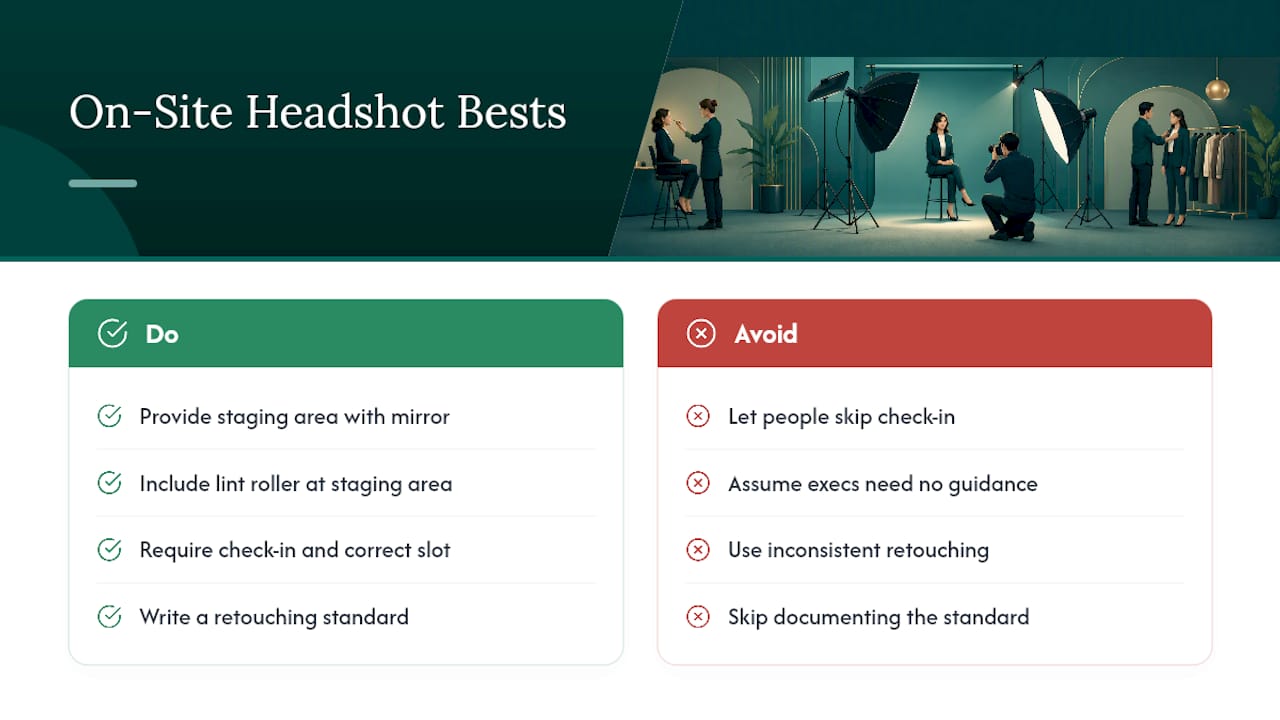
Most friction on headshot day isn’t about makeup at all. It’s someone showing up in the wrong slot, or an executive assuming they don’t need to check in. A staging area with a mirror and a lint roller solves half of it before anyone touches a camera.
The bigger lesson is retouching consistency. The moment one person’s photo looks noticeably smoother than a colleague’s, trust in the whole program erodes, fast. Write the standard down, apply it identically, and most of your inclusion concerns solve themselves.
— Kevin
Writing the policy is one job. Running seven to ten minute slots for 200 people across three floors without falling behind schedule is another. Studio2U brings a portable studio directly to your office, applies one retouching standard across every employee so no one looks noticeably more polished than the next person, and turns around finished files fast enough to hit a launch date.
Internal teams can absolutely run a small session with a written checklist and a staffer holding a lint roller. Where it gets harder is scale, multiple offices, executive portraits that need a pro stylist on-site, or a same-week turnaround for a press announcement. That’s the gap Studio2U exists to close, with standardized file specs, scalable scheduling, and a five-day delivery window built into every project. If you’re planning a company-wide session or an executive refresh, book a consult through the Studio2U landing page and get a pilot date on the calendar before your policy sits in a drafts folder for another quarter.
Yes. Under CROWN Act legislation active in 19 states and multiple localities, banning natural or protective hairstyles in a grooming policy creates real discrimination exposure.
It depends on reuse value. Cover it for leadership and high-visibility roles whose images run across investor and PR channels, and offer a stipend or DIY guidance for standard team headshots.
Plan for 7 to 10 minutes per person with a short buffer between slots, batched by department to keep the line moving.
Standard retouching removes shine, stray hairs, lint, and minor blemishes, applied identically to every employee regardless of role or seniority.
Yes. Have counsel review the draft for gender-neutral language and accommodation process wording before it goes company-wide, especially if you operate in multiple states.
A single-department pilot exposes scheduling and wardrobe issues you can fix before the full session, which is far cheaper than correcting them mid-shoot for a large group of employees.
