Keep Glasses in Headshots: Studio Tested 5° Tilt and Off Axis Lighting
%20(1)%201.png)
.png)
.png)
September 14, 2026
%20(1).jpg)

Awareness-stage clips should run under 30 to 60 seconds, consideration content works best at 60 to 180 seconds, and decision-stage videos can stretch past 10 minutes when the payoff is obvious. There’s no single right answer to b2b video length, but there is a clear pattern: shorter wins early in the funnel, and depth wins once a buyer is already leaning in. The one rule that holds at every duration is simple. Front-load the value in the first 15 to 30 seconds, or none of the rest matters.
TL;DR:
- Short awareness videos under 60 seconds are most effective for capturing attention and maximizing completion rates on social feeds like LinkedIn.
- Consideration-stage videos should last between 60 to 180 seconds to balance clarity and engagement, depending on the depth of information needed.
- Decision-stage content can extend beyond 10 minutes if the value is clear, especially for detailed demos, case studies, and testimonials that aim to drive conversions.
- Platform behavior dictates ideal length: LinkedIn favors native short videos of 30 seconds to 3 minutes, while YouTube viewers engage longer educational content, and hosted players suit detailed gated assets.
- Building a strong value hook within the first 10 seconds is critical, regardless of length, as perceived value strongly influences viewer retention and engagement.
The best B2B video duration guidelines start with a question most marketers skip: what job is this video doing? A LinkedIn teaser meant to stop a scroll has nothing in common with a gated product demo meant to close a deal, and treating them the same is why so many B2B video programs underperform.
Awareness-stage videos exist to interrupt a feed, not educate. Think brand teasers, founder soundbites, or a 20-second clip pulled from a longer interview. These perform best under 30 to 60 seconds, and SendSpark’s funnel breakdown confirms that awareness content should stay short precisely because the goal is attention, not comprehension.
Consideration-stage content gets a little more room, typically 60 to 180 seconds. This is where explainer videos, quick product walkthroughs, and “how it works” clips live. The viewer already knows they have a problem; they’re evaluating whether your solution fits.
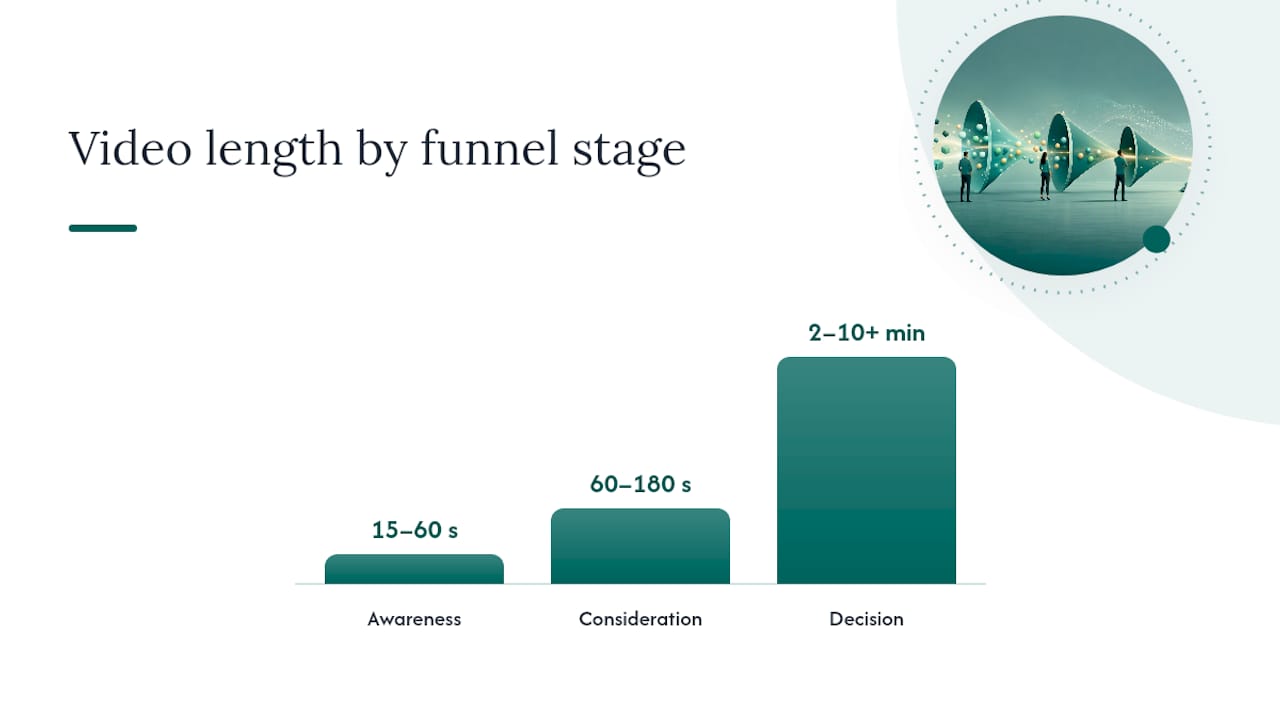
Decision-stage videos can run 2 to 10 minutes or longer, especially behind a form. Case studies, full demos, and customer testimonials fall here, because a buyer who’s ready to sign wants proof, not a teaser. Vidyard’s research on video length shows that how-to and demo content can sustain watch-through above 50 percent when the value is unmistakable, even at longer runtimes.
The tradeoff across all three stages is the same: shorter videos post better completion rates, longer videos generate deeper engagement and often better-qualified leads. Neither is “better.” They just answer different questions.
| Funnel stage | Content type | Best platform | Suggested length |
|---|---|---|---|
| Awareness | Brand teaser, culture clip, quick tip | LinkedIn, social feed | 15–60 seconds |
| Consideration | Explainer, short demo, FAQ video | LinkedIn, website | 60–180 seconds |
| Decision | Full demo, case study video, testimonial | YouTube, hosted player, email | 2–10+ minutes |
Yes, and the gap is bigger than most marketers assume. Platform behavior, not personal preference, should dictate your B2B content video duration.
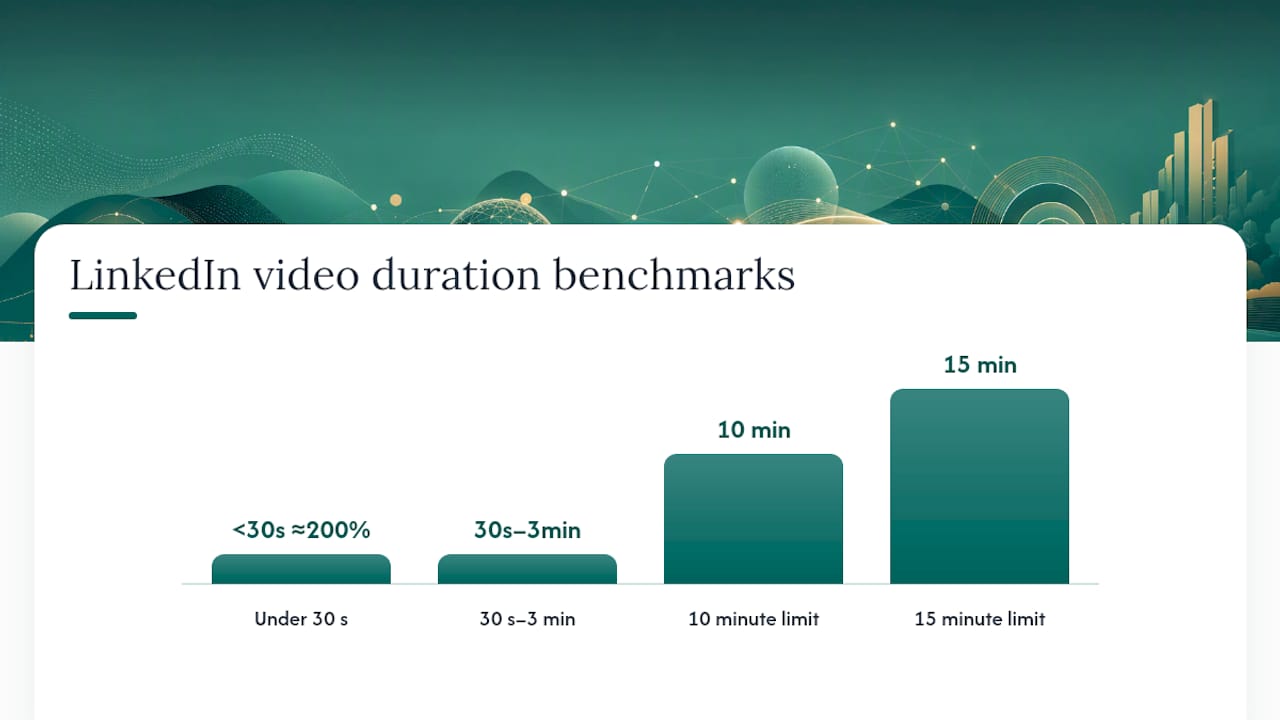
LinkedIn rewards brevity. Videos under 30 seconds see completion rates roughly 200 percent higher than longer formats, according to Whitehat’s video marketing benchmarks. The practical sweet spot for organic LinkedIn posts sits around 30 seconds to 3 minutes, even though the platform technically allows longer uploads. LinkedIn’s own upload specs permit up to 10 minutes on mobile and company pages, with some interfaces allowing 15 minutes on desktop, but posting to the limit rarely pays off. Native uploads also outperform links to externally hosted video, often by a wide margin, because LinkedIn’s algorithm favors content that keeps viewers on the platform.
YouTube functions differently. Viewers often seek answers and are generally willing to engage with several minutes of well-structured educational content, particularly when chapters help them navigate.
Hosted players like Vidyard or Wistia sit in a third lane entirely. These fit best for gated demos and detailed case studies where you want granular viewer analytics: who watched, how far, and when they dropped off.
Pro Tip: Shoot one long-form interview or demo, then treat it as raw material. A single 10 minute founder story can yield four or five LinkedIn clips, each built around a different hook.
Length only matters if people actually watch. Structure is what keeps them there, regardless of how long the video runs.
What “value” looks like changes by stage. In awareness content, value might be a single surprising insight. In decision-stage content, value looks like specific numbers: conversion lift, hours saved, revenue recovered.
Pro Tip: If your first 10 seconds could be cut and the video lost nothing, cut them. Most B2B videos bury the point instead of leading with it.
Three metrics matter more than runtime alone: view rate, completion rate, and conversion lift. Watching all three together tells you whether a video is actually working or just getting views.
Average B2B video length has compressed sharply, dropping from roughly 168 seconds in 2024 to around 76 seconds in 2026 across benchmark aggregates. That shift reflects shortening attention spans on social feeds, not a universal mandate to cut everything short.
Vidyard’s own analytics tools let marketers run this kind of test directly, and improving just the hook has been shown to lift completion dramatically without touching the rest of the video. Run A/B tests on hook and length quarterly, not once. Viewer behavior on any given platform shifts fast enough that a benchmark from last year can already be stale.
Before a single frame gets shot, answer these five questions.
Answering these five questions before production starts saves far more editing time than trying to fix a mismatched video after the fact.
Duration decisions get made on set, not just in a script meeting. When studio2U scopes a shoot, the funnel outcome drives everything downstream. A founder story built for investor and recruiting use runs longer and slower than a client story clipped for LinkedIn distribution.
Turnaround speed and on-location logistics shape those choices too. A five-day delivery window works when a shoot is scoped correctly from the start: one interview, filmed once, can be structured to yield a 90 second social cut and a 4 minute decision-stage asset without a second shoot day. Getting that right requires planning the edit before the camera rolls, not after.
Every duration guideline in this guide assumes one thing: the content inside that runtime is actually worth watching. That assumption doesn’t always hold, and it’s the real reason so many B2B videos underperform regardless of length.
A 45 second video with no clear point will lose viewers just as fast as a rambling 8 minute one. The completion-rate data from Vidyard makes this explicit: viewing rates decline as length increases, but that decline is driven by perceived value, not runtime alone. A dense, specific 6 minute case study can outperform a vague 90 second explainer.
This is why “keep it short” as a blanket rule misleads more marketers than it helps. Shorter is a tactic for capturing attention on crowded feeds like LinkedIn, not a universal quality signal. The actual test is whether every 15 second segment of a video earns the next 15 seconds. If a viewer would lose nothing by skipping a section, that section shouldn’t exist, regardless of whether the total runtime is 30 seconds or 10 minutes.
LinkedIn’s technical limits and its practical best practices are two different things, and confusing them costs marketers reach. The platform’s upload specifications allow videos up to 10 minutes through the mobile app and company pages, with some desktop uploads permitted up to 15 minutes. Very few organic posts should ever approach that ceiling.
The practical best-performing range for organic LinkedIn video sits between 30 seconds and 3 minutes. Push past that window and completion rates drop fast, particularly for cold audiences scrolling a feed rather than actively searching for your content.
File format and native upload matter as much as duration. LinkedIn’s algorithm favors natively uploaded video over links to YouTube or a hosted player, and that preference shows up directly in reach numbers. If a video is meant to perform in-feed, upload it directly rather than posting a link, even if the same asset also lives on a website or in a PR photo library.
Sponsored and gated content follows different rules than organic posts. A longer demo or testimonial can work as a paid LinkedIn asset targeting warmer audiences, since sponsored placement doesn’t rely on the same scroll-stopping mechanics as an organic feed post.
The data on b2b video length is more settled than most marketing content admits. Awareness needs to be short, decision-stage content can run long, and platform behavior dictates the middle. That part isn’t controversial anymore.
What the conventional advice gets wrong is treating length as the lever that matters most. It’s not. Every benchmark in this guide, from LinkedIn’s completion curve to Vidyard’s watch-through data, points to the same underlying driver: perceived value in the opening seconds. A short video with no hook fails just as often as a long one with no payoff.
If there’s one thing marketers should prioritize first, it’s building a repurposing plan before the camera rolls, not after. Shooting once and editing for three different funnel stages is a production decision, not a post-production afterthought. Get the scope right at the shoot, and the length question mostly answers itself.
— Kevin
Some production companies require multiple shoots for different funnel stages, but one on-location session, scoped correctly from the start, can produce a short LinkedIn clip, a mid-length explainer, and a longer decision-stage asset without the added cost or scheduling headache of hiring multiple crews.
Every project is built around the outcome the footage needs to drive, whether that’s a founder story for investor decks, a client testimonial for the decision stage, or leveraging specialized Sdr to support outreach and appointment-setting. Fast turnaround means the content can be ready to publish while the moment behind it is still relevant, not weeks later when the news has gone stale.
If your next campaign needs video sized correctly for every stage of the funnel, start by visiting studio2U to see how a single shoot day can be scoped to deliver all of it.
Not necessarily. Three minutes sits right at the edge of LinkedIn’s best-performing organic range of 30 seconds to 3 minutes, so it can work if the content stays tight and front-loads its value.
The rule suggests a prospect needs multiple touchpoints, video included, before they’re ready to buy. It’s a reminder that one video rarely closes a deal alone; it’s part of a longer sequence across the funnel.
Definitions vary across sources, but the version most commonly used suggests hooking viewers in 3 seconds, delivering a key point within 3 lines or beats, and reinforcing it within the first 3 shots. Treat it as a loose framework rather than a fixed standard.
There’s no single ideal figure across all B2B content, since it depends on funnel stage and platform. Awareness clips run 15 to 60 seconds, consideration content runs 60 to 180 seconds, and decision-stage videos often run 2 to 10 minutes or more.
Generally yes, but the decline is driven more by perceived value than raw runtime. A specific, well-structured longer video can outperform a vague short one, especially at the decision stage where buyers actively want depth.
