One-Day On-site Headshots: Templates & Proofs for Corporate Organizers
%20(1)%201.png)
.png)
.png)
August 10, 2026
%20(1).jpg)

Strategic, repeatable on-site photo and video production is one of the most underused value-creation levers available to PE operating teams right now. Visual assets directly affect sales conversion, recruiting velocity, M&A integration speed, and buyer perception at exit — all measurable, all tied to EBITDA or multiple expansion. The immediate next step: scope a 90-day pilot with a production partner that can execute across New York City, Chicago, San Francisco, Austin, Miami, and Boston without a six-week ramp.
Strategic, repeatable on-site photo and video production is a measurable PE value-creation lever that directly affects recruiting conversion, sales close rates, M&A integration speed, and exit buyer perception.
| Point | Details |
|---|---|
| Start with headshots and leadership photography | These assets feed every downstream channel — sales decks, recruiting ads, investor updates — so ROI compounds immediately. |
| Decide brand architecture within 100 days | Early governance decisions reduce integration debt and protect cross-sell execution across the portfolio. |
| Track five financial KPIs | Recruiting conversion, time-to-hire, demo-to-close, proposal conversion, and web uplift translate visual assets into board-level language. |
| Run two A/B experiments in the first 90 days | Test updated photography in recruiting ads and case-study video on a sales landing page to generate directional ROI data fast. |
| studio2U delivers at PE scale | Portable studios, five-day turnaround, and multi-city scheduling across NYC, Chicago, San Francisco, Austin, Miami, and Boston support portfolio-wide roll-outs. |
The commercial logic is direct. A portfolio company with inconsistent or outdated visual assets signals operational immaturity to buyers, candidates, and enterprise customers — before a single conversation happens. Fix the signal, and you improve the inputs to three separate value drivers.
Brand architecture decisions made within the first 100 days materially reduce integration debt and influence multiple expansion. That means the photography and video standards you set at acquisition compound across the hold period, not just at exit.
| Asset Type | Sales/Revenue | Recruiting | M&A Integration | Exit Readiness |
|---|---|---|---|---|
| Executive headshots | Medium | High | High | High |
| Leadership/team photography | Medium | High | High | Medium |
| Facility & product photography | High | Medium | Medium | High |
| Customer case-study videos | High | Low | Low | High |
| Product demo videos | High | Low | Low | Medium |
| Employer-branding & mission videos | Low | High | Medium | Medium |
| Event/conference content | Medium | Medium | High | Medium |
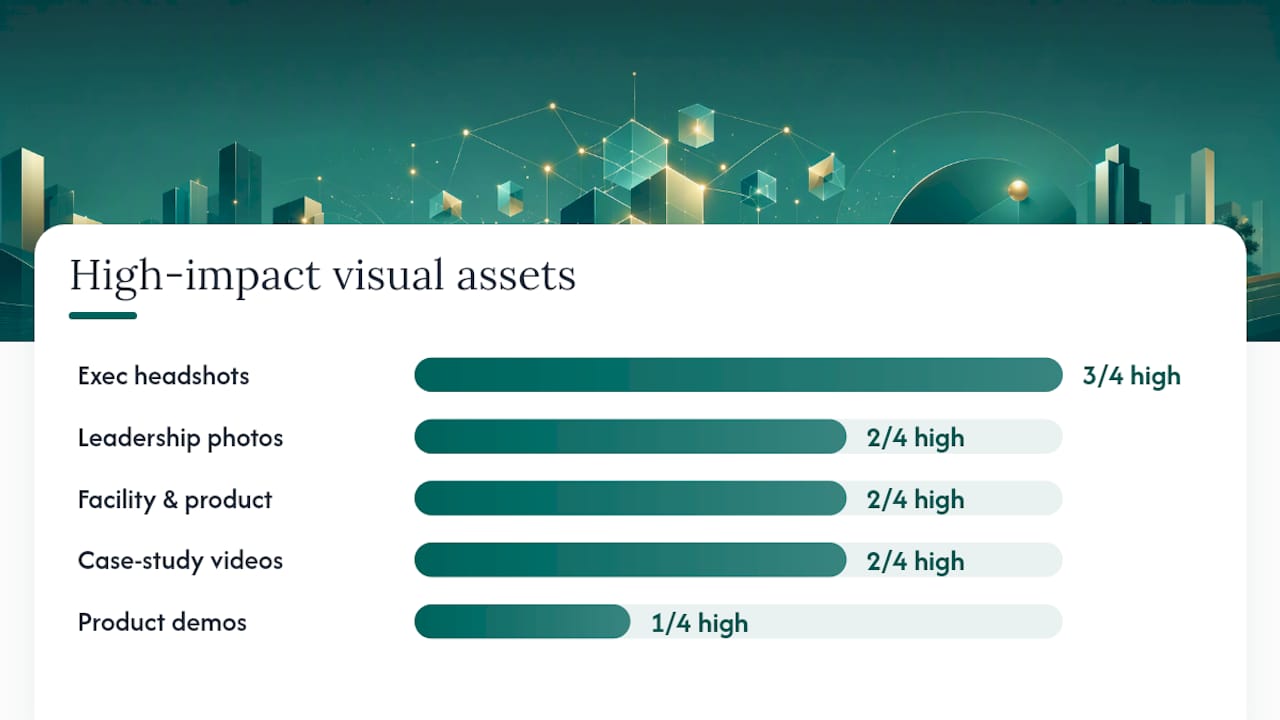
Treating brand as a financial asset requires measuring five outcomes: revenue repeatability, pricing power, demand volatility, concentration risk, and demand ratio. Visual assets are the most visible instrument of all five. Buyers pay premiums for portfolio companies with clear, audience-centered positioning — and that positioning is communicated visually before any pitch deck opens.
Commission in this order for fastest measurable impact:
Pro Tip: Sequence headshots and leadership photography first. They feed every other channel — sales decks, recruiting ads, investor updates, and exit materials — so the ROI compounds from day one.
The answer is governance architecture, not creative uniformity. Brand inconsistency during M&A causes customer confusion and employee friction; a unified visual identity reduces integration friction and protects revenue. The goal is a shared production standard with brand-specific expression.
Governance checklist:
Role-based required shot lists:
Each portfolio company keeps its own color palette, logo, and brand voice. The production standard — lighting, resolution, editing style, deliverable specs — stays identical across every location.
Before you book a multi-site shoot, confirm these operational elements are locked:
Sample SLAs to require from any production partner:
studio2U operates with portable-studio teams and standardized deliverable specs to enable multi-city shoots with predictable asset governance and a five-day turnaround.
Track these KPIs from day one:
Nearly 70% of mergers fail to achieve revenue synergies, with shortfalls concentrated in messaging, sales enablement, and brand legibility across acquired assets.
That figure frames the stakes for your board pack. Visual assets are not a marketing line item — they are a commercial integration input.
Simple experiment designs:
Reporting template for the board pack: Map each KPI to a financial outcome. Recruiting conversion improvement → reduced cost-per-hire and time-to-productivity. Sales close rate improvement → incremental revenue per rep. Translate both into EBITDA impact using your portfolio company’s own unit economics.
Budget banding by team size: Small teams (under 25 people) can complete a full headshot and leadership photography program in a single shoot day. Mid-size teams (25–75) typically require two days. Enterprise-scale portfolio companies with multiple locations should plan for a quarterly production cadence.
studio2U is built for exactly this operating model. Portable studio teams travel directly to portfolio company offices in New York City, Chicago, San Francisco, Austin, Miami, and Boston. Standardized deliverable specs mean every headshot, team photo, and video arrives in the same format, resolution, and edit style regardless of which city the shoot happened in.
A narrative-first discovery process identifies the single brand constraint limiting commercial performance, then builds a shot list around solving it. That focus is what separates a production that moves KPIs from one that just fills a Dropbox folder.
Pro Tip: When briefing studio2U for a portfolio-wide program, bring a one-page summary of each company’s top commercial priority (recruiting, sales enablement, or exit prep). That brief cuts discovery time in half and gets you to production faster.
Most operating partners I work with have detailed 100-day plans covering finance, operations, and go-to-market. Visual branding rarely appears before month six, if at all. That delay is expensive. The recruiting ads running in months two and three are pulling candidates with outdated photography. The sales team presenting in month four is using a deck with mismatched headshots from three different companies. The exit narrative being built in year three is missing the customer proof that buyers want to see.
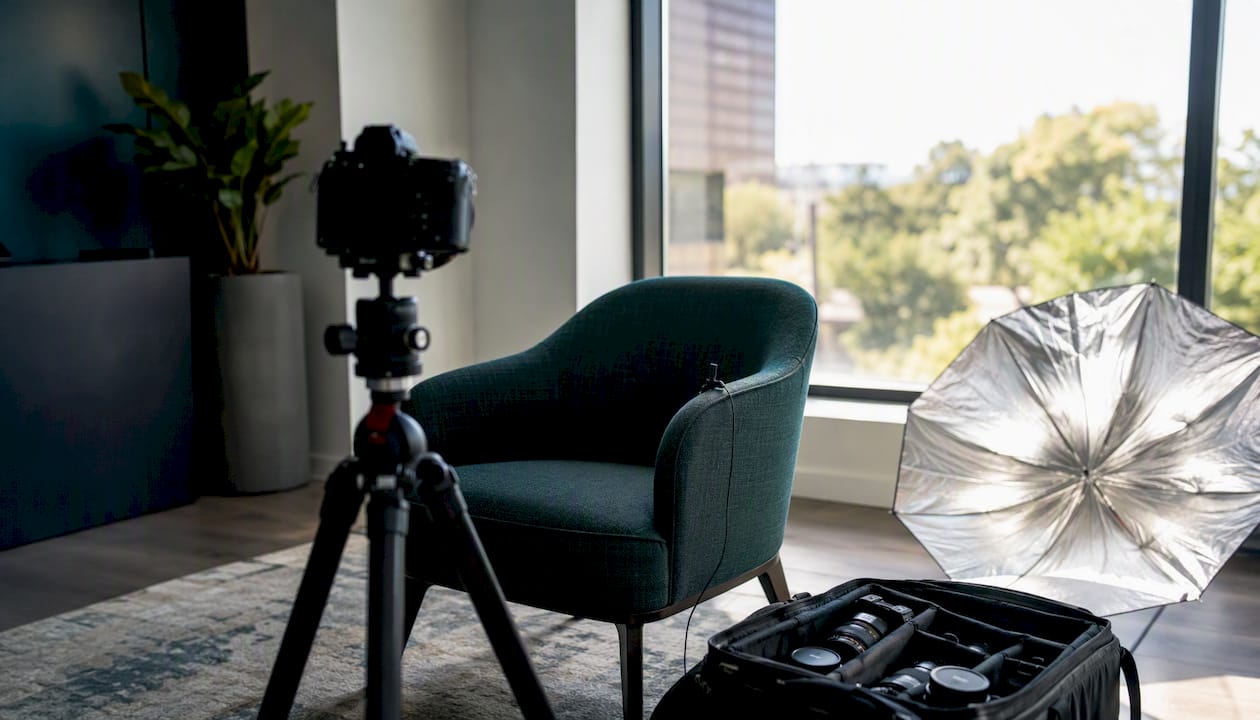
The fix is not a creative project. It is a production program with defined inputs, measurable outputs, and a governance model that keeps assets current across the hold period. The operating partners who treat visual assets the way they treat sales playbooks — as repeatable, instrumented inputs — are the ones who show up to exit with a cleaner story and stronger buyer perception.
studio2U offers three engagement models for PE operating teams: a single-company shoot for a fast proof-of-concept, a 90-day pilot covering one to three portfolio companies with full KPI tracking, and an annual portfolio program with scheduled production cadences across all locations.
To start a pilot, prepare a short brief: team roster and headcount by location, your top two commercial priorities (recruiting, sales, or exit prep), and any existing brand guidelines. studio2U handles the rest — shot lists, logistics, scheduling, and delivery within five business days of each shoot.
Request your pilot brief or discovery meeting at Studio2uheadshots.
Executive headshots and leadership team photography deliver the fastest cross-channel ROI because they feed recruiting ads, sales decks, investor materials, and exit narratives simultaneously.
Buyers pay premiums for portfolio companies with clear, audience-centered positioning; consistent photography and customer case-study video make that positioning legible before due diligence begins.
Set a shared production standard (lighting, resolution, editing style, deliverable specs) while preserving each company’s logo, color palette, and brand voice — governed through a centralized asset library with defined usage rights.
studio2U delivers photography within five business days of each shoot and schedules multi-city programs across New York City, Chicago, San Francisco, Austin, Miami, and Boston using portable studio teams.
Map KPIs (recruiting conversion, demo-to-close, web conversion uplift) to financial outcomes using your portfolio company’s unit economics, then present the delta as EBITDA impact in the board pack.
