Ten Point Contract Checklist for Headshot Rights, U.S. Businesses
%20(1)%201.png)
.png)
.png)
September 28, 2026
%20(1).jpg)

By default, the photographer owns the copyright to a headshot. Clients normally buy a license to use the image unless ownership is expressly assigned in a signed agreement. For most businesses, that means you can display, post, and print your team’s headshots freely within the terms you negotiated, but you cannot resell them or claim you own the underlying work unless a written transfer says so.
TL;DR:
- Most headshots are licensed for use, not owned outright, requiring a signed agreement to transfer copyright if full ownership is desired.
- A license’s scope depends on negotiated terms such as territory, duration, media, and whether sublicensing is permitted; these elements significantly impact licensing costs.
- Copyright ownership remains with the photographer unless a formal, signed transfer or work-for-hire agreement explicitly states otherwise, even if digital files are provided.
- Model releases for commercial use must be obtained separately from copyright licenses and are critical for marketing in advertisements or public campaigns.
- Building clear, detailed usage and ownership agreements before the shoot, including potential upgrade paths, effectively minimizes legal disputes and ensures business needs are met.
Copyright is a bundle of exclusive rights automatically attached to a photograph the moment it is created: the right to reproduce it, distribute it, adapt it, and display it publicly. A license is permission to use some or all of those rights without taking ownership of them. An assignment, by contrast, transfers the copyright itself to a new owner.
Licenses come in two basic flavors. A non-exclusive license lets the photographer sell the same or similar rights to other clients too, which keeps prices lower. An exclusive license means you are the only party allowed to use the image for the agreed purpose. It costs more because the photographer gives up the ability to license it elsewhere.
Having the digital files on your server does not mean you own the copyright. Many companies assume that receiving high-resolution files at the end of a shoot settles the matter. It does not; the license terms in your contract, not file possession, determine what you are legally allowed to do with the images.
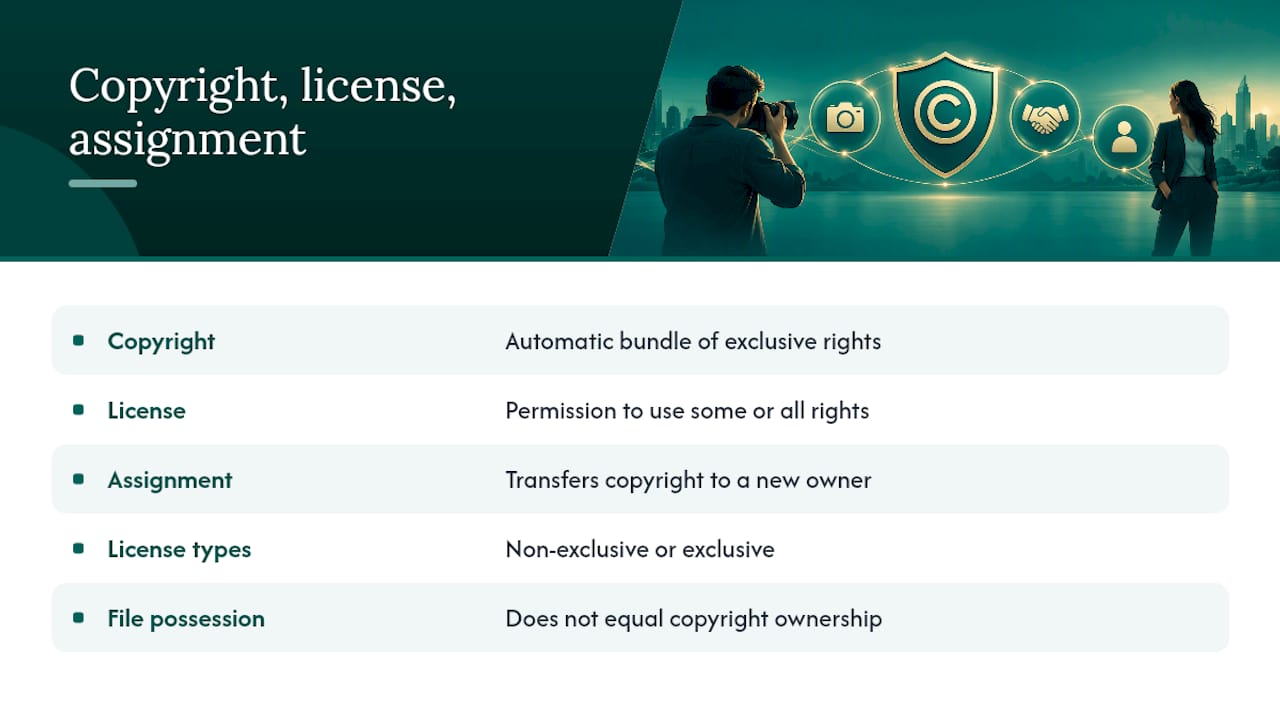
Under U.S. law, the photographer is the author and initial copyright owner of any image they capture, whether they shot it for free or for a substantial fee. This holds true even when a business pays for the session, unless the photographer is an employee acting within the scope of their job.
That employee exception is one half of the “work made for hire” doctrine. The other half applies to specially commissioned work, but only when the work fits one of the statutory categories and both parties sign a written agreement stating it is made for hire, before or at the time of creation. Absent that signed language, the photographer keeps the copyright regardless of who paid for the shoot.
Registering the images with the Copyright Office is not required to hold copyright, but it strengthens your position. Registration creates a public record of ownership and is required before certain infringement suits can seek statutory damages in court. If ownership matters to your business, ask whether the photographer has registered the shoot, or negotiate for registration as part of the deal.
Any transfer of copyright, whether full ownership or an exclusive license, must be documented in a signed written instrument. A verbal promise or an invoice that mentions “full rights” is not enough on its own.
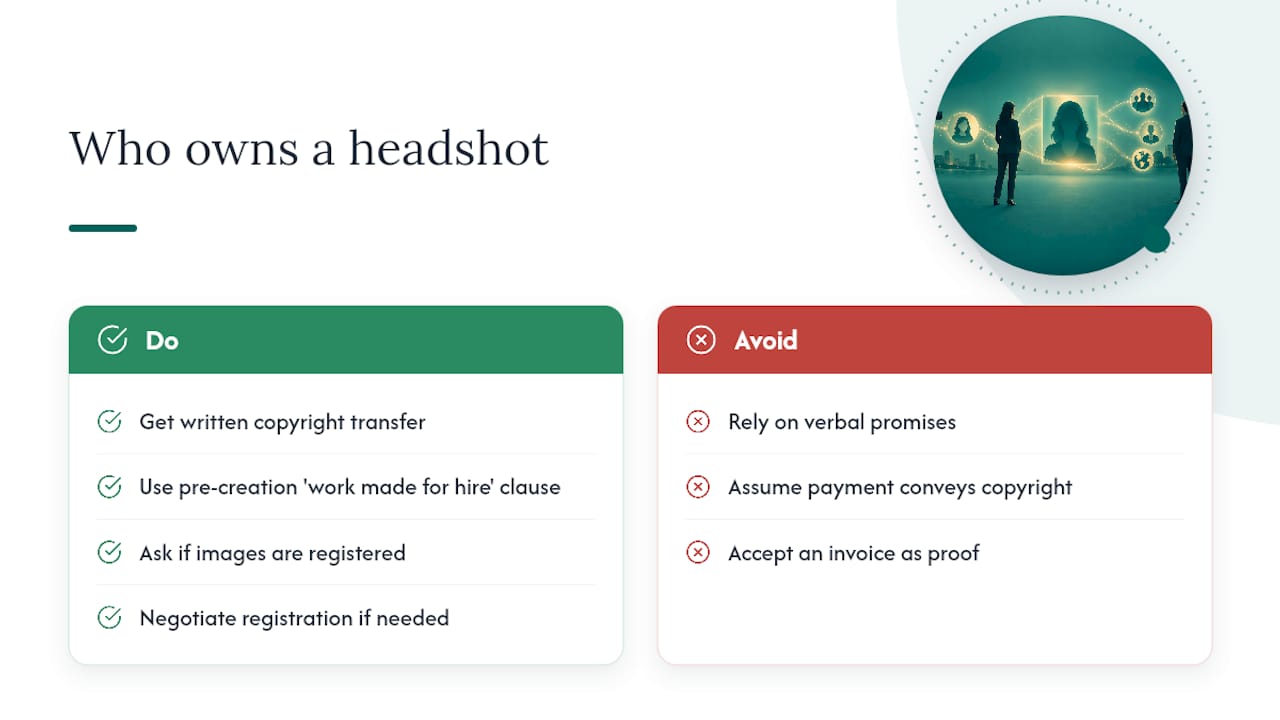
Most corporate headshot deals fall into a handful of license categories, each with different cost and control tradeoffs.
When negotiating, the levers that actually move price are territory, duration, which media the images can appear in (web, print, paid ads), how many employees or locations are covered, and whether you can sublicense the images to partners like PR firms or investors. Building an upgrade path into the contract from the start is usually cheaper than renegotiating from scratch later.
Copyright governs who owns and licenses the photograph. A model release governs whether the person in the photo has agreed to how their likeness is used commercially, and these are legally distinct permissions. Owning full copyright to a headshot does not automatically clear you to use that person’s face in an advertisement or endorsement.
Businesses need signed releases whenever headshots move beyond simple internal directories into advertising, testimonials, or public marketing campaigns. Executives, public figures, and minors sometimes require expanded release language covering additional uses or parental consent, since their likeness carries added legal or reputational weight.
The simplest fix is procedural: collect signed releases at the same time as the shoot, and file them alongside the image licenses so nothing is missing later when marketing wants to reuse a photo.
A usage-rights agreement is the single document that prevents most disputes, and industry practice treats it as the primary tool for managing both legal exposure and cost. At minimum, put these terms in writing before the shoot begins.
Ask for a clear formula, not a vague promise, if you might need broader rights later.
Pro Tip: Put the upgrade price in the original contract as a fixed formula rather than “to be negotiated,” so expanding your rights later doesn’t turn into a renegotiation from zero.
If you are purchasing copyright outright rather than a license, require signed assignment language explicitly, and confirm the photographer will hand over whatever documentation you need to register the work yourself.
Studio2U structures corporate shoots so procurement and legal teams do not have to reverse-engineer usage rights after the fact. Every session starts by mapping out where the images will actually appear, since a headshot destined for an employee’s LinkedIn profile and website bio needs different terms than one bound for a national ad campaign.
Procurement teams should ask any vendor to define permitted uses, provide sample contract language, and confirm delivery specs and release storage before signing.
The most common mistake is assuming a session fee buys copyright. It usually buys a license, and most photographers retain copyright unless assignment language is negotiated and signed in advance. A close second is failing to centralize license terms, so marketing reuses an image years later without anyone checking whether the license has expired or the territory covers the new campaign.
Model releases get skipped just as often, usually because they feel like paperwork rather than a legal requirement. Track your rights in one place, plan for refresh cycles as employees change, and get counsel involved for any transfer or unusual exclusivity claim.
— Kevin
Studio2U builds licensing and release terms into the shoot itself rather than leaving businesses to sort it out afterward. On-site sessions can include retouching, model-release collection, and delivery specifications defined before shooting to help facilitate timely legal review.
Companies booking a single-team session typically start with the headshot package, while organizations coordinating multiple offices or recurring shoots often need the branding and enterprise packages. If you are capturing headshots at a conference or summit, our event photography services cover that separately.
For a plain-language explainer aimed at other business owners, South Lake Agency’s photography overview walks through the same licensing basics from a different angle. Reach out to book a shoot or ask about contract language for your specific use case.
Yes. Under U.S. law, the person who captures a photograph is generally its author and initial copyright owner, including a business owner who takes their own headshot with a personal camera. That default only changes if you created the image as an employee acting for someone else within the scope of your job.
The photographer owns the copyright by default, even though you paid for the session. Ownership only transfers to you if the photographer signs a written agreement assigning the copyright, or if the work qualifies as work made for hire under one of its two narrow statutory paths.
This refers to a rough posing and composition guideline some photographers use, not a legal or copyright standard. Definitions vary by studio, and it has no bearing on who owns the rights to a headshot.
Yes, with the right camera, lighting, and setting, though results vary widely compared to a session designed for corporate use. Since you would own the copyright outright as the photographer, the licensing and ownership questions in this guide would not apply to that image.
