Press Release Photo Specs: Size, Format and Captions


October 14, 2026


The single highest-leverage move for Tech Week content is building a one-page event brief and setting Partiful as your event’s source of truth before you plan a single post. From there, capture founder-led clips, publish within hours, and repurpose everything. Do this and you get feed-centric reach, a bank of reusable assets, and posts with CTAs you can actually measure.
TL;DR:
- Prepare a social card, vertical announcement, and speaker quote graphics early; coordinate speaker posts and direct invitations to press or investors.
- Prioritize brief founder interviews, sharp speaker clips, clean portraits, and sponsor mentions; every asset needs enough context to identify who is speaking and why.
- Assign separate capture, mobile editing, and distribution owners before doors open, then publish a strong clip within an hour while the event remains timely.
- Get consent before filming and agree in writing who may publish footage; speakers must separately approve proprietary data or unreleased product details.
- Map each interview into a short clip, quote card, blog recap, or newsletter feature, and give every version one clear call to action.
Tech Week runs as a decentralized web of events rather than one managed conference, which means no central production plan exists to keep your content on-message. Every host owns their own experience, so a short brief is what keeps your team, your speakers, and your capture crew pointed at the same outcome instead of improvising on the day.
A working brief is quick to fill out and answers the questions that otherwise get decided in a hallway just before doors open. It should live in a shared doc your whole team can see, not in someone’s head.
Build it around these fields:
The official host guidance for 2026 lays out the operational sequence this brief supports: define the event concept, create the official listing, submit the proposal, update the listing as details firm up, promote ahead of the week, capture and publish during the event, then follow up with attendees afterward. The host request process also groups support around ticket tiers, promo codes, guest approval, and QR check-in, all of which your brief should reference so your content team isn’t guessing about access or attribution.
Discoverability during Tech Week is won in the days before the event, not the hour of it. Hosts who load their Partiful page and social channels with real assets ahead of time get picked up by attendees scanning a calendar with many competing listings.
Work through these steps in order:
#TechWeek and your city hashtag on every post so you surface in the right feeds.Pro Tip: Ask each speaker for their quote and headshot the moment they confirm, not the week of the event. Chasing assets under deadline is where promotion checklists fall apart.
A clip that needs context to make sense is a clip that will not get watched. Treat every piece of day-of capture as something that has to stand on its own in a stranger’s feed, with no caption explaining what event it came from or why it matters.
Prioritize capture in this order:
Every clip should answer who, what, and why in either the caption’s first line or the footage itself. If a viewer has to ask “wait, who is this,” the clip needs a recut or a better caption, not a longer explanation buried further down.
For interviews, skip the open-ended “tell us about your company” question. Ask something with a specific, teachable answer instead: “What’s one thing you changed after your first hundred customers?” or “What’s the worst advice you got at a Tech Week event?” A “hot seat” format, where a founder answers rapid questions on camera, can produce usable soundbites more efficiently than a loose conversation. The official 2026 schedule includes sessions built around exactly this format, pairing headshots with quick story workshopping to produce direct, usable assets on the spot.
On logistics: set up a small lighting corner for quick portraits near the entrance, confirm your consent or release process before anyone starts filming, and map your capture schedule against the actual event timeline so you know exactly when the keynote, panel, and networking windows happen.
Reporting on Tech Week’s scale notes that teams covering many events in parallel treat rapid publishing, sometimes within an hour, as an operational benchmark, because Tech Week content loses most of its value once the conversation has moved on to the next event.
Run a three-step pipeline:
Statistic Callout: Rapid publishing within an hour is the benchmark teams covering large volumes of Tech Week events use to stay relevant while attention is still high.
Assign clear roles before the event starts: a capture lead who owns the shot list, a mobile editor who can cut on a laptop or tablet between sessions, and a distribution owner who posts and monitors engagement. Build in a monitoring cadence, checking comments and DMs regularly rather than posting and walking away. Our own event highlight video workflow follows this same ingest-edit-publish structure, which is why a recap can go live before the next session even starts.
Aim to publish a piece of content promptly after a major moment, and have a short recap live before your next event opens its doors.
A single day of capture should fuel your feed well past the week it was filmed. The mistake most teams make is treating Tech Week footage as a one-time recap instead of a stockpile of smaller assets.
Map one piece of raw footage into several formats:
Every repurposed asset should carry one clear call to action, whether that is a follow, a signup, or a demo request, rather than existing purely as a recap. Build a simple asset bank, a shared folder organized by speaker and theme, so sponsors and speakers can pull their own clips for their own channels, which extends your reach for free. For a more detailed framework on turning one piece of pillar content into a full week’s worth of assets, this repurposing guide walks through the structure step by step.
Follow up with attendees in the days after using the footage itself: send filmed highlights along with any resources mentioned on stage, and invite them to your next event or a specific next step. Our event content repurposing approach is built around exactly this kind of asset mapping.
When your audience sees separate events across a feed, a consistent visual identity and publishing rhythm is what makes them feel like one shared experience rather than a string of unrelated posts. That recognition is what builds the sense of belonging that keeps people coming back to your content week after week.
Keep the system small enough that anyone on your team can apply it without a style guide meeting:
Rotate a few repeatable formats instead of inventing a new post style for every event: a quick takeaway clip paired with a one-line insight, a founder hot-seat still paired with their best quote, and a sponsor thank-you or grid recap. Keeping a small set of formats in rotation makes editing faster and makes your feed easier to recognize.
Pro Tip: Print your visual rules on one page and hand it to anyone capturing content, including a volunteer with a phone. Consistency beats production value when you are covering multiple events in a busy week.
The gap between forgettable event footage and content that actually moves a business usually comes down to what happens before anyone picks up a camera. A strategic discovery conversation, covering the event’s objective, audience, and the specific outcomes a host or sponsor is chasing, determines what gets shot far more than any piece of equipment does.
We build every event production around this kind of discovery first, so our coverage is planned around the event’s objectives rather than treated as a generic recap video. Portable studios let us bring consistent lighting and backdrops directly into a venue with minimal disruption to the event itself, and our editing turnaround helps make footage usable while the conversation is still happening.
For a single meetup, lightweight in-house coverage with a phone and a clear shot list is often enough. For a summit, conference, or multi-sponsor event where the content needs to work for speakers, sponsors, and your own growth goals at once, an on-site production partner who has planned the capture in advance tends to produce far more usable material per hour on-site.
Most hosts leave organizer and sponsor collaboration until the week of the event, which is usually too late to get anything beyond a logo placement. Reach out to co-hosts and sponsors while you are building your brief, not after, and ask what content they need in return for their support.
Sponsors often need a specific deliverable to justify their investment: a mention clip they can share internally, a photo of their branded space, or a quote from their representative on camera. Offering this proactively, rather than waiting to be asked, makes a sponsor relationship easier to renew for your next event.
Organizers of larger, multi-sponsor events frequently have their own brand kit, hashtag requirements, and approved messaging, so confirm those details early rather than designing your own graphics and discovering a conflict later. When several hosts are running co-located sessions, splitting capture duties and sharing footage across teams produces more usable content for everyone than each host filming the same room separately.
Every person on camera, speaker, attendee, or sponsor representative, should have given consent before footage of them gets published anywhere. Build a simple verbal or written consent process into your capture schedule rather than treating it as a side conversation.
Confirm who owns the footage before the event, particularly when a sponsor or organizer is paying for part of the production. A one-line agreement on usage rights, covering who can post what and where, avoids a dispute after the event when everyone wants to use the same clip.
Speaker quotes and slides carry their own permissions. Get explicit confirmation before publishing a clip that includes a speaker’s proprietary data or an unreleased product detail, even if they said it on an open stage. When in doubt, ask the specific person on camera rather than assuming stage visibility equals publishing rights.
A growing share of Tech Week attendees experience events entirely through a feed rather than in person, so your capture setup should produce content that works for someone who was never in the room. Treat remote viewers as a real audience, not an afterthought to in-person coverage.
Before the event, confirm venue WiFi strength or bring a mobile hotspot as backup, since unreliable upload speed is the most common reason same-day content gets delayed. Test your audio setup in the actual room, not just at your desk, since panel audio in a loud venue often needs a dedicated microphone rather than a camera’s built-in mic.
Pack a compact kit: one portable light, a phone or camera with a vertical mount, a lavalier or shotgun mic, and a portable charger bank. For hybrid sessions streaming to a remote audience, assign one person specifically to monitor chat or comments during the stream so remote attendees get the same engagement in-person attendees do.

Tech Week draws founders, investors, recruiters, and press into the same room, and a single piece of content rarely serves all of them equally well. Decide before you shoot which persona a specific asset is for, rather than trying to make one clip do everything.
A founder audience responds to tactical, specific insight, the kind of exchange workshops on build-in-public distribution are built around. An investor or press audience responds better to traction signals and founder credibility, often best delivered through a clean portrait and a sharp quote rather than a long clip. A recruiting audience wants to see team culture and the people behind the product, which favors behind-the-scenes and team shots over polished interviews.
Segmenting this way before the event means your capture list already has the right mix instead of forcing one generic set of clips to serve every goal after the fact.
Most Tech Week content advice treats the week as one big conference to document, when it is really a thousand small, separate rooms competing for the same scroll. Teams that plan for “a recap video” end up with one polished asset and nothing else, while teams that plan for twenty small, standalone moments end up with a week of content.
The other overrated idea is that production value wins the feed. A clean portrait with a sharp quote outperforms a beautifully lit but context-free highlight reel almost every time, because the feed rewards clarity and speed over polish. The teams getting real pipeline out of Tech Week are not the ones with the best camera. They are the ones who decided, before the event started, exactly which three moments mattered and who was responsible for posting them within the hour.
Prioritize the brief and the publishing clock first. Everything else, including your visual system and your gear, matters far less if those two things are missing.
— Kevin
We treat every Tech Week event as a production problem with a deadline: capture needs to happen fast, and the footage needs to work across a founder’s website, LinkedIn feed, and investor deck. Portable studios travel directly to your venue, so setup adds minimal disruption to the event itself, and our editing turnaround helps make usable clips available while your event is still the one people are talking about.
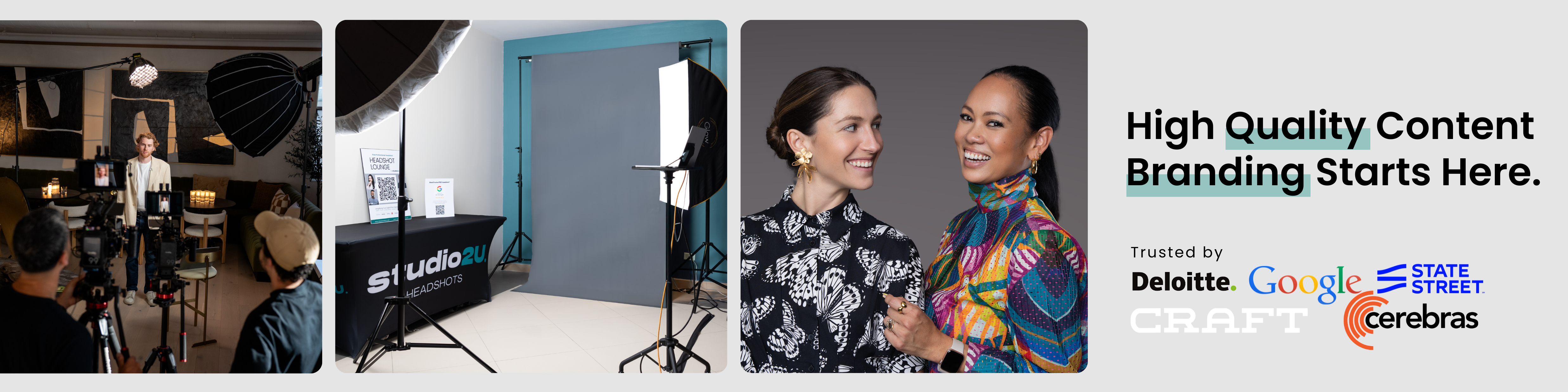
For a single summit or conference, our CONFERENCES packages cover NETWORKING, SUMMIT, and full CONFERENCE-scale coverage, with pricing options for different event needs. If your event needs a consistent visual system applied across speaker portraits and branding alongside the video capture, our BRANDING page covers STANDARD, ENTERPRISE, and BRANDING ADD-ON options for exactly that pairing. Start with a discovery call so we can map your event brief to a capture plan before the week begins.
Tech Week is made up of hundreds of independently hosted events, from panels to founder meetups, run across a single week in a given city. Attendees pick the sessions that match their goals, whether that is raising capital, hiring, or finding customers, and most hosts list their events through the official Tech Week calendar.
Strong Tech Week session topics tend to be tactical rather than broad, covering things like build-in-public distribution, founder branding, and converting content into pipeline. The 2026 SF schedule leans heavily toward actionable, founder-led sessions over general industry talk.
What counts as “new” during Tech Week shifts by city and by the specific events running that week, since the schedule is set independently by each host. Checking the official event calendar for your city is the most reliable way to see what is actually being announced or demoed.
The sessions that perform best tend to focus on one specific, teachable takeaway rather than a broad company update, such as a single growth tactic or a lesson from a specific milestone. Formats built around direct audience interaction, like a founder hot-seat or a workshop on a single skill, also tend to generate more usable content than a straight lecture-style talk.
