10–14 Assets From One Session: Event Content Repurposing for Marketers
%20(1)%201.png)
.png)
.png)
September 18, 2026
%20(1).jpg)

Event content repurposing turns your recorded sessions, slides, and photos into a reusable marketing engine instead of a one-time recap. Start by transcribing your footage and picking four to six hero sessions to feed a hub-and-spoke workflow, where one strong source generates ten or more downstream assets. The payoff shows up in search traffic, sales enablement, and pipeline that keeps growing for months after the event ends.
TL;DR:
- Selecting hero sessions should be based on attendance, speaker quotability, and evergreen search demand to maximize content impact.
- Planning content capture six weeks before the event with clear specifications ensures high-quality footage and faster turnaround times.
- A well-planned hero session can generate between 10 and 14 marketing assets, including videos, transcripts, quotes, and social content.
- Using AI tools for transcript-based editing and automatic formatting accelerates the repurposing process and improves efficiency.
- Distributing assets first through owned channels, then earned media, and finally paid promotion maximizes reach and measures revenue impact accurately.
Not every recording deserves the same treatment. Some sessions carry enough insight density and speaker pull to justify heavy editing investment; others are better mined for a single strong quote or photo.
The raw materials worth capturing and cataloging include full session video, isolated audio, presentation slides, speaker bios and headshots, high-resolution event photography, transcripts, and attendee-generated content like social posts and candid photos. Each type maps to a different downstream format:
Deciding which sessions become “hero” content versus supporting material comes down to three filters: attendance size, how quotable the speaker was, and whether the topic has evergreen search demand. A packed keynote on a trending industry shift outranks a well-attended but niche breakout, even if both drew a crowd.
The single biggest mistake event marketers make is treating content capture as a day-of logistics problem. It is actually a planning problem, and the leverage moment happens roughly six weeks out, not six days out.
That is when you write the capture brief, a working document that tells your production team, speakers, and internal stakeholders exactly what gets recorded and why. A solid brief answers:
Hero-session selection should weigh three factors together rather than any one alone: raw attendance numbers, how many quotable, specific claims the speaker made (vague inspirational talks clip poorly), and whether the speaker has an audience of their own who will share the clip. A mid-tier speaker with a large, engaged LinkedIn following can outperform a bigger name with no social presence.
Clean audio capture is non-negotiable. Separate mic feeds for each speaker on a panel let editors isolate voices for clips and captions without fighting crosstalk, and skipping this step makes fast turnaround nearly impossible.
Pro Tip: Build your capture brief backward from the assets you want, not forward from the schedule. If you know you need a 90-second LinkedIn clip of your keynote speaker, tell the videographer to get a clean, tight shot of that speaker’s face during their strongest three minutes, not a wide shot of the whole stage.
Align production and marketing on signoff timing before the event, not during it. A same-day rough-cut review with a 48-hour final approval window keeps momentum from stalling while the event is still fresh in attendees’ minds.
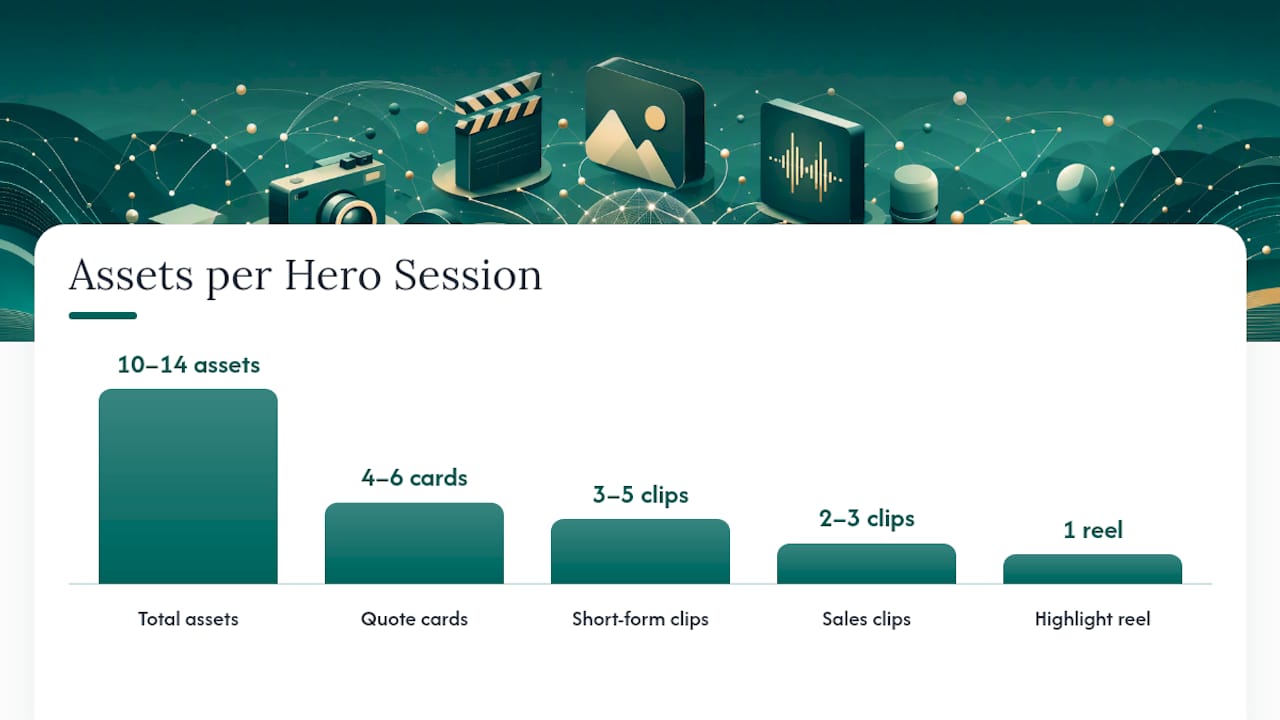
A single, well-captured hero session typically produces 10 to 14 distinct marketing assets per hour of footage when the capture was planned to spec. This is the hub-and-spoke model in practice: one recording as the hub, a dozen or so spokes radiating out across formats and channels.
A canonical asset set from a single 45 to 60-minute hero session usually includes:
The sequencing matters as much as the asset list itself. Publish owned content first, on your website and email list, so it earns search authority and email engagement before you spend money boosting it. A staggered release model treats the event as a content engine rather than a single deadline: front-load social-first assets in the first week, follow with evergreen SEO and nurture content through day 30, then shift to sales and paid amplification from day 30 through day 90 and beyond. Publishing everything on day one wastes the compounding value that comes from spacing releases against your search and nurture calendar.
Transcription is the foundation everything else builds on. Turning video into searchable text is the single biggest time-saver in the entire pipeline, because it lets editors find exact quotes and timestamps instead of scrubbing through hours of footage manually.
Once you have a clean transcript, the workflow gets faster at every step:
File naming and handoff discipline matter more than people expect. Tag every raw file and transcript with the session name, timestamp range, and speaker name before it reaches an editor, and link timestamps directly to their transcript location. That single habit removes hours of back-and-forth between production and marketing teams. Automation platforms like ExpressSheet can handle the recurring scheduling and reporting tasks that otherwise eat into the time your team should spend on creative decisions.
Pro Tip: Extract 10 standalone content fragments from every hero transcript before you touch a video editor: the core thesis, a contrarian claim, a top-line number, a process summary, a common mistake, who the talk is for, who should skip it, a before/after comparison, a strong blockquote line, and an FAQ pair. Those fragments become your quote cards, social captions, and blog subheadings without any extra writing.
Distribution sequencing follows the same logic as asset sequencing: owned channels first, then earned, then paid. Publish to your website and newsletter, let search and email engagement build, then layer in paid amplification once you know which assets are already performing organically. Email remains one of the highest-return channels for pushing repurposed content back to an existing audience, which is why nurture sequences deserve real assets, not an afterthought recap link.
Platform fit changes what you post where. LinkedIn rewards long-form thought leadership clips and carousel breakdowns from B2B sessions; Shorts and Reels reward fast-cut, high-energy moments regardless of topic depth.
The most underused lever in the entire process is attendee and speaker amplification. Attendees and speakers convert into your highest-ROI promotion team when you hand them tracked links and pre-formatted social posts instead of asking them to write their own caption. Concretely, that means:
Every asset needs its own UTM tag, tied to its own campaign name, so performance data does not blur together into one meaningless “event traffic” bucket. Add a custom CRM field that records which piece of content first touched a lead. That single field is what lets you say a specific clip or blog post influenced a specific deal.
Track these at the asset level, not the campaign level:
Report on a 30/60/90 day cadence so stakeholders see the ramp, not just a single snapshot. Surface top-performing assets to leadership monthly, and just as important, use underperforming assets to adjust your next capture brief. If a panel format consistently underperforms a solo keynote in engagement, that is real data for how you plan the next event, not a one-off.
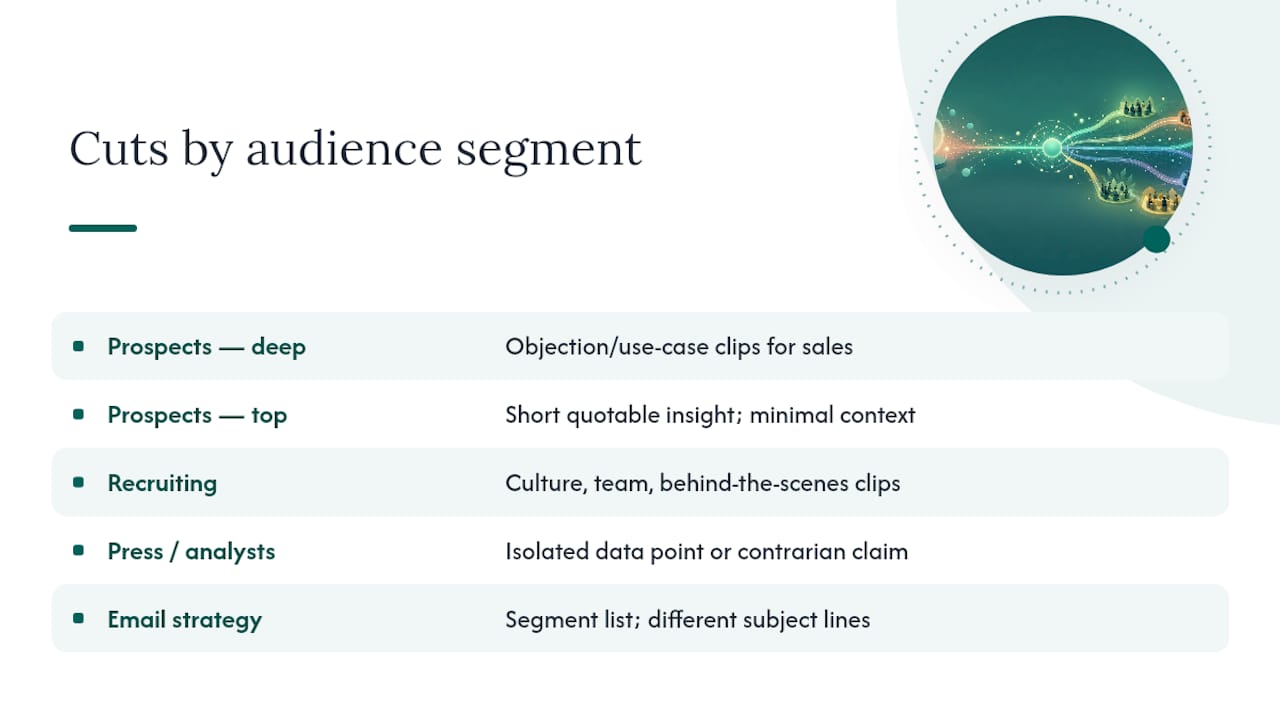
The same 45-minute keynote should never look identical when it reaches a prospect, a job candidate, and a journalist. Segment first, then decide which fragment of the hero session actually serves that reader.
For prospects deeper in the sales funnel, cut the sections where a speaker addresses a specific objection or use case, and hand those clips directly to sales reps as follow-up material after a demo call. For top-of-funnel awareness, pull the most quotable, broadly relevant insight and post it as a short clip with minimal context, since a cold audience has no patience for setup.
Recruiting audiences respond to a different cut entirely: culture, team dynamics, and behind-the-scenes moments outperform polished keynote clips when the goal is attracting talent rather than closing a deal. Press and analyst audiences want the data point or contrarian claim isolated and quotable, stripped of marketing language, because that is what gets picked up in coverage.
Segment your email list by role or funnel stage before you send repurposed content, and write a different subject line and framing for each segment even when the underlying clip is identical. A single transcript, run through this lens, can produce four or five genuinely distinct campaigns instead of one generic blast, which is the real advantage of building a structured event content plan before the cameras start rolling.
The pattern behind effective campaigns is consistency over novelty. Organizers who treat every conference as a fresh content sprint, publishing dozens of small assets on a fixed schedule rather than one large recap video, consistently outperform those chasing a single viral clip.
A multi-day summit that films every breakout, not just the mainstage, ends up with a far deeper well of niche, highly searchable content than an event that only records keynotes. Those breakout sessions often rank better in search because they answer specific, long-tail questions a mainstage talk never touches.
Conference organizers who convert long-form recordings into a stream of shorter, platform-specific posts rather than a single monolithic recap consistently see stronger reach and search performance, because each short asset can independently rank or get shared on its own merits. The events that keep generating registrations for their next event are the ones still publishing session clips and quote cards ninety days after the closing keynote, not the ones that went quiet the week after.
The bottleneck in most repurposing programs is not strategy. It is footage that is unusable because audio was muddy, the wrong angle got captured, or edits took three weeks to land. Lock your asset list during the discovery call, before a single camera rolls, and build your fast delivery window around it.
— Kevin
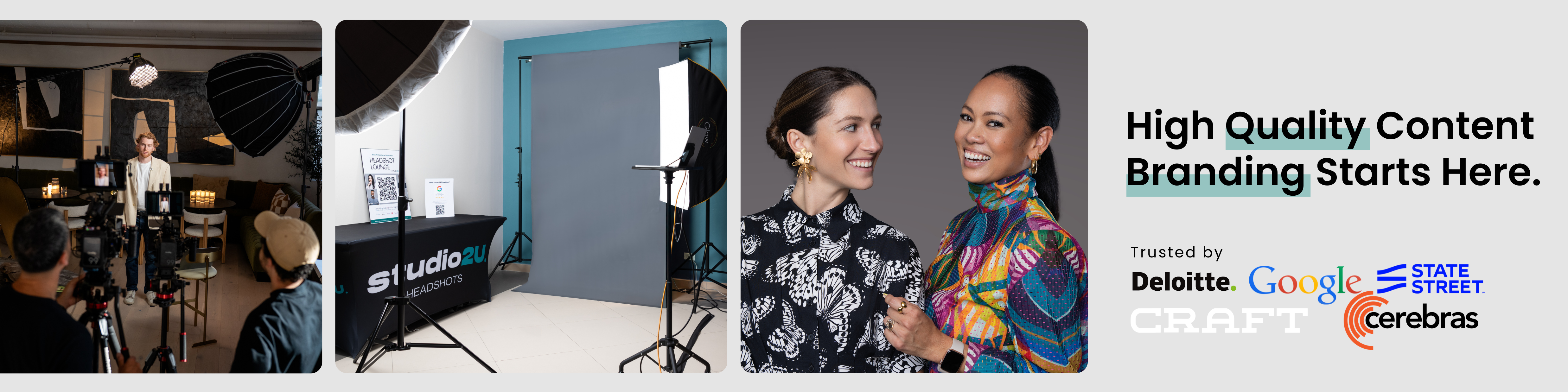
Studio2U’s conference and networking packages exist to solve exactly the capture problems that stall a repurposing program: mismatched angles, buried audio, and edits that arrive too late to matter. Portable studios travel to venues, so speaker portraits, keynote footage, and quick sponsor interviews can be captured with a consistent production standard, no matter how many rooms or days the event runs.
That consistency is what makes the hub-and-spoke model actually work. A hero session shot with clean, isolated audio and a proper camera angle turns into a highlight reel and a dozen usable clips without an editor fighting the raw material first. Rapid turnaround means your team gets footage while the event is still being discussed, not weeks later when momentum has cooled. For teams running headshot booths or portrait sessions alongside the main program, the conference headshot booth format adds another high-value asset stream from the same event day.
If your organization runs events across multiple cities or manages a portfolio of companies that all need visual consistency, the branding and enterprise packages extend that same production discipline beyond a single event. Book a discovery call and walk through your next event’s asset list before you finalize the agenda.
This guide draws on Convene’s research on attendee amplification, Sessionboard and Samaaro’s guidance on capture briefs and asset counts, Statista’s data on email channel economics, and tactical repurposing frameworks from Buffer and Attendir.
Common examples include turning a keynote transcript into an SEO blog post, cutting a panel discussion into short LinkedIn clips, converting slides into a carousel post, and pulling audio into a standalone podcast episode. A single hero session can realistically produce 10 to 14 distinct assets using this approach.
Successful capture planning centers on defining your purpose and audience for the event, securing the right speakers and venue logistics, setting a realistic production timeline, and budgeting for professional capture. Building the capture brief into that planning process, roughly six weeks out, ensures the content team has what it needs before the event starts rather than scrambling afterward.
Beyond the standard clip-and-blog approach, try audiograms for quote highlights, quote card carousels timed to trending discussions, sales enablement clips addressing specific objections, and recruiting-focused culture reels cut from behind-the-scenes footage. Segmenting one transcript by audience, prospects, candidates, press, can turn a single session into four or five distinct campaigns.
Transcribe the recording first, then pull the strongest three to five minute segment for a highlight reel and several 30 to 90 second clips for social. Turn the Q&A portion into a standalone FAQ blog post, and use audience questions as prompts for future content, since they reveal exactly what your audience wanted to know.
Costs vary depending on event size and whether you handle capture in-house or bring in a production partner. Studio2U’s conference and networking packages are listed on the conferences page, with current pricing available there for teams planning a specific event.
