Product Overview Video: What to Include and How to Make One


November 14, 2026


An about us video answers one question for a buyer, investor or candidate before they ever talk to you: can I trust these people? The best ones show real team members, say plainly what the company does and why, and end with a clear next step. If your company just closed a round, completed an acquisition or is entering a new market, this is the page asset worth getting right first, and it is best shot on location by a team that treats it as part of a wider visual brand. That is how we approach it at Studio2U: portable studios brought to your office, with a strategic discovery call before anything is filmed.
The about us page is where skeptical visitors go. A prospect who just saw your ad, an investor checking a founder’s background, a candidate reading about the culture: each lands there looking for proof that real, competent people stand behind the product.
Text can claim that. Video lets people check it. They see faces, hear how the founders talk, notice whether the office looks like a place they would want to work in or buy from. That is why the format works as a trust asset rather than a branding exercise.
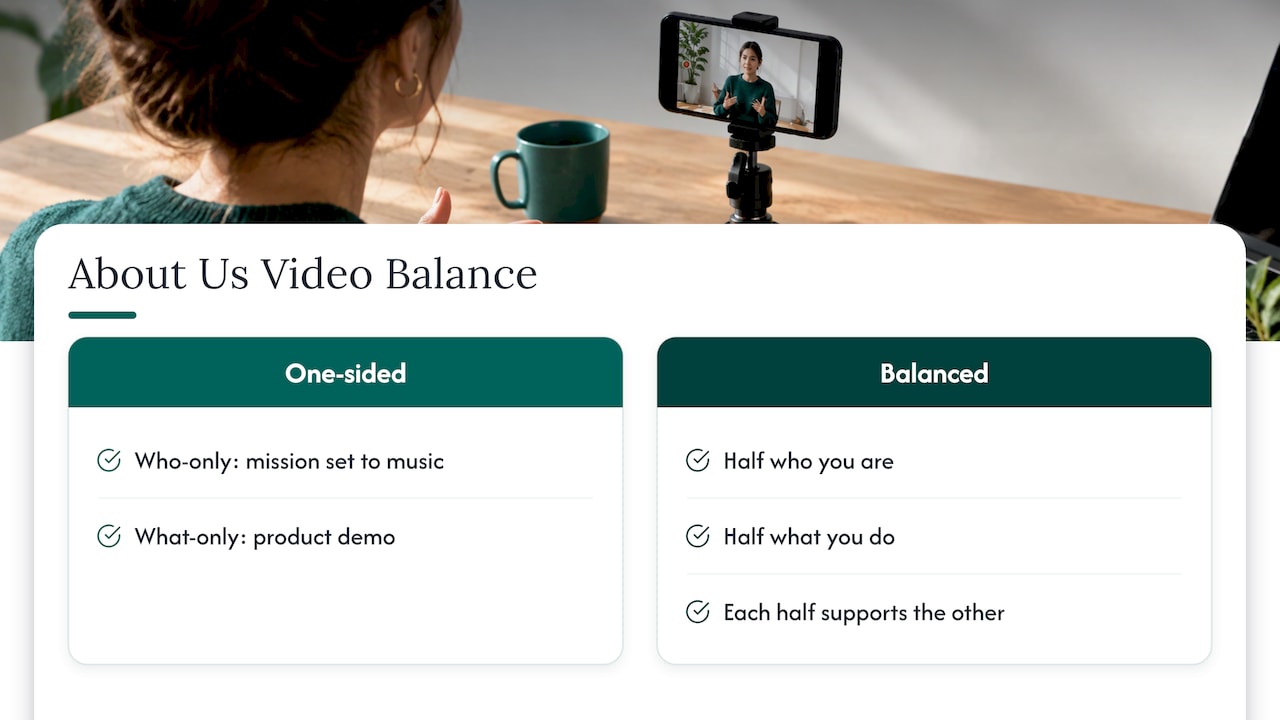
SproutVideo’s guide describes a good about us video as one that tells the brand’s story, gives the information a viewer needs, establishes social proof and makes clear what the brand stands for. It also recommends it be half who you are and half what you do, then end with a call to action such as following on social media or visiting a page.
That split is a useful discipline. Companies that only talk about what they do end up with a product demo. Companies that only talk about who they are produce a mission statement set to music. The video earns its place when each half supports the other.
The moments when an about us video pays off fastest are the ones where your story changes faster than your website does:
Start with the viewer’s problem or your reason for existing, not your founding year. Someone who clicked play has about the length of a breath to decide to keep watching. Put a human face and a concrete statement up front: what you do and for whom.
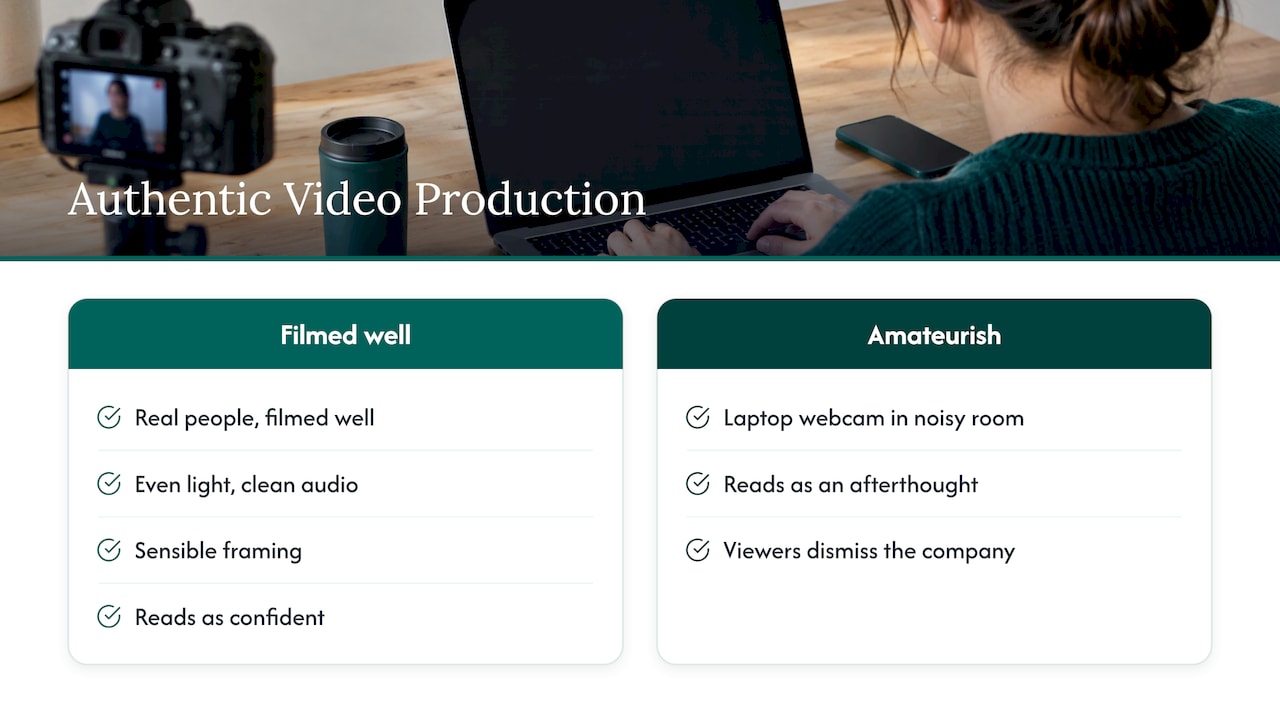
Victor Blasco, writing for MarketingProfs, names authenticity, creativity and high-quality production as the three pillars of a company story video. On authenticity he points to real employees, event footage and language that fits the brand. He also warns that amateurish-looking video leads viewers to dismiss the company.
That last point matters for planning. Authentic does not mean casual or shaky. It means real people, filmed well: even light, clean audio, sensible framing. A founder talking to camera in a lit, quiet space with a clear background reads as confident. The same founder on a laptop webcam in a noisy room reads as an afterthought.
Mission, vision, values and culture belong in the video, but Blasco cautions that a good script touches them without hammering viewers over the head. Every element should work toward a cohesive story with a beginning, middle and end. Instead of reading out a values list, let a founder tell the story of the moment a value was tested, and let a team member describe what it looks like on a normal Tuesday.
Show the work: the product in use, the team in a working session, a customer outcome. A short line from a customer or investor carries more weight than any self-description. If you already have longer client stories, an about us video can point toward them. We cover that format in our guides to client story videos and case study videos.
End with a single action: book a demo, read the case studies, see open roles. SproutVideo recommends a call to action that promotes further engagement. Pick the action that matches the page’s main visitor. A page that serves investors, customers and candidates equally should still end the video with one ask, and the surrounding page can carry the rest.
Rather than collecting famous brand videos to imitate, sort the formats by the question your visitor is asking. Most company videos fall into one of these patterns.
| Visitor’s question | Format that answers it | What to show |
|---|---|---|
| Who is behind this? | Founder story | The founder on camera, the origin of the problem, the team around them |
| Can I work with these people? | Meet the team | Short, unscripted-feeling moments from different roles in their real workspace |
| Does it work? | Customer-led story | A customer describing the before and after in their own words |
| Where is this going? | Vision piece | Leadership describing the direction, paired with real footage of the product and office |
| What is it like inside? | Culture video | Meetings, collaboration, events, everyday detail |
The strongest company videos usually combine two of these: a founder story with a short customer moment, or a meet-the-team piece that closes with the company’s direction. Our pieces on founder story videos and testimonial videos for B2B go deeper into each.
For investor-facing organizations, a variation is a founder video series: one short video per founder or partner on the same set, framed the same way, so the collection reads as a deliberate body of work rather than a pile of one-offs.
Write one sentence: “After watching, a [buyer / investor / candidate] should feel [X] and do [Y].” If you cannot fill in the sentence with a single audience, pick the one whose decision is worth the most this quarter. You can cut other versions later from the same footage.
List the three or four moments that explain why the company exists and why it is different: the problem a founder saw, the first customer, a turning point, what the team believes. Each should be something a person can describe in two or three sentences. This is where many teams stall, because the story is familiar to them and therefore feels boring. It is not boring to a stranger.
If you need a prompt for sharpening the narrative, this overview of visual storytelling tips covers how to turn a company’s experience into a coherent story.
People sound stiff reading prose. Write the points each speaker should hit, ask open questions on camera and edit the best answers together. Keep the finished piece tight. There is no universal ideal runtime, but a company video on a website generally works best in the range of one to two minutes. Shorter cuts of 15 to 30 seconds serve social channels and ads.
List the footage that backs up every line: office and workspace shots, team members at work, product in use, event moments. This b-roll is what keeps a talking-head interview watchable. Our corporate b-roll ideas guide lists what to capture so the edit never runs out of material.
A shoot at your own office means real surroundings and little disruption to the workday. It also means you can film several leaders and teammates in one session. If your company is spread over several cities, plan filming across locations with the same lighting and framing, so the final piece looks consistent.
Many visitors watch with the sound off, so add captions. Choose music that supports rather than overpowers the voices, and keep the edit moving. Cut the sentence that explains what the previous sentence already showed.
A single shoot should feed many placements. Plan these uses before filming so the footage works for all of them:
Still photography is part of the same plan. Headshots for the about us page, the team page, speaker bios and press releases should match the video’s look. For financial firms in particular, headshots for financial services is a good starting point, and PE firms with several holdings can read about portfolio company photography. If your team is split between home and office, see hybrid team headshots.
Set the measure before launch. Useful signals include how many visitors press play, how much of the video they watch, whether visitors who watch go on to book a demo or apply for a role, and whether sales mention it in calls. Compare these against the same page before the video went live. Adjust the opening and the call to action first, because those two choices decide most of the result.
Most about us videos fail for the same reason: they are about the company, not about the people the viewer will deal with. A buyer, an investor and a candidate all want the same thing before they commit: to know who is on the other side.
Our work starts with a strategic discovery call, because a video without a goal ends up as a nice file that nobody uses. We decide who the video is for, what they should believe afterward and where it will live. Then we bring a portable studio to your office, so the footage shows real people in their real environment, lit and framed to a premium standard.
The most useful thing you can do is treat the shoot as a source of assets, not a single video. One visit can supply an about us film, team photography and clips for sales, recruiting and investor communications, all consistent in look. That consistency is what makes a growing company, or a newly merged one, look like one organization.
The question to ask is not whether you can afford to invest in this. It is how many conversations will start from an unprofessional first impression while you wait.
Kevin
We bring portable studios and production teams to your offices, events and conferences, with minimal disruption to your team’s day. Each project begins with a discovery call about your goals and audience. Our on-site work covers team headshots, branding photography and video, with retouching and a five-day turnaround.
Published pricing, per shoot:
If you just closed a round or finished an acquisition and want a video and photo set that makes the whole company look aligned, start from the Studio2U site and book the discovery call.
There is no single correct length. For a website about us page, one to two minutes is a practical target, long enough to tell a story and short enough to hold attention. Cut 15 to 30 second versions for social posts and ads from the same footage.
Include who you are, what you do, why you exist, a bit of proof and a single next step. SproutVideo suggests splitting the content about evenly between who you are and what you do. Real employees and customers make it credible.
Founders, leaders and people from the teams a viewer would actually work with, such as sales, support or engineering. Pick people who speak naturally about their work. For a firm that just merged, include people from both sides.
Put it on the homepage, in sales emails and decks, on the careers page, in investor communications and in social clips. Plan these placements before shooting so you capture the right cuts and formats in one session.
