One-Day On-site Headshots: Templates & Proofs for Corporate Organizers
%20(1)%201.png)
.png)
.png)
August 30, 2026
%20(1).jpg)

Book a single strategic MVP brand shoot that captures founder portraits, team and culture moments, product-in-context images, and website-ready assets. One well-planned session, done right, supplies what you need for your homepage, PR outreach, recruiting pages, and investor deck at once. Studio2U runs this exact model nationwide with a five-day turnaround, so the assets are ready before your next milestone goes public.
TL;DR:
- A single half-day MVP branding shoot covers founder portraits, team, product-in-context, and office images, providing assets for 12 to 18 months across multiple channels.
- Timing should align with milestones like fundraising, product launches, hiring pushes, or major PR coverage to maximize the impact of new images.
- Planning involves answering key questions, creating a detailed shot list, securing logistics early, and clarifying usage rights with the vendor beforehand.
- Costs depend on scope, location, team size, and retouching needs, but an efficient MVP session offers greater ROI than multiple smaller shoots for different purposes.
- Assets should be mapped to channels for reuse, with a review and refresh planned around major milestones or after six months to maintain current branding.
Startup brand photography isn’t a headshot session with a nicer camera. It is a coordinated shoot designed to produce a visual system your company will lean on for the next 12 to 18 months, across five distinct asset categories.
Founder and executive portraits. These carry the most weight in fundraising and press. Investors research the person before they research the pitch deck, and a flat, badly lit LinkedIn photo undercuts credibility before a single word is read.
Team and culture shots. Recruiting pages convert better with real people in a real space than with posed stock photography. This is also the category most startups skip entirely until a hiring push forces the issue.
Product-in-context storytelling. Screenshots explain features. Photographs of a product being used, held, or integrated into someone’s workflow explain value. This matters most for hardware, physical goods, or any software with an in-person use case.
Workplace and environmental images. Office photography sets the tone for “About Us” pages, PR features, and investor site visits. It’s proof the company exists somewhere real, not just on a pitch deck.
Detail and process shots. Close-ups of hands working, whiteboards mid-session, prototypes on a bench. These add texture to blog posts, social captions, and case studies without requiring a full new shoot.
Here’s a simple checklist to scope your first session:
Studio2U’s early-stage startup branding work is built around exactly this five-category structure, because startups rarely get a second production budget before their next big announcement.
Timing matters more than budget here. The right moment is tied to a milestone, not a calendar quarter.
The clearest triggers are:
The MVP session concept solves the “which trigger do I plan around” question by simply covering all of them in one sitting. You don’t need four separate shoots for four different milestones. A single half-day session, planned with the next 6 to 12 months of announcements in mind, produces the founder portrait for the fundraise, the team shot for the careers page, and the office image for the press kit.
Plan on 2 to 4 weeks of lead time, which is enough to scout a location, confirm wardrobe, and build a shot list without rushing. A full MVP session typically takes several hours to cover all five asset categories. Turnaround for edited, delivered files is usually within a week with an efficient post-production workflow.
Pro Tip: Schedule your MVP session well in advance of a known announcement to allow sufficient preparation time. Founders consistently underestimate how much prep time wardrobe and location scouting eat up, and a rushed shoot shows in the final images.
A good shoot starts weeks before anyone picks up a camera. Skipping the planning phase is the single biggest reason startups end up with images that don’t match their brand.
Before you brief a photographer, answer four questions: Who is the audience for these images (investors, candidates, press, customers)? What are the three messages you want the photos to communicate? What impression should someone form in the first three seconds of seeing your homepage? Which channels will these images live on? A planning-first approach that answers these questions before booking production consistently avoids the on-day confusion that leads to wasted shots.
Pull 10 to 15 reference images that reflect your brand’s color palette, energy, and tone. Are you clean and minimal, or warm and approachable? A clear creative brief with channel specs and a sample deliverable list shortens preproduction and cuts down on costly reshoots.
A workable MVP shot list generally includes multiple founder/executive portrait setups, a variety of team and culture frames, product-in-context images, environmental or office wide shots, and detail and process close-ups.
Confirm your location (office, coworking space, or outdoor setting that matches brand tone), lock wardrobe guidance (solid colors, no busy patterns, team consistency), and gather any props relevant to your product. Build in a rain or backup plan if shooting outdoors, and make sure the space is accessible to every team member being photographed.
Before signing anything, get clear answers on:
Pro Tip: Get usage rights in writing before the shoot, not after. Some photographers license images for limited use only, which becomes a problem the moment your fundraise announcement needs the same photo on five different channels.
Pricing varies by scope, but most startups fall into one of two models: a flat-rate MVP session or a larger multi-day production.
An MVP session, covering the four core categories in a half-day, is the most efficient way for an early-stage company to get a complete asset library without a production budget better spent on growth. Larger productions, spanning multiple locations or including video, cost proportionally more and make sense once a company has outgrown a single-office footprint.
Several factors move the price up or down:
The ROI case is straightforward once you map assets to outcomes. A founder portrait that appears in a fundraise press release, on the “About” page, and in the investor deck has done three jobs from one sitting. A single strategic production session creates exactly this kind of multipurpose visual library, spanning websites, social media, sales decks, and investor communications. Compare that cost against running three separate smaller shoots for the same three purposes, and the MVP model wins on efficiency every time.
A consistent, positive brand image also justifies higher pricing and attracts both customers and talent, which is the long-term payoff beyond any single campaign.
One shoot, planned correctly, should feed your marketing calendar for the better part of a year. The trick is treating the raw files as a library, not a one-time asset drop.
Map your deliverables to channels before the shoot ends:
Delivery with consistent file naming and metadata speeds up reuse significantly, especially once your marketing team is pulling assets for a campaign six months after the original shoot.
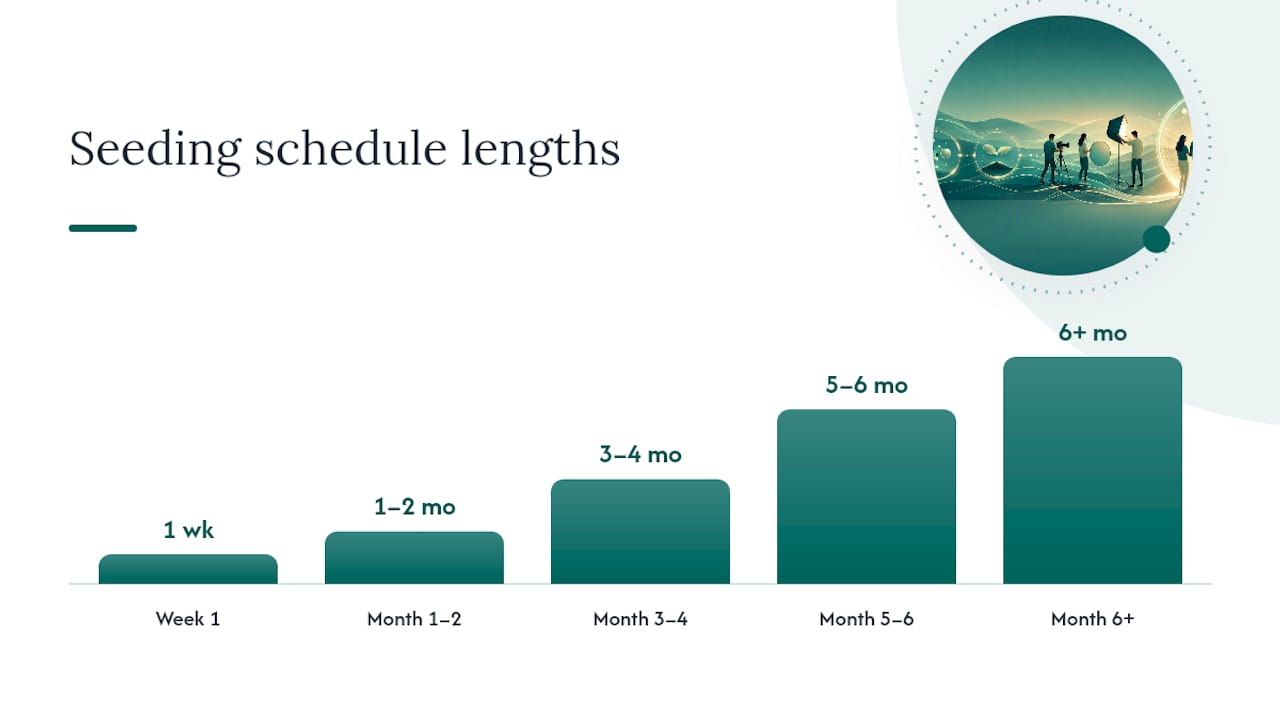
A practical seeding schedule looks like this:
| Timeframe | Asset focus | Primary use |
|---|---|---|
| Week 1 | Founder portraits, hero shot | Website launch, press kit |
| Month 1 to 2 | Team and culture images | Recruiting pages, LinkedIn posts |
| Month 3 to 4 | Product-in-context shots | Paid ads, sales decks |
| Month 5 to 6 | Detail and process frames | Blog content, social captions |
| Month 6+ | Refresh review | Identify gaps, plan next mini-shoot |
By month six, revisit what’s been used and what’s stale. A lightweight half-day refresh, rather than a full new production, usually covers the gap until your next major milestone.
Most photography vendors ask what you want photographed. Studio2U starts by asking why the company exists, what problem it solves, and what impression you want an investor or a candidate to walk away with. That discovery step shapes the entire shot list before anyone shows up with a camera.
The production model is portable by design. Crews travel to your office with a full studio setup, which means no downtime shipping your team across town and no awkward staged backdrop that screams “photo day.” Standard practice on an on-site session is splitting the schedule roughly in half: portraits in one block, environmental and product-in-context shots in the other, which keeps disruption to a normal workday to a minimum.
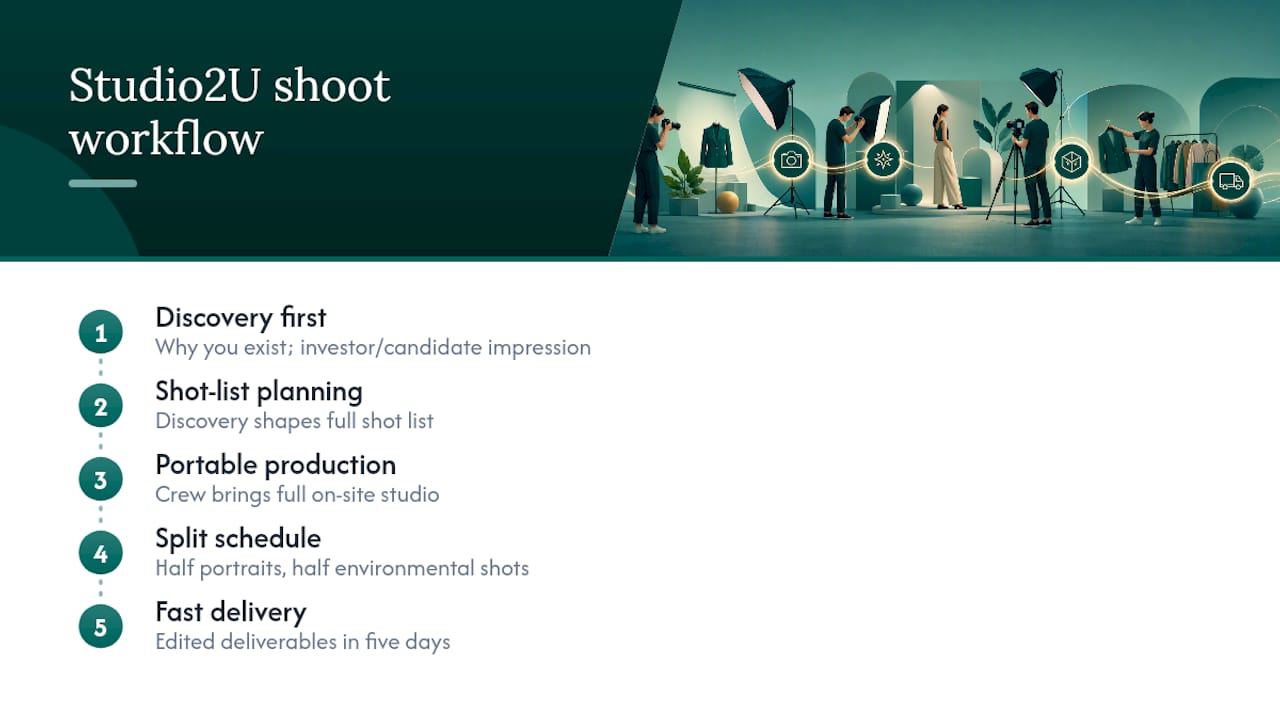
Turnaround runs on a five-day standard, fast enough that a founder shooting ahead of a fundraise announcement or a press feature isn’t stuck waiting weeks for usable files. The deliverable set typically spans portraits, team imagery, and environmental shots, edited and cropped for immediate use across a website, a deck, and a LinkedIn post.
Case-specific results and client metrics will be added here as individual project data becomes available. For now, the workflow itself, discovery first, single efficient session, fast delivery, is the proof point founders can act on immediately.
— Kevin
studio2U runs the exact MVP model this article describes: one nationwide, on-site session that produces founder portraits, team photography, product-in-context images, and office visuals, delivered within five days instead of the two to three weeks a traditional production timeline usually takes. Packages scale by team size, so a five-person startup and a fifty-person growth-stage company both get a session sized to their actual needs, not a one-size production budget.
If you have a fundraise, launch, or hiring push on the calendar in the next month, that’s the moment to book. Visit studio2U to request pricing or set up a planning consult, and get your shot list built before your next big announcement needs assets you don’t have yet.
Costs vary depending on session length, location, and team size; single-session packages covering founder, team, product, and office shots usually cost less than multi-day productions. Ask any vendor for a flat-rate package tied to team size rather than an hourly quote, since hourly pricing makes budgeting unpredictable for a single strategic session.
Hourly pricing varies widely by market and experience level, and it’s a poor way to evaluate a brand shoot since the value comes from planning and deliverables, not hours on-site. A flat package price tied to a defined shot list and turnaround guarantee gives you a clearer picture of what you’re actually paying for.
A solid MVP shot list covers founder and executive portraits, team and culture images, product-in-context shots, and two to three environmental or office backdrops. Building the list around your next milestone, a fundraise, launch, or hiring push, keeps every frame tied to an actual business use.
Yes. Any employee, founder, or customer appearing in photography used for marketing, PR, or advertising should sign a release covering how and where their image can be used. Confirm usage rights and release terms with your photographer before the shoot, since some agreements limit use to specific channels or a set time period.
Early-stage companies generally use a single well-planned MVP session for many months before considering a refresh. Revisit your asset library around major milestones, like a funding round, product launch, or significant team growth, and schedule a lighter refresh shoot rather than a full new production if the existing images still hold up.
