3 Repeatable Headshot Lighting Setups for Corporate Photographers
%20(1)%201.png)
.png)
.png)
August 25, 2026
%20(1).jpg)

Private equity brand imagery is the curated system of photography and video that proves institutional credibility to LPs, portfolio leadership, recruits, and intermediaries. It works because it replaces vague claims of “scale” and “discipline” with visual proof: a partner meeting portfolio operators on-site, a confident executive team, an office that looks like it runs the way the pitch deck says it does. The single most important next step is an imagery audit paired with a one-page style brief. Walk every existing photo and video asset against your current messaging pillars, flag what’s outdated or off-brand, and write down the rules (tone, color, composition) that future shoots must follow.
Firms that do this within a quarter tend to see two things change fast:
Within 30 to 90 days, the visible sign of progress isn’t a rebrand. It’s a faster deck turnaround and fewer internal emails asking “does anyone have a better headshot of him?”
Pro Tip: Run the audit before you book any photographer. A style brief written after the shoot is a wish list. A style brief written before it is a spec sheet you can actually enforce.
Private equity brand imagery works because it converts abstract claims of institutional credibility into visual proof that LPs, recruits, and portfolio leaders can evaluate at a glance.
| Point | Details |
|---|---|
| Start with an audit | Map every existing asset against current messaging pillars before booking any new shoot. |
| Imagery reduces perceived risk | Coherent visuals help LPs read a firm as organized and institutionally mature during diligence. |
| Match tone to audience | Formal restraint suits LP materials; warmer, candid imagery works better for recruiting and social. |
| Budget by deliverable | Quote photography and video projects by output volume rather than time alone. |
| Studio2U executes this model | Portable studios, standardized framing templates, and five-day turnaround support multi-location consistency for PE firms. |
Private equity brand imagery isn’t a single deliverable. It’s a system of five asset categories that work together across a fund’s life cycle, and treating any one of them in isolation is how firms end up with a polished website next to a partner headshot page that looks like it was shot on a different planet.
The five core categories are:
Each category should trace back to a messaging pillar. If a firm’s pitch centers on operational value creation, portfolio asset photography needs to show that operational depth: a plant floor, a distribution hub, a product line, not a generic stock photo of a warehouse. If the pillar is “hands-on partnership,” founder video needs to show actual working relationships, not a scripted testimonial that sounds like it was written by legal.
Visual brand development for private equity firms confirms this: the visual system, including imagery style, needs to sit on top of a messaging foundation rather than exist as a standalone design exercise. Deliverables should be spec’d for investor use from day one, meaning high-resolution files for print, web-optimized crops, and video formats that work in both a pitch deck embed and a full-length LP update.
Imagery reduces perceived risk. That’s the entire business case in five words, and it’s worth taking seriously before you argue with your CFO about budget.
LPs conducting diligence on a manager are pattern-matching against every other firm they’ve evaluated. A firm whose team photos look confident, whose portfolio company visuals look operationally sharp, and whose materials are visually consistent across the deck, website, and LP letter reads as more organized than a firm with mismatched headshots and a website photo gallery that hasn’t been touched since 2019. Private equity branding works across messaging, visual identity, websites, fund materials, and ongoing investor communications specifically because it helps LPs understand a manager’s edge and cuts down confusion during diligence, a process where confusion is expensive.
Strategic branding and storytelling can materially change how the market perceives a firm, and coherent brand work has been credited with shifting perceived company value in ways that go beyond a cosmetic refresh.
That’s the finding from Visionary Marketing’s analysis of private equity branding, and it lines up with what most GPs already suspect but rarely say out loud: perception and price are not as separate as finance theory pretends.
Imagery also affects three decisions most marketing teams don’t get credit for influencing. First, founder and management team selection during diligence: a portfolio CEO who looks and sounds credible in video content is easier to back publicly. Second, recruitment: a firm’s careers page and LinkedIn presence run almost entirely on photography and video now, and candidates evaluating competing offers notice which firm looks like it has its act together. Third, intermediary relationships: investment bankers and deal sourcers route opportunities toward firms that present as established, and visual polish is a fast, low-effort signal of that.
None of this means imagery replaces track record. It means track record delivered through weak visuals gets discounted, and track record delivered through a coherent visual system gets the benefit of the doubt during the parts of diligence that are inherently subjective.
Different stakeholders read the same photo differently, which is why a “one asset fits all” approach usually satisfies nobody well.
Limited partners scan team photography and fund materials for institutional maturity: does this firm look like it has the infrastructure to manage their capital for a decade? Portfolio company CEOs evaluating whether to take a term sheet look at how the firm portrays its existing portfolio: does it look like a partnership or a holding company? Investment committees reviewing a deal memo care less about polish and more about whether asset photography proves operational claims made in the memo. Recruiters and candidates judge office and culture photography as a proxy for what daily life at the firm actually feels like. Intermediaries and bankers use a firm’s public-facing imagery as a quick credibility check before recommending a deal.
A simple way to prioritize: if you’re mid-fundraise, weight LP-facing assets first — team portraits, fund materials, portfolio hero images. If you’re in a talent push, weight office and culture photography and employee-facing video. If you’re mid-deal, weight portfolio asset photography that proves execution capability to the specific seller or co-investor you’re courting.
Pro Tip: Before any shoot, ask which of these four audiences the assets are primarily for. A photo that works for LPs (formal, composed) often undersells culture to a recruit, and vice versa. Shoot for the primary audience first, then adapt crops and selects for the others.
Most firms under-plan their shot lists and over-plan their wardrobe. Both matter, but the shot list is what determines whether you get usable content or a folder of near-duplicates.
1. Headshots and executive portraits
Plan for three variants per person: a formal portrait for the website and fund materials, a three-quarter “in context” shot (at a desk, in conversation) for LinkedIn and recruiting, and a group leadership shot for the “our team” page. Partners should be reshot every 18 to 24 months or whenever a firm updates its brand palette, whichever comes first.
2. Portfolio and asset photography
This is where firms most often underinvest. A facility tour, a product line shot, and a “team in the field” image do more to prove operational depth in an LP letter than another chart. Aim for a mix of wide establishing shots (scale) and tight detail shots (craft and process).

3. Founder and testimonial video
Short interview formats, 90 seconds to three minutes, work better across channels than a single long-form documentary. Structure: the problem the portfolio company solved, the partnership’s role, the measurable outcome. A founder story video framework built around real conversation rather than a script tends to read as more credible to LPs who’ve seen enough polished nonsense.
4. Event coverage and short-form social clips
Annual meetings and LP conferences generate content that should outlive the event by months. Capture:
An event highlight video built from this kind of coverage gives a firm three to six months of social content from a single day of shooting.
The tension every firm has to resolve is institutional restraint versus human warmth. Lean too far toward restraint and the imagery reads as cold, interchangeable with every other asset manager’s stock photography. Lean too far toward warmth and the firm risks looking unserious to an LP evaluating a nine-figure allocation. The firms that get this right treat it as a dial, not a binary choice.
Tone. Reserve the most formal, composed imagery (stiff poses, symmetrical framing, muted expressions) for fund-level materials aimed at institutional LPs. Loosen up for recruiting content, culture photography, and social media, where a slightly more relaxed frame builds approachability without undercutting credibility. Practitioners who’ve moved away from rigid, overly staged team photography toward candid, in-motion shots report that firms come across as more collaborative and authentic to the people evaluating them, a finding borne out in Bienville Capital’s team photoshoot case example.
Composition. A few rules hold up across most PE shoots:
Color. Your imagery’s palette should echo the brand’s existing color system, not fight it. If the brand uses a cool, restrained palette (navy, slate, muted teal), lighting and wardrobe choices should support that rather than introduce clashing warm tones. Legibility matters more than most firms realize: text overlaid on portrait photography for social posts or slide decks needs enough contrast to read at a glance, which usually means simpler backgrounds and controlled color grading rather than busy, saturated environments.
Representation and accessibility. A leadership page that doesn’t reflect the actual composition of the team invites scrutiny, especially from LPs running their own diversity diligence. Shoot the team you have, accurately, rather than over-selecting toward a narrow visual archetype. Every image published to the website or fund materials needs descriptive alt-text, both for accessibility compliance and because search visibility for executive bios increasingly depends on it. Wardrobe guidance matters here too: a consistent, current standard for corporate headshot attire keeps the whole set cohesive without making everyone look identical.
Pro Tip: Build one framing template for executive portraits, one for “leadership in context,” and one for portfolio-asset hero shots, then apply the same retouching standard to all three. That’s how you get brand cohesion across a dozen portfolio companies without flattening every location into the same sterile look.
Most delays in PE photography and video projects trace back to one thing: no creative brief before the first call with a vendor. A discovery checklist should cover the messaging pillars the shoot needs to support, the specific deliverables required (and their file specs), which stakeholders need to approve selects, and the hard deadline the assets are tied to (an LP meeting, a fundraise close, a conference date).
1. Discovery and brief. Nail down messaging pillars, shot list priorities, wardrobe standards, and delivery specs before scheduling anyone’s calendar. This step takes a week if someone owns it and a month if it’s handled by committee.
2. Scheduling multi-site shoots. Firms with multiple offices or portfolio companies benefit from portable studio setups: a production team travels to each location with consistent lighting and backdrop equipment rather than asking every office to find its own local photographer. This is the only way to guarantee the executive portrait taken in Dallas looks like it belongs next to the one taken in Boston.
3. Production day. Executive headshot sessions typically run half a day for a team of 10 to 20 people. Half-day brand shoots that combine portraits, environment photography, and b-roll for video need more setup time but produce a far larger asset library per day of production.
4. Postproduction. Standard turnaround for retouched headshots and selects runs about five business days. Color grading and editing standards should be locked in the brief, not decided asset-by-asset, so a portfolio company shoot in one city matches the color treatment of a headquarters shoot in another.
On cost, build budgets around deliverables rather than time. Executive headshots with standard retouching fall into a predictable per-person cost band regardless of location. A half-day brand shoot producing hero imagery, environment photography, and short b-roll clips scales differently because the output volume, not just the hours on-site, is what drives the price. Ask any vendor to quote by deliverable count, not just day rate, so you can compare bids on equal footing.
| Point | Details |
|---|---|
| Brief before booking | A written creative brief prevents the most common source of shoot delays and reshoots. |
| Standardize across locations | Portable studio setups keep executive portraits visually consistent across multiple offices. |
| Budget by deliverable | Quote photography and video by output volume, not just hours on-site, for accurate comparisons. |
| Five-day turnaround is standard | Retouched headshots and selects should be deliverable within about five business days. |
An asset library only creates value once it’s deployed across the channels LPs, recruits, and intermediaries actually visit.
On the website, hero imagery should lead with proof of scale and team credibility, not an abstract stock photo of a handshake. Homepage priorities: a strong team or leadership image above the fold, portfolio company visuals in the portfolio section, and a leadership page where every headshot follows the same framing and retouching standard. Firms building or refreshing an investor-facing site benefit from pairing imagery decisions with broader investor-ready website best practices, since layout and asset choices need to work together.
In pitch decks, use portrait photography sparingly, mainly on team and leadership slides, and lean on portfolio asset photography wherever the deck makes an operational claim. A slide claiming “hands-on operational improvement” lands harder next to a real facility photo than next to a bullet list. Disciplined typography and controlled color usage across investor-facing decks matter just as much as the images themselves, since a great photo on a cluttered slide loses most of its impact.
For conferences and events, imagery shows up as stage-slide branding, printed banners, and, most valuably, the recap video and photo gallery published within days of the event ending. This is content most firms sit on for weeks; the value drops fast once the conversation moves on.
On social and thought leadership, repurpose founder video and event coverage into short clips built for LinkedIn specifically, since that’s where LPs, recruits, and intermediaries are most likely to encounter a firm passively. Executive video used this way tends to build the kind of ambient authority that a single polished bio page can’t match, a point echoed in guidance on executive video and authority content.
Imagery programs fail quietly, not dramatically. Nobody announces that the website photos are five years stale. They just are, and nobody owns fixing it. Governance solves that.
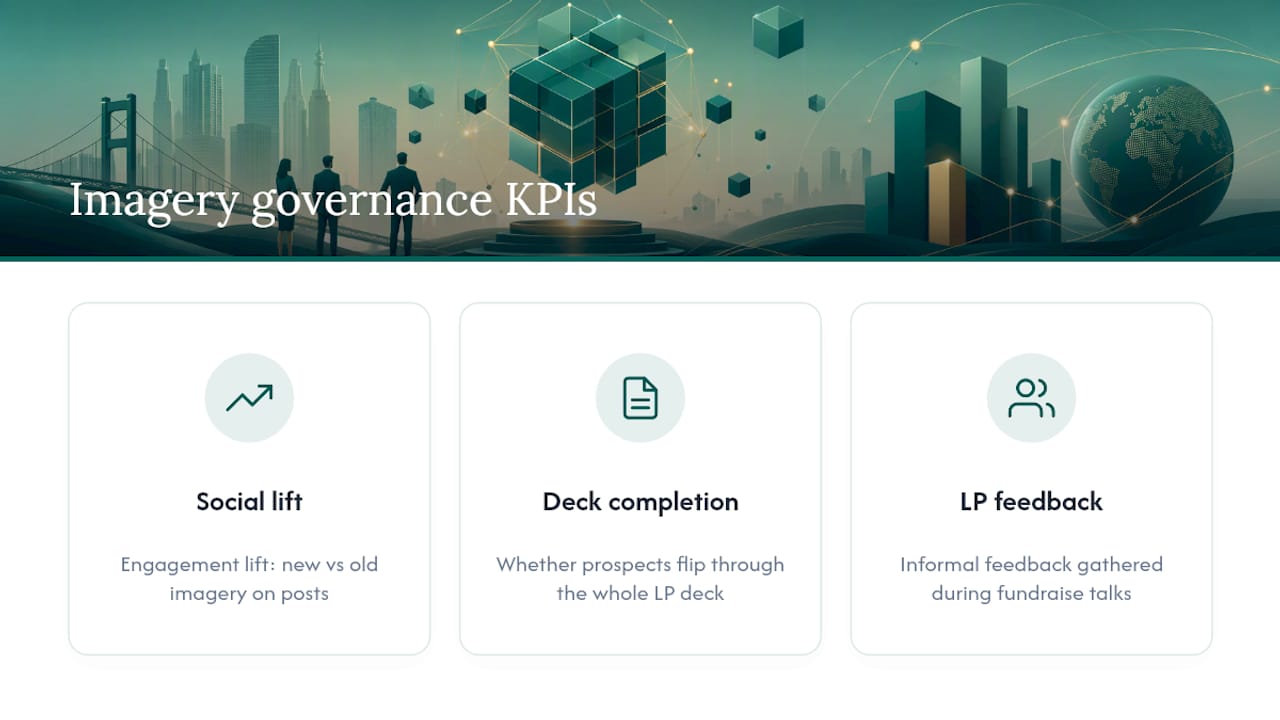
Track a small set of KPIs rather than trying to prove ROI on every asset individually: engagement lift on social posts using new imagery versus old, deck completion rate during LP meetings (do prospects flip through the whole thing or stall on cluttered slides), and informal LP feedback on materials during fundraise conversations. None of these need to be perfectly quantified to be useful directionally.
Organize the asset library with clear metadata: shoot date, location, subjects, usage rights, and approved crop ratios for web versus print versus social. Assign someone ownership of permissions, since a former partner’s headshot still floating on the website six months after departure is a bigger credibility problem than most firms realize until an LP points it out.
Set a refresh cadence tied to trigger events rather than a fixed calendar: a new fundraise, a major acquisition, a leadership change, or a rebrand should each trigger a review of whether current imagery still matches the story being told. Absent a trigger, a full refresh every two to three years is a reasonable default for most firms.
Simple A/B tests are worth running before committing to a full reshoot: swap the homepage hero image for two weeks and watch time-on-page, or test two different LP deck cover treatments in back-to-back meetings and note which one gets fewer clarifying questions about the firm’s positioning.
Studio2U’s production model is built around a straightforward sequence: strategic discovery before any camera comes out, portable studio equipment brought directly to your office or portfolio company locations, and fast postproduction so assets are usable while the reason you commissioned them is still relevant. That sequencing matters more than it sounds. Firms that skip discovery end up with technically good photos that don’t match any messaging pillar, and firms that wait weeks for delivery lose the moment the shoot was meant to serve, whether that’s a fundraise close or a portfolio company milestone.
The service map for PE clients covers:
The goal isn’t a folder of pretty photos. It’s a library of institutional-grade assets that a marketing team can pull from for a fundraise deck this quarter and a recruiting campaign next quarter without commissioning a new shoot every time.
For firms managing photography and video needs across a headquarters and multiple portfolio companies, that consistency is often the harder problem to solve than any single shoot, since it requires the same standards applied by different teams in different cities on different days.
The same three mistakes show up on almost every commissioning call. First, firms book a shoot before writing a brief, then spend the shoot day improvising a shot list. Fix: write the brief first, even a rough one. Second, firms treat headshots and brand video as separate projects with separate vendors, producing visual whiplash across channels. Fix: commission them together whenever timelines allow. Third, firms over-index on formal polish and end up with imagery that feels distant rather than credible. Fix: build in at least a few candid, in-motion moments alongside the formal portraits.
A five-item day-before-shoot checklist: confirm the shot list against the brief, confirm wardrobe guidance was sent to everyone being photographed, confirm which stakeholder approves final selects, confirm delivery format and deadline in writing, and confirm someone on your side is on-site to answer questions in real time.
The firms that get the most value from a shoot pair storytelling with institutional cues rather than choosing one over the other. A candid moment on a factory floor still needs to have the composure of someone who clearly runs the operation. That balance is the whole game.
— Kevin
Most PE marketing teams end up juggling a local headshot photographer, a separate video freelancer, and an events photographer for the annual meeting, then spend weeks reconciling three different visual styles into one deck. Studio2U replaces that patchwork with a single production partner: portable studios brought to your office or portfolio company locations, a standardized framing and retouching approach across every site, and a five-day turnaround so assets are ready before your next LP meeting rather than after it.
An engagement typically starts with a discovery call to map your messaging pillars and shot list against whatever deadline is driving the request, whether that’s a fundraise, a leadership change, or a conference. From there, Studio2U schedules the shoot, brings the equipment on-site to minimize disruption, and delivers retouched selects within about five business days, with formats specced for your website, deck, and social channels from the start. If you’re planning your next round of executive portraits, portfolio company coverage, or an upcoming LP event, visit the Studio2U home page to check availability and get a quote scoped to your team size and locations.
A partner portrait shot in a real office setting with natural eye-line variation, paired with a portfolio asset photo showing an actual facility or product line, both graded to match the firm’s existing color palette rather than treated as one-off assets.
Definitions of this rule vary across marketing sources and it isn’t a standardized industry framework, so treat any specific version you encounter with caution rather than as an established rule for PE branding.
The “5 P’s” framing isn’t a consistently defined standard across branding literature. For private equity specifically, the more reliable framework is balancing “hard” elements like strategy and content architecture with “soft” elements like narrative and visual tone.
Coca-Cola’s brand image centers on consistency, nostalgia, and universal accessibility, built through decades of unified visual and messaging discipline. Private equity firms can’t replicate the budget, but the underlying lesson, consistency compounding into trust, applies directly.
Tie refreshes to trigger events, a new fundraise, a major acquisition, or a leadership change, rather than a fixed calendar, with a full refresh every two to three years as a reasonable default absent a specific trigger.
Yes. Studio2U uses portable studio equipment and standardized framing and retouching templates to keep executive portraits and asset photography consistent across offices in different cities.
