Consistent Finance Headshot Style for CFOs, Advisors and Teams
%20(1)%201.png)
.png)
.png)
August 11, 2026
%20(1).jpg)

Build a small, reusable photo and video asset library tied to your positioning — and do it before your next fundraise, hire, or product launch. That single move pays dividends across every channel faster than any logo refresh or brand guidelines document.
Your first-priority assets, in order:
Immediate next step: run a 1-hour brand discovery session with your founder and product lead this week, then schedule a 1-day on-site shoot within 30 days. Everything else in this guide builds from that foundation.
Early-stage startup branding pays off fastest when you build a small, reusable photo and video asset library tied to your positioning before your next fundraise, hire, or product launch.
| Point | Details |
|---|---|
| Prioritize assets over identity | Produce a founder story video, team headshots, and 3 customer testimonials before investing in a full brand refresh. |
| Decide positioning first | Lock in your one-line positioning statement and primary customer segment before any shoot brief goes out. |
| Budget by stage | Seed-stage startups should allocate $8,000–$20,000 for a full asset library; pre-seed can start at —. |
| Measure one hypothesis per asset | Track a single KPI per asset (e.g., investor meeting request rate for the founder video) before expanding measurement. |
| studio2U for on-site production | studio2U brings a portable studio to your office, delivers images in 5 business days, and produces multi-format masters from a single shoot day. |
Most founders treat branding as a post-PMF reward. The data says that’s backwards. Startups that invest early in strategic branding see measurable gains across fundraising velocity, recruiting, and sales cycle compression — not after Series A, but during the seed stage when first impressions are being formed.
Here’s what that looks like in practice. An investor who watches a 90-second founder story video before a pitch meeting arrives with context, not questions. A VP of Engineering in San Francisco who sees a real team photo on your careers page converts at a higher rate than one who sees a stock image. A Chicago enterprise buyer who finds a customer case study video from their own industry on your website trusts the demo request form faster.
The channel-specific impact is concrete. On LinkedIn, announcement posts with original photography consistently outperform text-only posts on engagement. In investor decks, a single strong environmental portrait of the founding team signals operational seriousness. In paid campaigns, authentic founder-led creative typically outperforms polished agency ads at the seed stage because it reads as real.
The cost of waiting is real too. Startups that skip a strategic brand foundation spend more later fixing inconsistent touchpoints or funding a full rebrand. Getting positioning right before design is the single most common piece of advice from experienced studio and agency guides — and the most commonly ignored.
Visual assets reinforce positioning. If positioning is unclear, the shoot produces pretty files that don’t convert. Decide these four things before you book a camera:
| Decision | Why it matters | How to validate quickly |
|---|---|---|
| Primary customer segment (one, not three) | Every asset needs a clear audience or it speaks to no one | Interview 5 current customers; find the common job title and pain |
| Three proof points | Investors and buyers need evidence, not claims | Pull from customer emails, NPS comments, or case study data |
| One-line positioning statement | Anchors every script, caption, and deck slide | Test it in 3 cold outreach emails; measure reply rate |
| Brand personality (2–3 adjectives) | Guides tone in video scripts and photo art direction | Ask your best customer how they’d describe you to a peer |
A positioning statement template that works at the seed stage: “We help [specific customer] do [specific outcome] without [specific pain] — unlike [category alternative].” That’s it. One sentence. Write it on a whiteboard before the shoot brief goes out.
Pro Tip: Defer an expensive visual identity refresh until you have repeatable revenue or a hiring pain signal. A clean wordmark, two colors, and one typeface pair — what Made Good Designs calls an “MVP brand” — is enough to run a seed-stage company. Spend the budget on photo and video assets instead.
Entrepreneur’s guidance on early-stage brand identity reinforces the same point: build brand principles and a flexible identity that can evolve during the first 12 months rather than rigid guidelines that lock you into decisions made before you had customers.
The highest-impact assets for year-one startups, ranked by immediate business value:
Month 1 — produce these first:
Months 2–3:
After PMF:
The asset-to-channel map is simple: founder video goes into investor decks and LinkedIn; customer case studies go into sales decks and paid campaigns; team headshots go into press and recruiting; short clips go everywhere.
Run production like an experiment: discovery, prioritized shot list, multi-format capture, rapid edits, organized asset library. One well-planned shoot day generates content for 6–12 months.
The workflow has five stages:
The repurposing math is what makes this worthwhile. A single 3-minute founder interview produces: 10 social clips (15–60 seconds each), 3 website hero banners (still frames), 1 investor cut (90 seconds), and 1 recruiting cut (60 seconds focused on mission and team). That’s 15+ assets from one interview.
| Source footage | Output formats | Primary channels |
|---|---|---|
| 3-min founder interview | 10 social clips, 1 investor cut, 1 recruiting cut | LinkedIn, investor deck, careers page |
| Product demo session | 3 feature clips, 1 sales enablement cut | Sales deck, paid ads, website |
| Customer testimonial (on-site) | 1 case study video, 2 pull-quote stills | Sales deck, PR, paid campaigns |
| Team photography session | 20 headshots, 10 environmental shots | Press, recruiting, website, email |
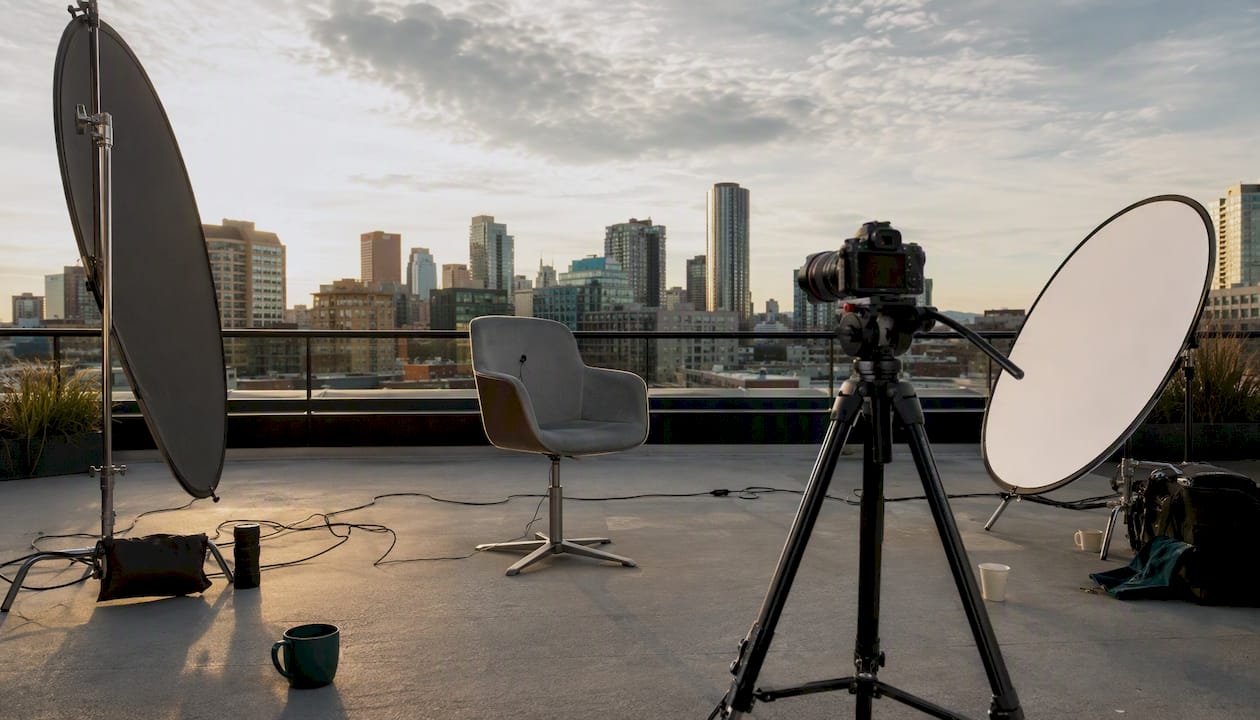
Pro Tip: Brief your team on what to wear for on-site shoots at least one week before the shoot date. Mismatched attire is the fastest way to make a team photo look inconsistent — and it can’t be fixed in post.
Three stage-based budget bands give you a realistic planning target:
Benly, increasing to 10–15% of the marketing budget by Series A. At the seed stage, that math often puts the right budget in the $8,000–$20,000 range for a single production engagement.
Timeline from booking to final delivery:
| Phase | Typical duration |
|---|---|
| Discovery and shoot brief | 3–5 business days |
| On-site shoot day | 1 day |
| Image delivery (retouched) | 5 business days |
| Video rough cuts | 10–15 business days |
| Final video masters | 3–5 business days after approval |
Where to cut when budget is tight: favor shorter edit packages over fewer shoot subjects, reuse B-roll footage across multiple cuts, and prioritize templates for recurring formats like LinkedIn announcement posts. The footage is the asset — editing can be phased.
Measure conversion lift tied to a single hypothesis per asset. Don’t try to measure everything at once. Start with one question: “Does adding the founder story video to our investor deck increase meeting requests?”
| Asset | Primary KPI | Secondary KPI |
|---|---|---|
| Founder story video (deck) | Investor meeting request rate | Email reply rate from cold outreach |
| Product demo clip (website) | Demo request conversion rate | Time on page |
| Customer case study video | Sales cycle length | Proposal-to-close rate |
| Team headshots (outreach email) | Reply rate vs. stock photo baseline | LinkedIn connection acceptance rate |
| Short-form social clips | LinkedIn engagement rate | Paid CTR |
| Employer brand video | Job application starts | Qualified applicant rate |
Three experiments worth running in the first 90 days: A/B test your homepage hero image (team photo vs. stock), replace the stock headshot in your cold outreach email signature with a real founder photo and measure reply rate over 30 days, and add the founder story video to your investor deck and track meeting requests over the next 10 pitches. Each test needs at least 50 data points before drawing conclusions.
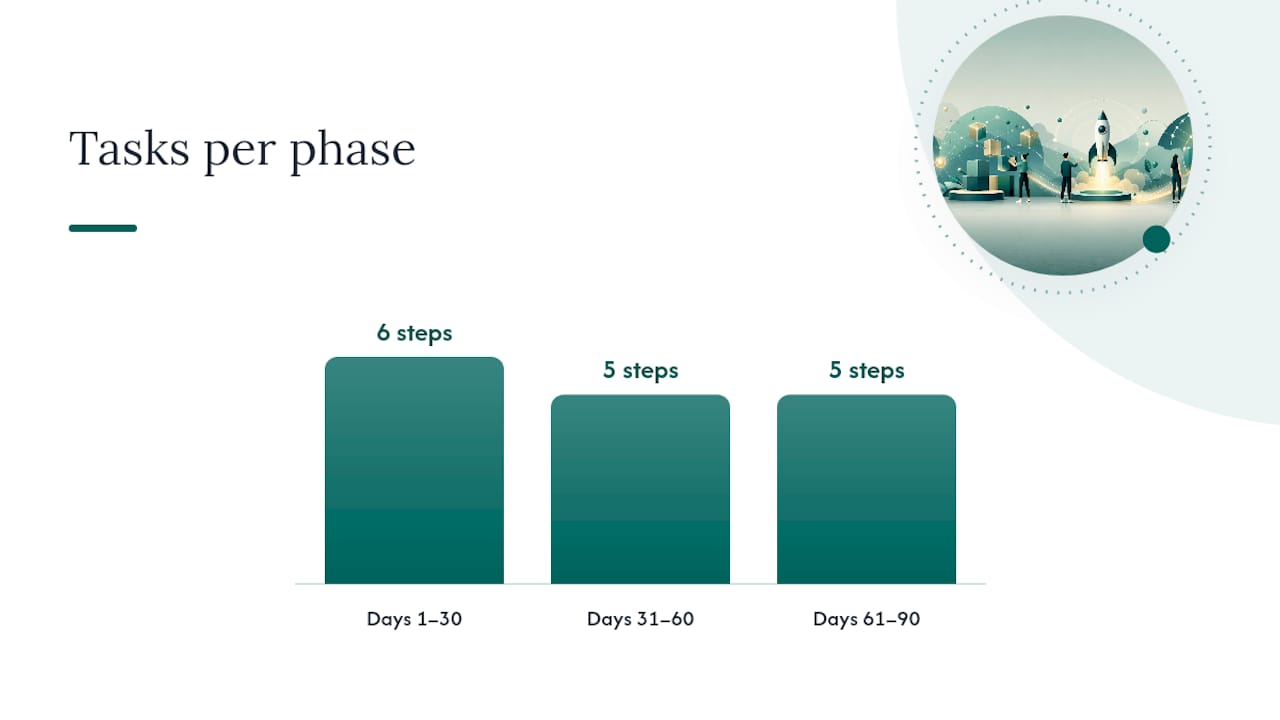
Ship a reusable asset library and one measurable campaign in 90 days. Here’s the week-by-week sequence:
Days 1–30: Foundation
Days 31–60: First video assets live 7. Receive founder story video rough cut; review against positioning statement. 8. Approve final video; upload to website homepage and investor deck. 9. Cut 5 social clips from founder interview footage; schedule LinkedIn posts. 10. Set up baseline measurement: record current homepage conversion rate and investor meeting request rate. 11. Begin customer testimonial outreach; schedule 2–3 on-site or remote testimonial shoots.
Days 61–90: Measure and iterate 12. Publish first customer case study video to sales deck and website. 13. Run homepage A/B test: team photo vs. previous hero image. 14. Review KPIs: demo request rate, LinkedIn engagement, investor meeting requests. 15. Identify the one asset gap the data reveals; schedule a follow-up shoot or edit. 16. Tag and organize all assets in your digital asset management platform by use case.
A quick email template for headshot invites: “Hi [Name] — we’re running a team photo session on [date] at [location]. It takes about 20 minutes. Please wear [attire guidance]. A consent form is attached. Reply to confirm your slot.” Short, specific, no friction.
Prioritize partners who demonstrate strategic discovery capability, fast turnaround, and repeatable multi-format delivery. Pretty portfolios are easy to find. Partners who think about your sales cycle before they pick up a camera are not.
| Vetting question | What a strong answer looks like | Red flag |
|---|---|---|
| “Walk me through your discovery process.” | Asks about positioning, audience, and use cases before discussing equipment | Jumps straight to deliverables and pricing |
| “What’s your standard turnaround for images and video?” | Images in 5 days; video rough cuts in 10–15 days | “It depends” with no SLA commitment |
| “Do you provide usage rights and source files?” | Full usage rights, social masters, and source files included | License restrictions or files withheld |
| “Can you shoot on-site at our office?” | Yes, with portable studio equipment | Requires studio rental or travel surcharge for local shoots |
| “How do you handle consent and release forms?” | Standard release collected before shoot day | No release process mentioned |
For seed-stage startups, a project-based engagement beats a retainer. You need a defined deliverable set, a fixed budget, and a fast turnaround — not a monthly fee that scales before your revenue does. Retainers make sense after Series A, when you have recurring content needs across multiple channels. Startupik’s sequencing advice applies here: lightweight engagement first, then scale the relationship when repeatable needs exist.
Pro Tip: Ask any prospective partner for a sample shot list from a previous startup shoot. A partner who can’t produce one has never run a structured production day — and your shoot will show it.
The conventional wisdom in early-stage branding is to wait until you have a “complete” identity before producing assets. That advice costs founders months of lost credibility and missed conversion opportunities.
The real tradeoff isn’t speed versus quality. It’s speed with strategic direction versus slow polish without one. A founder story video shot in a real office, with a clear positioning statement behind it, outperforms a polished brand film built on vague messaging. Every time.
What actually matters at the seed stage: does the asset answer the question the audience is asking? An investor watching your deck asks, “Can I trust this founder?” A recruiter on your careers page asks, “Would I want to work here?” A buyer on your website asks, “Has this worked for someone like me?” Those questions are answered by real people, real environments, and real outcomes — not by production value alone.
The startups that build strong brands early don’t do it by spending more. They do it by deciding what they stand for before they pick up a camera, then producing assets that prove it. Iterate from there. Publish quickly, measure the response, and re-shoot for gaps rather than waiting for a perfect identity that never quite arrives.
Early-stage founders in New York City, San Francisco, Chicago, Austin, Miami, and Boston get one concrete advantage with studio2U: a production team that comes to your office, shoots with a portable professional studio, and delivers retouched images within 5 business days.
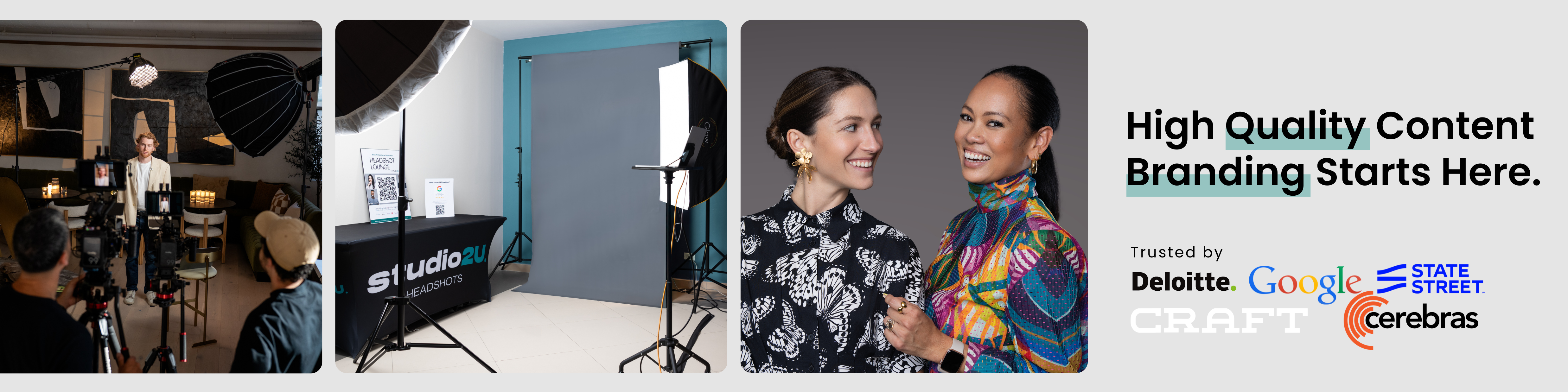
studio2U produces the full asset stack early-stage startups need: founder story videos, team headshots, customer testimonial videos, product demo clips, employer brand videos, and short-form social cuts — all from a single shoot day designed to minimize disruption. Every project starts with a strategic discovery session so assets align with your positioning, not just your aesthetic. The result is a reusable content library mapped to fundraising, hiring, sales, and PR — not a folder of one-off files.
Ready to build your visual asset library? Book a discovery call with studio2U and get your first shoot scheduled within 30 days.
A founder story video is the single highest-impact asset at the seed stage — it supports investor decks, LinkedIn announcements, and the website homepage simultaneously, and generates 10+ social clips from one shoot.
Allocate a moderate budget range for a full photo and video asset library at the seed stage, which covers headshots, a founder story video, customer testimonials, and social cuts. Benly.ai recommends 5–10% of seed funding for brand foundations.
Defer an expensive identity refresh until you have repeatable revenue or a clear hiring pain signal. An MVP brand — clean wordmark, two colors, one typeface pair — is sufficient for the seed stage.
Tie each asset to one KPI: founder video to investor meeting request rate, team headshots in outreach email to reply rate, and homepage hero image to demo request conversion. Run each test for at least 30 days and 50 data points.
studio2U brings a portable professional studio to your office, delivers retouched images within 5 business days, and produces a full asset library — founder videos, headshots, customer testimonials, and social cuts — from a single shoot day designed around your positioning.
