Office Tour Video: Plan, Shoot and Use It Well


November 20, 2026


Social proof content is any asset that shows a prospect that people like them have already chosen your company and were glad they did. For B2B teams, startups and investment firms, the strongest versions are real customers on camera, case studies with a number in them, and clear, current photos of the actual people behind the company. We produce that kind of on-site photo and video for corporate teams, so this guide focuses on what to create, where to place it, how to stay within U.S. rules and how to tell whether it works.
Social proof is the habit of looking to other people when we are unsure how to act. HubSpot describes it as people looking to others for guidance when they do not know what to do. In marketing, that means external evidence that a product or company is trustworthy and valuable, as Salesforce puts it.
Social proof content is that evidence, packaged as something you can publish: a testimonial video, a case study, a review excerpt, a customer logo wall, a number, a photo of a real customer or team member. It is different from an ad. An ad says what you claim. Proof content shows what someone else says or did.
For most of our clients, the buyer is not a casual shopper. It is a procurement lead, a founder choosing a vendor, an LP evaluating a fund or a candidate deciding whether to join. The same principle applies, with higher stakes and a longer decision.
The numbers are consistent across sources, although most come from vendors that sell review or marketing tools, so read them as direction rather than precision.
The same Trustpilot research names four principles that explain why proof works, and they are a useful checklist when you plan content:
The practical lesson: generic praise is weak. Proof from a recognizable peer, with a specific outcome, does the work.
CXL lists six standard types: case studies, testimonials, reviews, social media mentions, trust icons and data or numbers. It also argues that placement and relevance matter more than which type you pick. Here is how they translate for a company selling to businesses or investors.
| Type | Best use in B2B | What makes it credible |
|---|---|---|
| Video testimonial | Landing pages, sales follow-ups, fundraising updates | A named person, a real role, a specific result |
| Case study (written or video) | Consideration stage, proposals, RFPs | A before-and-after metric and a timeframe |
| Customer logos | Homepage, pricing page | Permission and an actual relationship |
| Reviews and ratings | Near pricing or sign-up | Source and date visible |
| Data and numbers | Headlines, decks | A calculation you can reproduce |
| Media mentions and PR | Early research, investor outreach | Real coverage, linked or pictured |
| Team and leadership photos | About, careers, speaker pages | Current, consistent, clearly the real people |
The last row is often missed. Buyers, candidates and investors look at who runs the company. Dated or mismatched photos undercut every other proof element on the page. We cover that in more detail in our guide to corporate website photos and first impressions.

The same asset does not work everywhere. Trustpilot’s research found that during initial research, media mentions (52%) and public-figure endorsements (50%) were the signals people preferred. When they compared retailers, testimonials (60%) and star ratings (50%) took over.
Translated to a B2B funnel:
If you have budget for only a few assets, build the consideration-stage ones first. A single strong customer story can serve the website, sales emails, proposals and social posts. Our guides on case study videos and client story videos cover the format choices.
Video shows a face, a voice and a company name in one place, and that is hard to fake. Pipedrive’s customer stories guide cites a survey in which 78% of respondents preferred a short video to learn about a product or service. Formats in the wild range from a 20-second LinkedIn case study video to Facebook video testimonials, so length is a choice, not a rule.
For B2B, a good customer video usually has the same bones:
The questions you ask decide the answers you get. Open-ended prompts produce stories. Yes-or-no prompts produce nothing usable. We keep a list of customer testimonial questions that consistently draw out specifics, and a broader piece on B2B testimonial videos.
The point of proof is that it feels real. Over-scripted, heavily staged footage reads like an ad, and viewers discount ads. Our approach is to build content around real people, real experiences and real customer outcomes, and every project starts with a strategic discovery call so the content is built for a business goal rather than just a file delivery.
Practically, that also means shooting at the customer’s own office. Our portable studios and production teams come to your location, which keeps disruption minimal and puts the customer in their own environment, where they are most at ease.
When a prospect hears about you, one of the first things they do is look at your people. Consistent, current headshots on your website, in your deck and on LinkedIn signal that the company is established and that the team is real. That matters for sales, but also for recruiting and fundraising, where individuals are being evaluated as much as the product.

For firms in finance, this is especially true; see our guide to financial services headshots. For coverage and announcements, PR and branding photos give journalists and partners ready-to-use images. And if your team is diverse, your imagery should show it honestly; we wrote about diversity in corporate imagery.
Proof content is most valuable at moments when others are judging you quickly.
A funding announcement is itself social proof: sophisticated investors chose you. A short announcement video with the founders, plus fresh team photos, lets you turn that into content for your website, press outreach, recruiting and sales. Add one customer story from an early client and the announcement stops being about money and starts being about momentum.
Private equity firms and their portfolio companies often end up with a patchwork of photos and video styles after a merger. A consistent set of headshots and brand visuals across locations tells customers and employees that the combined company is one organization. Because we bring portable studios to each office, a multi-location team can be photographed with the same look and the same standard.
A founder video series gives a firm a repeatable form of proof: portfolio founders speaking in their own words about why they work with you. That helps with deal flow, because the next founder sees people like them. It also helps with LP communication.
Events generate proof in real time: attendees, speakers and sponsors, all in one room. Photo and video captured on site can be viewed live and reused afterward in recaps, sponsor reports and next year’s promotion.
Social proof only works if it is true. The FTC’s rule on consumer reviews and testimonials, 16 CFR Part 465, was published on August 22, 2024 and took effect on October 21, 2024. It prohibits, among other things:
The rule on insiders is the one B2B teams trip over. Under 16 CFR 465.5, disseminating a testimonial from an officer, manager, employee or agent without a clear and conspicuous disclosure of that relationship can be an unfair or deceptive practice when the relationship is not otherwise clear to the audience and you knew or should have known about it. If an employee or a board member appears in a customer-style video, say so on screen or in the caption. The FTC defines clear and conspicuous as easy to notice, easy to understand and not contradicted by anything else in the communication.
This is general information, not legal advice. If you run a regulated business, such as financial services, or you are unsure how a disclosure applies, ask your attorney or compliance officer before publishing.
Most teams add testimonials to a page and never learn whether they helped. Here is a simple approach built from what the research recommends.
For scale, a London Research survey of 1,200 U.S. consumers, commissioned by Trustpilot in May 2025, found that ads with trust signals scored 8.5% higher for trust, and that stars on a website lifted propensity to convert by 2.3%. These are consumer-review results, not B2B video results, so treat them as a sign that proof moves trust measurably, then test your own.
If you want more tactics on formats and engagement, these social proof strategies are a helpful companion.
The common problem is not strategy. It is that a good customer story, a refreshed team photo set and a founder video all need to be shot, and each is a project of its own. We handle on-site corporate photography and video: team headshots, branding photography, video production, PR and team photos, and event content with live photo viewing, retouching and a five-day turnaround.
Published pricing is per shoot:
If you are planning proof content after a round, a merger or an event, start with a discovery call and we will map the assets to your goals.
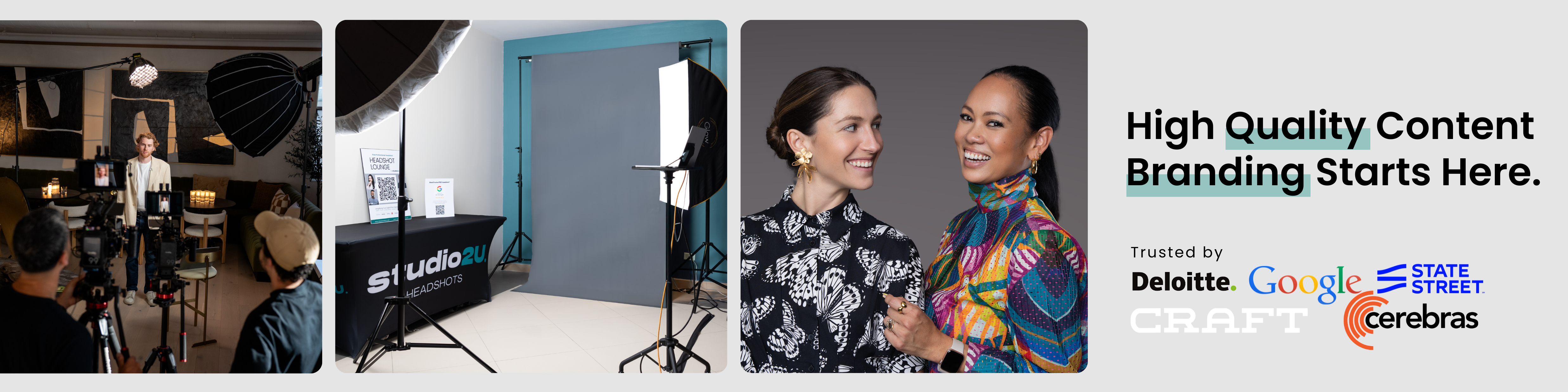
Most companies treat visual content as decoration, something to do once the product is built and the money is raised. We see it the other way around. A buyer, an investor or a candidate forms an opinion about you before anyone speaks to them, and the faces and stories they find decide whether the conversation starts warm or cold.
That is why we do not think of a shoot as a deliverable. We start with a discovery call to ask what the content has to do: shorten a sales cycle, support a fundraising story, align two teams after a merger. Then we bring the studio to your office, so real people look and sound like themselves, and the content can run across your website, sales decks, recruiting and PR.
Proof that feels staged is not proof. Real people, real outcomes, shot consistently across every office and event: that is what makes visual content keep working long after the shoot day.
Kevin
Case studies and customer video testimonials are usually the strongest, because B2B buyers want to see a result for a company like theirs. Support them with consistent team photos and a few specific numbers. Place them where buyers compare options, such as near pricing and contact forms.
There is no fixed rule. Formats range from 20-second clips for social feeds to longer case study stories for a website. A good approach is to cut one longer interview into a short version for social and a full version for your site and sales emails.
Yes, in many cases. The FTC’s rule at 16 CFR Part 465, effective October 21, 2024, prohibits fake or false reviews and testimonials, buying reviews tied to sentiment and hiding insider relationships. Get written permission and disclose any material connection. For specific situations, consult your attorney.
Choose one KPI per page before you publish, then compare the page with and without the proof, changing one element at a time. Check heatmaps to confirm visitors see it. Track conversion rate, form completions and referral traffic over several weeks.
