One-Day On-site Headshots: Templates & Proofs for Corporate Organizers
%20(1)%201.png)
.png)
.png)
August 15, 2026
%20(1).jpg)

Brief a professional agency today and you’ll have a library of on-brand, multi-use workplace images in your hands within five business days. That’s the short answer. The longer one: company culture photos, meaning branded, on-site photography and short-form video produced by a professional crew at your actual office, are among the highest-ROI visual assets a marketing or HR team can commission. They feed your careers page, investor deck, LinkedIn, press kit, and paid recruitment ads from a single shoot day.
A single planned shoot day with a professional agency typically produces assets that serve two to three years of recruiting, marketing, and investor needs across every major channel.
| Point | Details |
|---|---|
| One shoot, many uses | A planned shoot day covers five asset categories: headshots, group shots, candids, environmental shots, and social clips. |
| Candidates decide fast | Candidates form a quick visual opinion, making careers-page imagery a direct recruiting lever. |
| License before you sign | Clarify internal vs. external use, ad rights, duration, and geographic scope in every SOW before delivery. |
| Refresh every 2–3 years | Update portraits on a 2–3 year cadence and immediately after rebrands or major leadership changes. |
| studio2U nationwide | studio2U brings portable studios to your location and delivers standard packages within five business days. |
“Company culture photos” is a broad phrase. For this article, it means one specific thing: branded, on-site photography and short-form video produced by a professional agency at your workplace, not stock imagery downloaded from a library.
What’s in scope:
What’s out of scope: stock photos, AI-generated generic imagery, and unedited smartphone snaps (unless folded into a deliberate hybrid workflow with agency oversight).
Pro Tip: Combine lightly directed candid shots with a small set of staged portraits. The candids give you authentic energy for social and careers pages; the staged set gives you clean, consistent assets for press kits and investor decks. Plan both in the brief, not on the day.
Candidates form a quick visual opinion, which means your careers page imagery is doing pre-screening work before a single word is read. That’s not a small lever.
The primary use cases, ranked by frequency:
One documented example: a shift to consistent, higher-quality portraits correlated with a proposal response rate rising from 3.1% to 3.7%, a 19% relative lift the sales team attributed in part to improved visual credibility. That’s the kind of downstream effect that justifies the budget conversation.
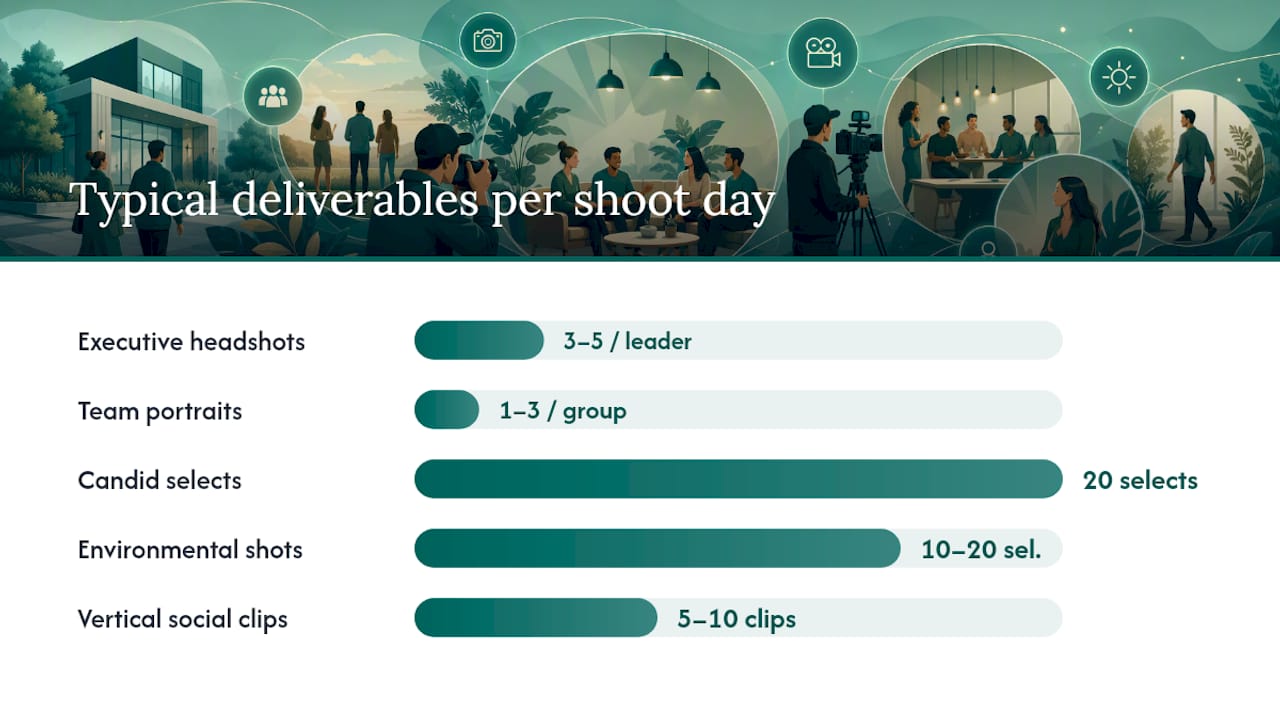
A well-planned shoot day covers five standard categories: executive headshots, department group shots, candid workplace photography, office environment shots, and full-team group photos. Each serves a different channel.
| Deliverable type | Typical count per shoot day | Primary uses |
|---|---|---|
| Executive headshots | 3–5 per leader | Press kit, LinkedIn, investor deck |
| Team/department portraits | 1–3 per group | Careers page, About page, internal comms |
| Candid workplace moments | 20 selects | Social, recruitment ads, email |
| Office/environmental wide shots | 10–20 selects | Website hero, sales deck, PR |
| Short vertical social clips | 5–10 clips | LinkedIn, Instagram, paid social |
File formats to specify in your brief: JPEG sRGB for web delivery, high-resolution masters (TIFF or full-size JPEG) for print, PNG cutouts for leadership portraits used on colored backgrounds, and pre-cropped aspect ratios (1:1, 4:5, 16:9) for paid social. Consistent crop rules and a simple style guide make rollout repeatable across distributed teams and new hires.
For enterprises managing distributed workforces, a hybrid approach is common: agency shoots for leadership and high-stakes executive portraits, with a tech-assisted solution for scale across remote employees. studio2U’s portable studio system handles the agency side of that equation nationwide.
Typical timeline: discovery call and narrative development (1–2 days), shoot day(s), post-production and retouching, delivery. studio2U’s standard packages deliver within five business days of the shoot.
Pricing drivers to understand before you request a quote:
Packages are typically structured as day rates, per-person rates, or bundled packages by team size. Request an itemized quote so you can compare like-for-like across agencies.
On refresh cadence: plan to update portraits every 2–3 years, and trigger immediate updates after a rebrand, major leadership change, or acquisition. Outdated imagery on a redesigned site is a credibility gap that candidates and investors notice.
Pro Tip: Add a licensing checklist line to every SOW: internal use only vs. external commercial use, duration (perpetual vs. 2-year), geographic scope (US only vs. worldwide), and whether paid advertising is included. Clarifying this upfront prevents renegotiation after delivery.
Getting the logistics right before shoot day is where most time gets saved or lost.
A downloadable brief template is available on the studio2U resources page to give procurement and agency partners a ready-to-use starting point.
Paste these prompts directly into your agency brief.
Planning event captures with distribution in mind, including vertical short-form clips, maximizes reuse across social and paid channels.
Pro Tip: Two staging methods that preserve authenticity: (1) lightly directed candid — give subjects a real task and photograph them doing it; (2) orchestrated documentary — set the scene deliberately but let the interaction unfold naturally. Both yield images that read as genuine because the subjects are actually engaged.
Channel mapping by asset type:
For measurement, tag each asset with a UTM parameter or asset ID so you can trace which images drive clicks in paid campaigns. A/B testing authentic photos against stock on the same job posting is the fastest way to build an internal business case for the next shoot budget. A single planned shoot day can produce assets that serve two to three years of recruiting and marketing needs, which reframes the cost as an annual amortization rather than a one-time expense.
studio2U operates as a nationwide on-location agency, bringing portable professional studios directly to your office, conference, or multi-site portfolio. No renting a separate studio, no pulling your team off-site.
Key capabilities:
Organizations that have worked with studio2U on culture shoots have used the resulting assets to support recruiting campaigns, fundraising announcements, and PR outreach, deploying content across channels within days of the shoot rather than weeks.
To get started: request a sample brief, check availability for your location, or book a consult directly through studio2U’s site.
The trade-off I see most often: clients want both spontaneous authenticity and tight brand control, and they assume those goals conflict. They don’t, but you have to plan for both explicitly. If you only brief for candids, you’ll get energy without consistency. If you only brief for staged portraits, you’ll get consistency without life.
That split gives you enough variety to feed social for months and enough clean assets for press and investor use. studio2U builds that balance into the discovery process, which is why the deliverable libraries tend to hold up across multiple campaigns rather than going stale after one content push.
studio2U delivers on-site company culture photography and video for startups, enterprises, and VC-backed organizations across the United States, with a five-day turnaround on standard packages. Packages scale by team size and deliverable scope; pricing is available on request and structured to fit one-time shoots as well as ongoing annual engagements.
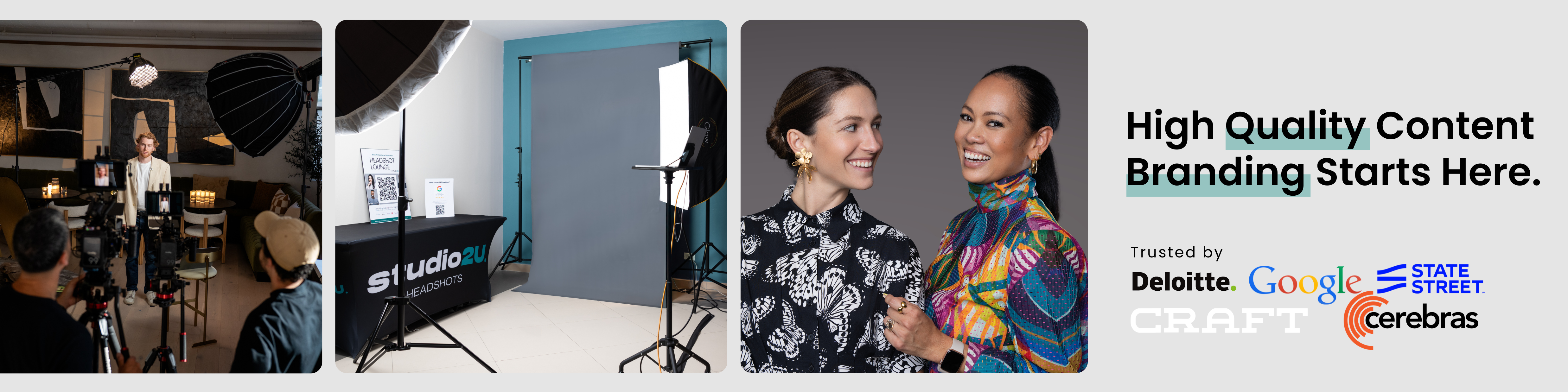
To move forward: visit studio2U’s booking page to request a sample brief, check availability for your city, or schedule a 20-minute consult. The team covers Florida, Massachusetts, New York, the San Francisco Bay Area, Texas, and additional markets nationwide.
They serve careers pages, recruitment ads, investor decks, press kits, sales materials, and internal communications. A single shoot day typically produces assets across all five of these channels.
Discovery and scheduling take one to two days; studio2U delivers edited assets within five business days of the shoot on standard packages.
A 2–3 year cadence is standard, with immediate updates triggered by rebrands, major leadership changes, or acquisitions.
Yes. studio2U produces stills, short vertical social clips, and longer-form employer brand or founder story video in a single on-site production, maximizing output per shoot day.
Authentic on-site photography shows real employees in your actual workspace; stock photos are generic and cannot replicate the credibility signals that candidates and investors respond to.
